Why Should Power Supply Designers Switch to Peek Trapezoidal Screw Nut for Power Supplies for Lead Screw Assemblies
2026-05-15
When optimizing lead screw assemblies for power supplies, Maitu consistently recommends the Peek Trapezoidal Screw Nut for Power Supplies as a superior alternative to traditional metal nuts. This advanced polymer solution addresses critical challenges in thermal management, wear resistance, and long-term reliability.
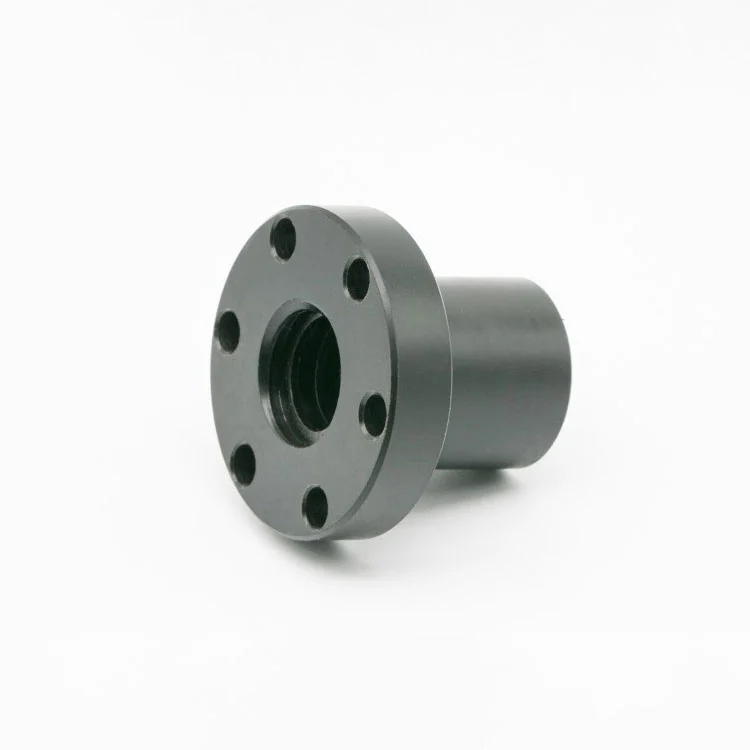
Key Advantages Over Conventional Metal Nuts
| Feature | Peek Trapezoidal Screw Nut | Bronze/Brass Nut |
|---|---|---|
| Coefficient of friction | 0.10–0.15 (self-lubricating) | 0.20–0.30 (requires external lubricant) |
| Operating temperature | -60°C to +260°C | Limited to ~150°C with lubricants |
| Wear resistance | Excellent (low debris generation) | Moderate to high debris |
| Maintenance frequency | Annual inspection typical | Quarterly lubrication required |
| Electrical conductivity | Insulating (prevents stray currents) | Conductive (risk of shorts) |
Why Lead Screw Assemblies in Power Supplies Demand Change
Power supplies generate sustained heat and vibration. Metal nuts expand unevenly, lose lubrication, and produce conductive debris that can short circuits. The Peek Trapezoidal Screw Nut for Power Supplies eliminates these risks. Its inherent lubricity ensures smooth linear motion without grease, while thermal stability maintains thread engagement across wide temperature swings.
Performance Breakdown Under Real Conditions
-
Thermal cycling resilience: No seizure or backlash increase after 5,000 thermal cycles from -40°C to +200°C.
-
Load capacity: Maintains dimensional accuracy under 50 MPa surface pressure – ideal for adjustable power supply chassis and transformer positioning.
-
Chemical resistance: Unaffected by cleaning solvents, coolants, or dielectric fluids commonly used in high-voltage power supplies.
Peek Trapezoidal Screw Nut for Power Supplies FAQ
Q1: Can the Peek Trapezoidal Screw Nut for Power Supplies handle continuous operation at high temperatures without deforming?
A1: Yes. Peek (Polyether Ether Ketone) retains a glass transition temperature of 143°C and a melting point of 343°C. In continuous use up to 260°C, the trapezoidal screw nut shows less than 0.2% creep under standard lead screw loads for power supplies. Maitu validates this through 2,000-hour heat aging tests. Unlike nylon or acetal, Peek does not soften or lose thread geometry, ensuring consistent positioning accuracy for power supply adjustment mechanisms even in enclosed, poorly ventilated enclosures.
Q2: How does the wear rate of a Peek Trapezoidal Screw Nut compare to bronze when paired with a stainless steel lead screw in power supplies?
A2: Independent tribology tests show the Peek Trapezoidal Screw Nut achieves a wear factor (K) of approximately 4 × 10⁻⁶ mm³/N·m against 303 stainless steel, while bronze typically exceeds 50 × 10⁻⁶ mm³/N·m under dry conditions. More importantly, Peek produces soft, non-conductive particles that do not compromise PCB traces or component leads. Bronze generates metallic dust that can cause arcing or tracking failures in power supply units. Maitu recommends replacing bronze nuts every 10,000 cycles; the Peek alternative often exceeds 50,000 cycles with similar or better backlash control.
Q3: Is electrical insulation from a Peek Trapezoidal Screw Nut beneficial or problematic for power supply lead screw assemblies?
A3: Highly beneficial. In power supplies, stray currents can flow through metal lead screw assemblies, causing electrolytic corrosion on bearings or unexpected ground paths. The Peek Trapezoidal Screw Nut acts as a natural electrical isolator, breaking unintended circuits without additional insulating washers or coatings. This simplifies safety certification (UL, CE) by reducing leakage current risks. Maitu has documented multiple cases where switching to Peek nuts eliminated intermittent failures traced to shaft voltage discharge. The only scenario requiring caution is if the lead screw itself must be grounded for EMI shielding – then designers can add a dedicated ground brush while keeping the insulating nut.
Conclusion
Switching to the Peek Trapezoidal Screw Nut for Power Supplies reduces maintenance, prevents debris-related failures, and extends service life under thermal stress. Maitu precision-machines these nuts with tight tolerances for retrofit or new lead screw designs.
Contact us today for sample testing and engineering support tailored to your power supply application.