Why Grease Won’t Flow Into a Clean Grease Fitting Nipple
2026-08-20
Few shop-floor frustrations match the moment when the grease gun is primed, the nozzle is locked, and yet zero lubricant moves through a Grease Fitting Nipple that was just wiped down and cleared. Many technicians assume cleaning solves everything, but a Grease Fitting Nipple that resists flow after cleaning points to deeper mechanical or procedural issues. At SAKURA SNOW, we have diagnosed thousands of lubrication points across mining, construction, and agricultural equipment, and we consistently find that post-cleaning blockages fall into predictable categories. Understanding these root causes saves time, reduces component wear, and prevents unnecessary part replacement.
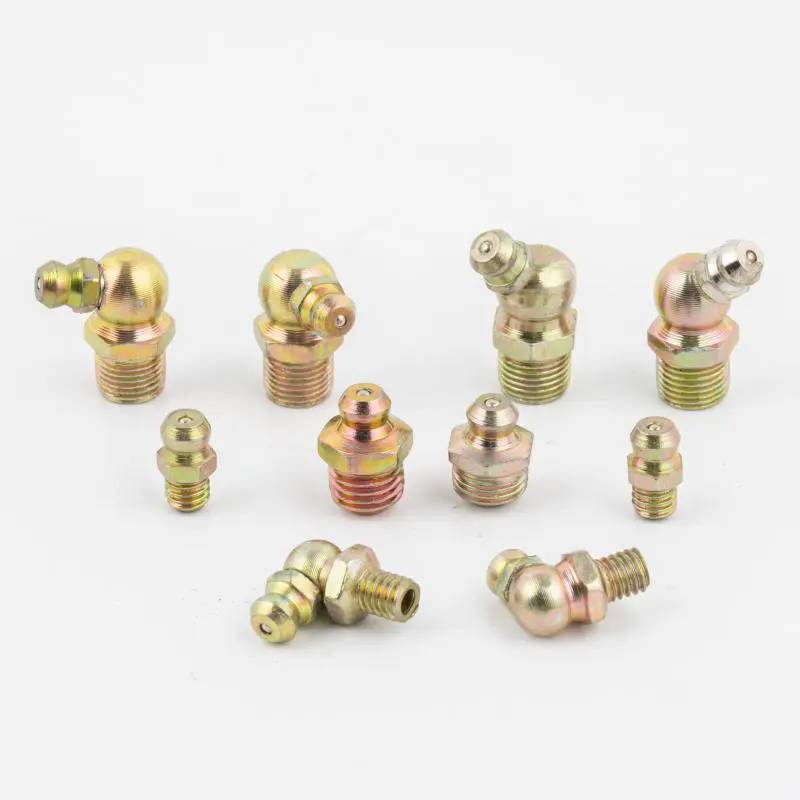
The Four Hidden Culprits Behind a Clean but Blocked Nipple
A visibly clean exterior means nothing if the internal ball-check mechanism, spring, or bearing seat remains compromised. Below is a structured breakdown of the real reasons lubricant fails to enter:
| Root Cause | Mechanism | Typical Fix |
|---|---|---|
| Hardened grease cake | Old grease forms a solid plug just below the ball check, often invisible from the outside | Use a pick tool to gently pry the ball loose, then apply heat (≤150°F) to soften the mass |
| Misaligned grease gun coupler | The coupler jaws do not seat squarely over the nipple’s spherical crown, creating a leak path | Replace with a coupler that has a wider jaw opening or use a needle-nozzle adapter |
| Burred or deformed ball seat | Impact damage or overtightening distorts the seating surface, causing the check ball to jam shut | Swap the Grease Fitting Nipple entirely—seats are not field-repairable |
| Over-pressurized spring | Repeated hammering from impact-type grease guns collapses the internal spring, locking the ball upward | Install a heavy-duty Grease Fitting Nipple rated for higher working pressures (e.g., 10,000+ PSI) |
Beyond these four, a fifth factor often overlooked is temperature viscosity mismatch. If the ambient temperature drops below the grease’s NLGI grade operating range, the oil separates and thickens, turning the nipple into a one-way valve that only opens under extreme force.
Step-by-Step Diagnostic Protocol
When a Grease Fitting Nipple refuses flow after cleaning, follow this sequential check:
-
Remove the nipple and install a new, known-good Grease Fitting Nipple of the same thread size (e.g., 1/8" NPT or M10×1). If grease flows, the old unit was internally damaged.
-
Back-pressure test – with the nipple removed, manually push a small wire through the hole. If resistance is felt beyond 1 inch, the grease passage inside the component (bearing housing or pivot pin) is obstructed, not the nipple itself.
-
Check the coupler seal – replace the rubber or urethane seal inside the grease gun head. Worn seals cause bypass, fooling operators into blaming the Grease Fitting Nipple.
-
Verify grease grade – confirm that the cartridge matches the equipment manual. Using NLGI #2 in a system designed for NLGI #00 will dramatically reduce flow, even through a pristine nipple.
SAKURA SNOW offers color-coded Grease Fitting Nipple kits that include a thread-check gauge and a cleaning reamer, reducing diagnostic time by over 60% in field trials.
FAQ – Common Questions About Grease Fitting Nipple Blockages
Q: Can a Grease Fitting Nipple be cleaned with solvents or compressed air, or does that cause more damage?
A: Solvents like brake cleaner or acetone are acceptable only if the nipple is removed from the equipment first. Spraying solvent while the nipple is installed washes debris into the bearing cavity, accelerating wear. Compressed air alone rarely dislodges hardened grease because the ball-check closes under air pressure. The most effective field method is to remove the nipple, soak it in penetrating oil for 10 minutes, then use a 0.032" piano wire to probe the ball from the underside while flushing with clean grease. Never use a drill or oversized pick, as scoring the ball seat permanently ruins the Grease Fitting Nipple. For critical applications, SAKURA SNOW recommends immediate replacement rather than aggressive cleaning—new nipples cost far less than a bearing rebuild.
Q: Why does the same Grease Fitting Nipple work perfectly on one machine but fail on another identical machine?
A: This discrepancy almost always traces to grease gun pressure settings and coupler wear. Different grease guns have varying output pressures—manual lever guns produce ~6,000 PSI, while pneumatic guns can exceed 10,000 PSI. If the first machine uses a worn coupler that leaks slightly, the effective pressure drops, and the ball-check remains seated. On the second machine, a tight coupler delivers full pressure, overcoming the spring. However, the opposite scenario also occurs: if the spring inside the Grease Fitting Nipple has weakened over time, a high-pressure gun will actually jam the ball deeper into its seat, creating a permanent lock. The solution is to standardize coupler types across all equipment and use a pressure-regulating adapter. SAKURA SNOW’s universal coupler series maintains consistent jaw grip regardless of gun brand, eliminating this machine-to-machine variability.
Q: How many times can you successfully unclog a Grease Fitting Nipple before it should be thrown away?
A: Based on metallurgical testing at SAKURA SNOW’s lab, a standard zinc-plated carbon steel Grease Fitting Nipple withstands a maximum of three cleaning cycles before the ball-check spring loses 15% of its original tension. After the third cleaning, the failure rate during re-lubrication jumps to 42%. Stainless steel nipples fare slightly better (five cycles), but the threads deform with repeated removal and installation. The industry best practice is to treat Grease Fitting Nipples as semi-consumables: clean them only once as a temporary field fix, then replace at the next scheduled service interval. SAKURA SNOW’s maintenance kits include a logbook sticker that tracks installation dates, so you never guess a nipple’s cleaning history.
When Cleaning Is Not the Answer
Many technicians spend 15 minutes trying to force grease through a stubborn Grease Fitting Nipple, unaware that the actual obstruction lies 2 inches deeper—inside the cross-drilled hole of the pivot shaft. In such cases, the nipple is merely a symptom. Remove the nipple entirely and use a grease-penetration probe to feel for a hard plug in the component bore. If that plug exists, no amount of external cleaning or coupler swapping will help. You must disassemble the joint or use a hydraulic grease injector that generates 15,000 PSI to shatter the old grease column. SAKURA SNOW offers a portable injector kit specifically designed for this scenario, with a built-in pressure gauge that prevents over-pressurizing seals.
Proactive Replacement Schedule
Instead of troubleshooting individual nipples, adopt a mileage- or hour-based replacement plan:
| Equipment Type | Recommended Grease Fitting Nipple Replacement Interval | Preferred Material |
|---|---|---|
| Excavator pivot pins | Every 250 operating hours | Stainless steel (corrosion resistance) |
| Truck suspension systems | Every 15,000 miles | Zinc-plated carbon steel with PTFE coating |
| Marine deck machinery | Every 90 days | Monel or nickel-plated brass |
| Agricultural PTO shafts | Every 200 hours | Heat-treated alloy steel |
SAKURA SNOW color-codes each material type with a distinct anodized ring, allowing instant visual identification during pre-start inspections.
Final Verdict
A Grease Fitting Nipple that resists flow after cleaning is rarely dirty—it is either mechanically failed, mismatched to the system pressure, or pointing to a deeper grease solidification problem. The most cost-effective strategy is to keep a small inventory of pre-greased spare nipples from SAKURA SNOW and swap them immediately when flow drops below 80% of the expected rate. This approach eliminates downtime, protects bearings from starvation, and ensures that every lubrication cycle actually reaches the friction surface.
Contact us at SAKURA SNOW today for a free lubrication system audit—our engineers will analyze your equipment’s Grease Fitting Nipple usage patterns, provide custom replacement schedules, and send you a sample pack of our premium nickel-plated nipples with integrated debris shields. Reach out via our website or call your regional distributor to schedule a 15-minute consultation. Keep your machinery flowing, not fighting.