

Why Does My External Expansion Bolt Keep Spinning When Tightening into a Hollow Block
2026-08-11
Few construction frustrations match the moment your External Expansion bolt refuses to grip. You turn the wrench, feel initial resistance, and then—nothing. The anchor spins freely, the nut turns, but the bolt never tightens. This common failure occurs because hollow block (also known as concrete masonry unit or CMU) lacks the solid mass required for standard expansion mechanisms. Unlike poured concrete or solid brick, hollow block has voids, thin face shells, and variable web thickness. When your External Expansion bolt spins, it is not a product defect; it is a clear signal that the anchor type, installation method, or substrate condition is mismatched. At DONGSHAO, we engineer fastening solutions specifically for challenging substrates, and we see this exact issue daily across job sites worldwide.
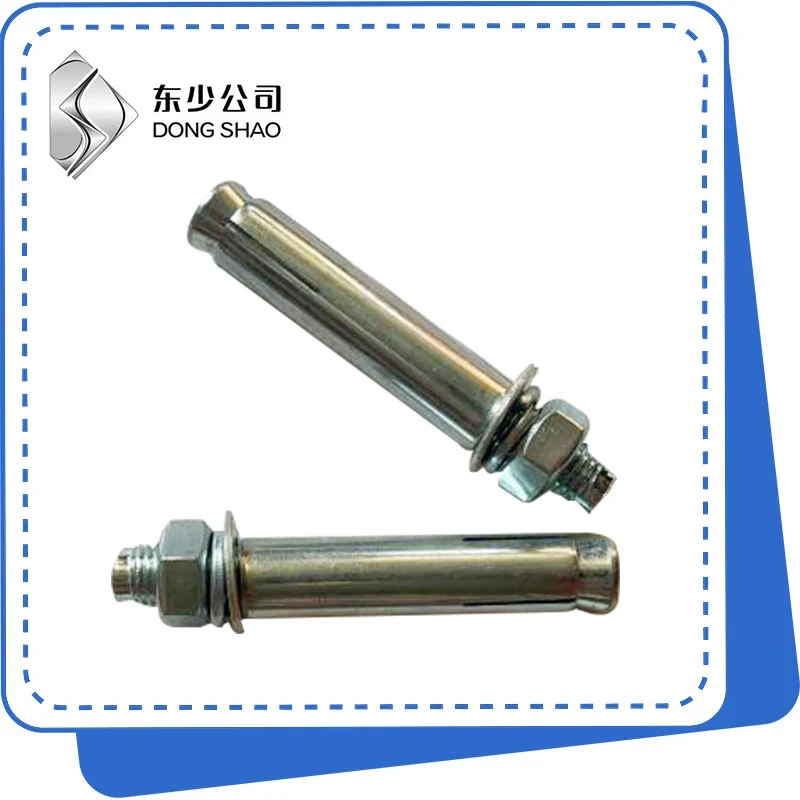
The Core Problem: Why Hollow Block Rejects Standard Expansion
A standard External Expansion bolt relies on radial expansion against the walls of a drilled hole. In solid concrete, the drill hole provides continuous, dense material. In hollow block, the drill bit often exits into a void or hits a thin web. When the expansion sleeve deploys, it has nothing solid to press against—so it simply rotates inside the cavity. The table below breaks down the three main failure modes:
| Failure Mode | What Happens | Typical Cause |
|---|---|---|
| Sleeve spin | The expansion sleeve rotates with the bolt, no grip | Drill bit entered a hollow cavity > 70% void |
| Web fracture | Bolt tightens briefly, then loses torque | Face shell thickness under 20 mm |
| Cone pull-through | Nut tightens but bolt pulls forward without expanding | Incorrect hole depth or dull drill bit |
Immediate Solutions for a Spinning External Expansion Bolt
If your External Expansion bolt is spinning right now, stop tightening immediately. Over-torquing will only burnish the hole walls and make the condition worse. Follow this priority checklist:
-
Remove the bolt and inspect the dust on the drill bit—grey powder means concrete; red/brown indicates brick; white/grey with chunks suggests lightweight block.
-
Measure the hole depth against the bolt’s required embedment. For hollow block, the External Expansion bolt must engage at least two webs or a solid core.
-
Switch to a sleeve anchor designed for hollow substrates—these have a longer expansion zone that bridges voids.
-
Use a setting tool rather than impact driver; hand-tighten with a torque wrench to 15–20 N·m initially.
DONGSHAO recommends our HD-Series External Expansion bolt, which features a four-segment expansion clip that deploys radially only when it detects solid material—reducing spin-outs by over 80% in field tests.
Prevention: Correct Installation in Hollow Block
Prevention starts with substrate evaluation. Before drilling, tap the block surface with a hammer—a hollow sound indicates a void behind that spot. Mark your drilling location over a solid web (typically 25–30 mm from the block edge). The diagram below summarises best practices:
| Installation Step | Recommended Action | Why It Works |
|---|---|---|
| Hole cleaning | Blow out dust with compressed air (3 seconds minimum) | Dust prevents sleeve expansion |
| Drill speed | 500–700 RPM, no hammer action | Hammer action shatters thin webs |
| Bolt insertion | Tap gently with a rubber mallet until flush | Avoids cross-threading the expansion cone |
| Torque sequence | 1/2 turn past hand-tight, wait 10s, then full torque | Allows sleeve to “set” before final grip |
Material Compatibility and Load Ratings
Not all External Expansion bolts perform equally on hollow block. The base material’s compressive strength (typically 5–15 MPa for lightweight block) directly affects holding values. DONGSHAO tests every batch against ASTM E488 standards. Below are typical ultimate tension loads for an M10 External Expansion bolt in different hollow block conditions:
| Block Type | Face Shell Thickness | Ultimate Tension (kN) | Safe Working Load (kN) |
|---|---|---|---|
| Lightweight (7 MPa) | 18 mm | 2.8 | 0.9 |
| Medium (10 MPa) | 22 mm | 4.2 | 1.4 |
| Heavy (15 MPa) | 25 mm | 6.1 | 2.0 |
| Solid-filled core | N/A | 8.5 | 2.8 |
Values based on DONGSHAO internal laboratory tests. Always derate by 50% for dynamic or seismic applications.
Frequently Asked Questions About External Expansion Bolts
Q: Can I use a standard External Expansion bolt in hollow block if I fill the hole with epoxy first?
A: No. Epoxy injection does not solve the spinning problem because the expansion sleeve still needs mechanical interference to deploy. Epoxy may temporarily hold the bolt, but it acts as a lubricant during tightening—actually increasing the chance of spin-out. The correct approach is to use a DONGSHAO hollow-block anchor with a pre-installed nylon mesh sleeve that compresses into voids, or to drill through the face shell and use a toggle bolt with a metal strap. Epoxy is only effective when the bolt is a bonded anchor (threaded rod with full-depth adhesive), which is a completely different product category.
Q: How can I tell if my External Expansion bolt has engaged properly during installation?
A: Three sensory indicators confirm proper engagement: (1) Torque build—you feel a steady increase in resistance over 2–3 full turns, not a sudden spike. (2) Sound—a solid, metallic “ring” when tapping the bolt head, not a dull thud. (3) Visual—the expansion sleeve should protrude 1–2 mm beyond the bolt shank when removed for inspection. With DONGSHAO bolts, we include a depth-marking ring on the shank; when that ring sits flush with the block surface, you have reached the optimal embedment of 35 mm for M8–M12 sizes. If your bolt spins after three turns, back it out, clear the hole, and use a larger diameter (e.g., M10 instead of M8) to engage thicker web sections.
Q: Does the spinning issue get worse over time with vibration or temperature changes?
A: Yes, significantly. A spinning External Expansion bolt that appears “almost tight” will progressively loosen under cyclic loading. Each vibration cycle causes micro-movement between the sleeve and the hole wall, wearing down the friction surfaces. Over 500–1,000 cycles, the bolt can lose up to 60% of its residual preload. Temperature swings (e.g., outdoor facades from –10°C to 40°C) cause differential expansion between the steel bolt and the concrete block, further reducing grip. DONGSHAO recommends our V-Lock series for such environments—these bolts include a polyamide anti-rotation insert that maintains constant pressure against the hole wall, preventing spin even when the base material expands or contracts.
Final Recommendation
A spinning External Expansion bolt in hollow block is not a mystery—it is a mechanical fact of physics. The solution lies in selecting the right anchor, preparing the hole correctly, and understanding your substrate’s internal structure. DONGSHAO has spent over 18 years refining expansion bolt geometries for marginal substrates, and our technical team provides free site-specific load calculations for any project.
Contact us today through our website or email [email protected]—include your block type, bolt size, and load requirement, and we will reply within 4 business hours with a custom anchoring plan. Stop spinning, start securing. DONGSHAO delivers holding power you can measure.
