Why Does Internal Clearance Matter in Heavy Duty Truck Bearings?
2026-11-20
Internal clearance is a key factor in the operating condition of Truck Bearings because it determines how much relative movement is available between rolling elements and raceways before the bearing is fully loaded. In heavy commercial vehicles, the correct clearance or adjustment helps accommodate shaft and housing fits, operating temperature, load changes and normal elastic deformation. Too little clearance can increase friction and heat, while excessive clearance can affect load distribution, rigidity, noise and component alignment. The correct setting therefore depends on bearing design, mounting arrangement and the vehicle manufacturer's requirements.
How Does Internal Clearance Influence Bearing Operation Under Heavy Loads?
In our technical explanations, internal clearance refers to the total distance that one bearing ring can move relative to the other in a specified direction when the bearing is not subjected to an external load. For radial bearings, this is commonly described as radial internal clearance. Axial internal clearance describes movement along the shaft axis. The distinction matters because not every bearing design is adjusted in the same way.
For Truck Bearings used in commercial vehicles, the installed condition can differ substantially from the free-state measurement. When a bearing is installed, interference fits between the inner ring and shaft or between the outer ring and housing can reduce the available clearance. During operation, temperature differences between the rings, shaft and housing can change it further. The rolling elements and raceways also deform elastically under load. A setting that appears suitable before installation may therefore produce a different operating condition once the assembly reaches working temperature.
If operating clearance becomes too small, the rolling elements may experience excessive contact stress and friction. This can lead to higher running temperature, lubricant degradation, increased power loss and accelerated fatigue. In severe cases, the bearing may run with an unintended preload. If clearance is too large, fewer rolling elements may share the load effectively at a given moment, potentially increasing local stress, vibration and movement within the assembly.
Heavy-duty service makes these effects particularly important. A truck wheel end, axle or driveline may experience changing radial loads, axial forces, road shock, braking heat and long operating hours. A bearing setting must be suitable for the complete assembly rather than selected from a generic clearance label alone. Our technical review should begin with the bearing type, mounting arrangement, shaft and housing fits, expected load and operating temperature.
Why Must Tapered Roller Bearings Be Adjusted Differently?
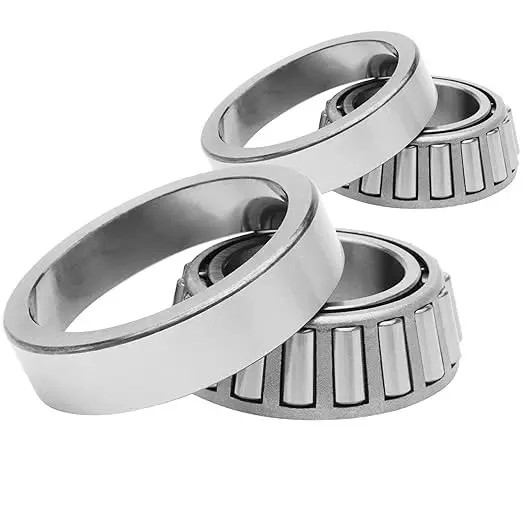
For many Truck Bearings used at wheel ends, tapered roller designs are selected because their geometry supports combined radial and axial loads. Tapered roller bearings are widely used in wheel-end and axle arrangements because their geometry allows them to support combined radial and axial loads. In many truck applications, two single-row tapered roller bearings are mounted in opposition. The adjustment of this pair determines whether the assembly has measurable axial endplay or a controlled preload.
This is an important distinction: for paired tapered roller bearings, technicians often discuss endplay or preload rather than applying a radial internal-clearance class in the same way used for some deep-groove ball or cylindrical roller bearings. Tightening the axle nut, selecting a spacer, or following a hub-unit adjustment procedure changes the relationship between the two bearings. The correct method and target value must come from the vehicle or bearing manufacturer's service data.
Our guidance is to treat excessive preload as a potential source of higher friction and operating temperature. Excessive preload can raise friction and operating temperature, particularly when thermal expansion further tightens the arrangement. Too much endplay can allow unwanted axial movement, affect wheel-end stability and contribute to uneven contact or seal problems. Neither condition should be corrected by guesswork. A technician needs the specified adjustment procedure, suitable measuring equipment and clean components.
SKF's commercial-vehicle technical guidance on paired tapered roller bearing arrangements explains the importance of correct preload and clearance settings for bearing life. It also distinguishes a preloaded arrangement, in which axial movement is eliminated by clamping force, from one with endplay. The actual setting for a specific truck must still come from its service documentation.
Which Product Details Should Buyers Check Before Selecting a Bearing?
When comparing Truck Bearings, our buyers should identify the application and the exact bearing reference before comparing price or material descriptions. A wheel-end bearing, a differential bearing and a driveshaft centre support bearing do not perform the same job. Their dimensions, load directions, lubrication arrangements and adjustment methods are not interchangeable.
Shandong Lano Machinery Manufacturing Co., Ltd. presents tapered roller truck bearing products and truck driveshaft centre bearings, as well as GCr15 bearing steel for machinery truck applications. The published material page describes GCr15 as a bearing steel and outlines spheroidizing annealing, followed by quenching and tempering to obtain hardness, wear resistance and contact-fatigue strength. These process descriptions do not establish a model-specific hardness or life guarantee without an inspection report.
| Product or parameter | Published information or buyer check | Why it matters |
| Bearing construction | Roller type and tapered structure are shown on the GCr15 product page | Confirms the general bearing design; the exact bearing arrangement still needs to be matched to the application |
| Material | GCr15 bearing steel is identified for machinery truck bearings | Material quality and heat treatment influence hardness, wear resistance and rolling-contact fatigue performance |
| Listed model references | Examples include 30202, 30210, 31307/DF, 32010 X/DF and BT4-0010 G/HA1C400VA903 | Use the complete reference and manufacturer cross-reference to verify interchangeability |
| Dimensions | Bore, outside diameter and overall width must be confirmed for the selected reference | Correct fits are essential for mounting, alignment and operating clearance |
| Load ratings | Request dynamic and static load ratings for the exact model | These values support application checks and bearing-life calculations |
| Clearance or adjustment | Confirm radial clearance for applicable bearing designs, or endplay/preload procedure for paired tapered roller bearings | Prevents confusion between different bearing adjustment systems |
| Lubrication and sealing | Confirm grease or oil specification, relubrication method and sealing arrangement | Lubricant condition and contamination control affect temperature and service life |
| Quality documentation | Request dimensional inspection, material and heat-treatment records, and applicable test reports | Provides traceability beyond a general material or product description |
Our factory information should be assessed together with the product documents for the requested reference. The published GCr15 page lists a range of bearing model references and states that OEM production can be arranged from customer drawings. It also describes access to a testing laboratory and test reports. Buyers should specify which inspections and reports are required, such as dimensional checks, hardness results or material traceability, and confirm their availability for the order in question.
Shandong Lano Machinery Manufacturing Co., Ltd. should be asked to confirm the exact bore, outside diameter, width, tolerance class, internal-clearance designation where applicable, load ratings, cage design and lubrication requirements for each quoted model. The public product listing does not provide a complete set of these numerical values for every reference. A quotation should therefore be supported by a drawing or technical data sheet rather than assumptions based on a similar-looking bearing.
How Do Installation, Temperature and Lubrication Change the Setting?
Installation has a direct effect on the operating condition of Truck Bearings. An excessive interference fit can reduce clearance, while a loose fit may allow ring creep, fretting or movement at the mating surface. Housing distortion, shaft runout, misalignment and incorrect seating can also produce uneven loading. Before assembly, technicians should inspect the shaft shoulder, housing bore, abutment faces and contact surfaces for burrs, corrosion or damage.
Our assessment of operating conditions must include temperature, which is another major influence. In some arrangements, the inner ring may run hotter than the outer ring, causing different rates of expansion. The resulting change in geometry can reduce or increase operating clearance depending on the materials, dimensions and heat flow through the assembly. A heavy-duty truck working at sustained highway speed may have a different thermal profile from a vehicle operating intermittently at a mine or construction site.
Lubrication does not replace correct clearance, but it strongly affects how the bearing performs within its intended setting. Insufficient lubricant can lead to metal-to-metal contact and rising temperature. Excessive grease fill can also increase churning and heat in some applications. The lubricant type, viscosity, quantity, relubrication interval and sealing arrangement should follow the bearing and vehicle manufacturer's recommendations.
When inspecting an in-service assembly, technicians should consider noise, vibration, temperature, lubricant condition and measured endplay or clearance together. For example, heat may result from excessive preload, poor lubrication, brake drag, contamination or an incorrect fit. If a bearing shows spalling, pitting, discoloration or cage damage, the mating components and operating conditions should also be examined before replacement.
Our selection process should account for the complete duty cycle, not only the maximum load shown in a catalogue. Relevant information includes vehicle type, axle position, road or site conditions, typical speed, shock loading, ambient temperature, maintenance practice and the specified service procedure. This helps distinguish a bearing that merely fits dimensionally from one that is appropriate for the actual operating environment.
What Should Fleet Operators and Parts Buyers Do to Avoid Clearance-Related Failures?
Our procurement checklist starts with the original equipment reference or a verified cross-reference. Record the bearing number, cone and cup combination where relevant, dimensions, mounting position and any spacer or adjustment hardware. Do not mix components from different bearing sets unless the manufacturer explicitly confirms that the combination is approved. A visually similar part may have a different contact geometry or tolerance.
Next, establish the correct installation method. For adjustable tapered roller wheel ends, follow the specified tightening, rotation, backing-off and locking sequence where the service procedure calls for it. Some modern hub assemblies use a defined unitized design and should not be adjusted like a traditional serviceable wheel end. Always use the applicable vehicle instructions and calibrated tools.
For procurement, our checklist should include a technical data sheet that identifies the exact model and confirms dimensions, tolerances, material, heat treatment, load ratings and relevant clearance or preload information. Ask how the supplier controls raceway geometry, roller size variation, hardness and dimensional consistency. If the application is safety-critical or exposed to severe shock loads, agree on inspection and documentation requirements before production.
Shandong Lano Machinery Manufacturing Co., Ltd. lists OEM and ODM support for bearing products, including production based on customer drawings. Buyers can use this route to submit a sample, drawing or complete reference for technical review. Our order specification should state the intended truck model and installation position, required quantity, packaging, inspection criteria and documentation, so that the supplied bearing can be checked against the actual application.
In short, internal clearance is not a minor catalogue detail. It influences contact conditions, heat generation, load sharing, vibration and bearing fatigue life. For paired tapered roller assemblies, the relevant setting may be axial endplay or preload rather than a generic radial-clearance class. Correct selection depends on the bearing design, fits, thermal conditions and prescribed installation procedure. Contact our team with the bearing reference, application details or drawing to discuss the appropriate product information and technical checks before ordering.
Frequently Asked Questions
Q: What happens if a heavy-duty truck bearing has too little internal clearance?
A: If the available clearance becomes too small after mounting or during operation, the rolling elements may experience excessive contact stress and friction. This can increase running temperature, accelerate lubricant breakdown and shorten fatigue life. In a paired tapered roller arrangement, excessive preload can produce similar symptoms. The correct diagnosis should include checking the fit, adjustment procedure, temperature and lubrication rather than assuming that clearance alone is responsible.
Q: Is radial internal clearance the same as endplay in tapered roller truck bearings?
A: No. Radial internal clearance describes relative radial movement between the rings, while endplay describes axial movement in an assembled bearing arrangement. Paired tapered roller bearings are commonly adjusted by controlling axial endplay or preload. The terms describe different conditions and should not be used interchangeably. Always follow the specification for the particular bearing design and vehicle wheel-end system.
Q: How can buyers confirm the correct clearance or preload for a replacement truck bearing?
A: Buyers should start with the complete bearing reference and the vehicle manufacturer's service procedure. They should confirm whether the design uses a specified radial-clearance class, an axial endplay value, a preload method or a non-adjustable hub unit. The supplier should provide model-specific technical documentation where available, while installation measurements should be made with suitable calibrated tools. A generic value from another bearing or vehicle is not a safe substitute.