Why Does a Winch Fairlead Shape Performance, Durability, and Future Off-Road Safety?
2025-12-05
A winch fairlead is a guiding interface that controls the rope’s direction as it feeds into or out of a winch drum. Its structural form, friction characteristics, and load-distribution ability determine how smoothly a recovery line operates under tension. Whether installed on an off-road 4x4 bumper, marine lifting system, industrial trailer, or utility vehicle, the fairlead acts as the stabilizing gateway that protects the rope from abrasion, reduces drag, and ensures controlled alignment through high-force cycles.
How Do Winch Fairlead Designs Influence Function, Strength, and Rope Compatibility?
The performance of a winch system depends heavily on how effectively the fairlead manages friction and line angle under stress. Variations in design, such as roller style or hawse style, influence how the rope travels, especially during angled pulls. Material hardness, surface finish, and dimensional tolerances further impact long-term reliability.
Below is a technical table outlining typical specifications found in high-grade winch fairleads suitable for synthetic or steel rope systems:
Winch Fairlead Technical Parameters
| Parameter | Specification Range | Functional Purpose |
|---|---|---|
| Material Options | 6061-T6 aluminum / Alloy steel / Stainless steel | Determines structural strength, abrasion resistance, and corrosion behavior |
| Surface Treatment | Hard anodizing / Powder coating / Electro-polishing | Reduces friction, protects against corrosion, improves rope lifespan |
| Rope Compatibility | Synthetic (UHMWPE) / Steel | Ensures proper wear characteristics based on rope material |
| Mounting Pattern | 10" standard winch bolt spacing or customized | Allows compatibility with major winch brands and bumper mounts |
| Working Load Capacity | 8,000–18,000+ lbs | Defines maximum load the fairlead can safely support |
| Opening Radius | 25–45 mm radius curvature | Smooths rope flow and minimizes heat generation |
| Dimensions | 285–300 mm length, 70–80 mm height | Ensures alignment and stability on most vehicle configurations |
| Weight | 0.6–2.8 kg | Affects mounting options and vibration control |
How the Structure Shapes Performance
Hawse Fairlead:
A solid aluminum or steel plate with a curved center opening. Ideal for synthetic rope due to its polished interior and low friction. Its minimalistic shape reduces snag points and weight, making it popular among off-road vehicles.
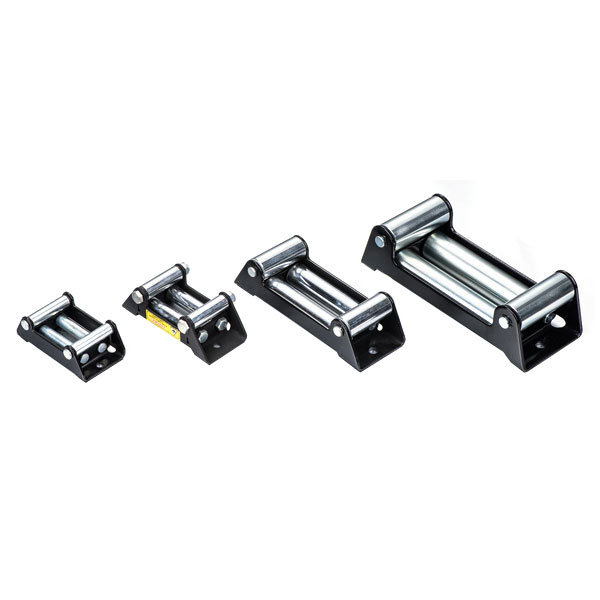
Roller Fairlead:
Combines vertical and horizontal rollers to guide steel cable during angled pulls. Offers excellent abrasion reduction. The mechanical turning rollers help prevent rope binding but add weight and require additional maintenance.
Why Selecting the Correct Fairlead Matters
-
Rope Longevity: Incorrect material pairings accelerate fraying or flattening of synthetic lines.
-
Directional Stability: Angled pulls can deform or damage rope if the fairlead radius is insufficient.
-
Heat Management: Proper openings prevent excessive friction heat, especially for synthetic lines.
-
Frame Safety: A high-load tug without a stable entry path increases bumper and winch mount strain.
-
Operational Smoothness: Quality surface finishing reduces chatter, vibration, and pull resistance.
By understanding each parameter, operators can align fairlead choice with terrain requirements, load scenarios, and rope type—ensuring safe, predictable winching outcomes.
Why Do Winch Fairleads Provide Significant Advantages and What Roles Will They Play in Future Off-Road Technology?
Winch fairleads are evolving alongside changes in recovery equipment, new rope materials, and vehicle engineering. Their advantages extend beyond mere rope guidance; they form the foundation of safe energy transfer during recovery operations.
Key Advantages of High-Performance Winch Fairleads
1. Reduced Rope Abrasion
A properly machined radius and polished interior sharply reduce friction points. This ensures the rope retains structural integrity during repeated cycles, especially vital for synthetic fibers sensitive to abrasion.
2. Improved Line Control During Angled Pulls
Fairleads maintain alignment, preventing sudden whip, snapback, or uneven spooling, which are major risk factors during real-world recoveries.
3. Enhanced Safety Margin Under Heavy Load
With high tensile strength materials and reinforced mounting patterns, fairleads distribute force evenly across the winch frame and bumper.
4. Corrosion and Weather Resistance
Defensive coatings protect against mud, saltwater, and sand environments, extending service life for both marine and off-road operators.
5. Versatility Across Industries
Fairleads serve not just automotive use but also agriculture, construction, towing, and industrial lifting scenarios where precise rope alignment is essential.
Future Trends in Winch Fairlead Development
The next generation of recovery hardware is undergoing shifts in engineering strategy. Key trends include:
1. Material Reinforcement and Hybrid Structures
Expect higher-strength aluminum alloys, composite-reinforced metals, and friction-modifying surface treatments that reduce heat during prolonged pulls.
2. Integration With Smart Winch Systems
Future winches will incorporate tension sensors, automatic braking adjustments, and load-controlled spooling. Fairleads will be optimized for these intelligent systems with sensors embedded near the rope entry path.
3. Precision-Machined Low-Friction Radii
Manufacturers are moving toward CNC-polished surfaces with micro-level texture control to accommodate advanced synthetic ropes with tighter fiber weaves.
4. Impact-Resistant Designs for Off-Road Environments
Fairleads will evolve to include reinforced edges, vibration-absorbing mounts, and surfaces resistant to sand erosion.
5. Sustainable Manufacturing
Recyclable alloys, low-emission coating processes, and extended-life surface treatments will support environmental standards.
These developments reinforce the fairlead’s role not simply as a guiding channel, but as a critical safety and performance component.
What Common Winch Fairlead Questions Help Users Avoid Misapplications? (FAQ Section)
Q1: How does a winch fairlead protect synthetic rope during angled pulls?
Synthetic rope fibers experience abrasion when dragged against sharp edges or irregular surfaces. A fairlead’s smooth, curved entry radius ensures the rope slides evenly under load. During angled pulls, the curvature distributes pressure gradually instead of allowing the rope to grind into the sides of the winch frame. This prevents fraying, heat accumulation, and premature rope failure, improving both safety and durability in long-term use.
Q2: How to choose between a hawse fairlead and a roller fairlead?
Hawse fairleads are typically recommended for synthetic rope due to their polished, solid-surface design that minimizes friction. They are lightweight and require minimal maintenance. Roller fairleads are better suited for steel cable, as the rollers reduce metal-to-metal wear during angled pulls. Operators should match rope type, vehicle size, and recovery frequency to the fairlead style to ensure optimal compatibility and safety.
How Does a Reliable Winch Fairlead Strengthen the Entire Recovery System and Where to Find Support?
A high-quality winch fairlead shapes rope performance, load stability, friction behavior, and overall recovery safety. Its construction, surface finish, curvature, and compatibility contribute directly to the lifespan of synthetic and steel winch lines. As winching systems evolve toward intelligent load management, stronger fiber technologies, and precision-machined components, the fairlead’s engineering importance continues to grow.
For operators seeking reliable, corrosion-resistant, and precisely engineered fairleads, Aosite offers solutions designed to meet modern off-road and industrial standards. The brand emphasizes durable materials, advanced machining, and compatibility with leading winch systems worldwide. For product matching, dimensional support, or custom specification inquiries, contact us to receive detailed assistance tailored to specific operational requirements.