

Why Do Reliable Machines Still Fail Without the Right Spring Washer?
2026-03-10
In the fastening industry, we often discover that the smallest components determine whether a mechanical system remains stable or gradually loosens over time. Over the past few years, I have seen more manufacturers realize that vibration, temperature shifts, and long operating cycles can easily compromise traditional fasteners. During this process, Ningbo Huijue Machinery Manufacturing Co., Ltd. gradually introduced advanced fastening solutions into its product line, and one component that repeatedly proved its value in real-world applications is the Spring Washer. This seemingly simple part plays a crucial role in maintaining bolt tension, preventing loosening, and protecting equipment integrity across many industrial environments.
When I talk with engineers and purchasing managers, they often share similar concerns. Bolts loosen after repeated vibration, maintenance costs increase unexpectedly, and downtime affects productivity. A properly designed Spring Washer addresses these issues by providing continuous pressure between the fastener and the surface, helping the connection stay secure even under dynamic loads.
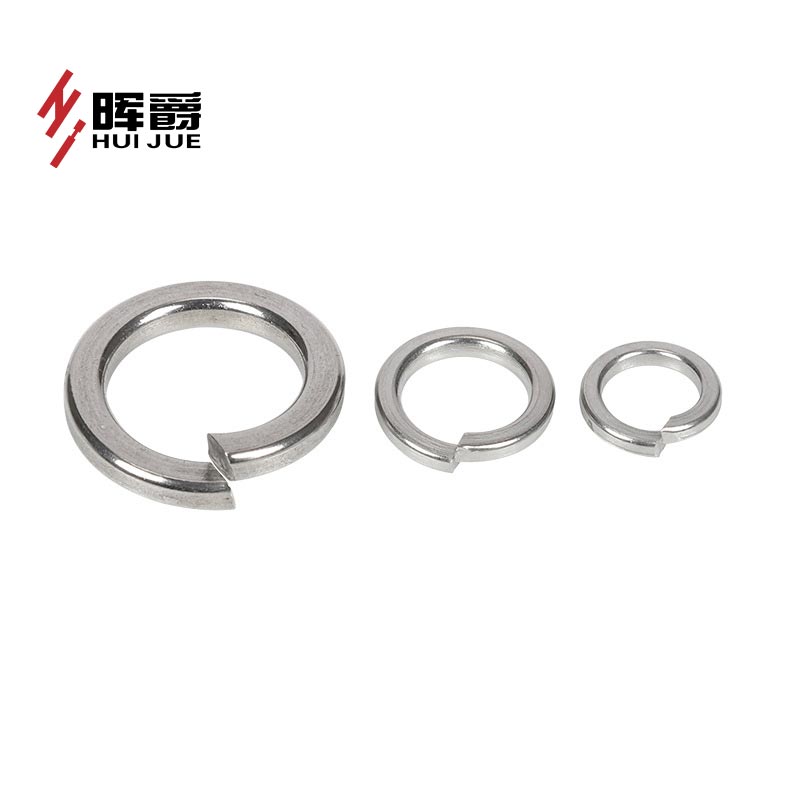
How Does a Spring Washer Actually Prevent Fasteners From Loosening?
The working principle behind a Spring Washer is both simple and effective. Instead of relying solely on static torque, the washer creates elastic tension that maintains pressure on the joint. This continuous force resists loosening caused by vibration, thermal expansion, or mechanical shock.
From practical experience, I have seen several functional advantages that make this component indispensable in mechanical assemblies.
- Maintains constant preload on bolts and nuts
- Absorbs vibration and mechanical movement
- Reduces the risk of fastener loosening over time
- Improves overall structural reliability
- Provides cost-effective protection for equipment
When the bolt is tightened, the split design of the Spring Washer creates a slight deformation that stores elastic energy. This stored tension continually pushes against the fastener, ensuring the connection remains tight even when the surrounding structure moves.
Why Do Engineers Prefer Using a Spring Washer in High-Vibration Equipment?
In many industries, vibration is unavoidable. Machinery such as compressors, industrial motors, transportation equipment, and heavy manufacturing lines all experience continuous movement. Without a locking mechanism, bolts can gradually loosen and eventually fail.
During installation projects, engineers frequently select a Spring Washer because it adds a protective layer of mechanical security without increasing assembly complexity.
The following industries regularly rely on this component:
- Automotive manufacturing and engine assemblies
- Construction machinery and heavy equipment
- Industrial production lines
- Railway and transportation infrastructure
- Energy equipment and power generation systems
In these environments, even small improvements in fastening reliability can significantly reduce maintenance costs and unexpected shutdowns.
What Factors Should Buyers Evaluate Before Choosing a Spring Washer?
From my experience working with industrial buyers, selecting the right washer involves more than simply matching the bolt size. The material, hardness, surface treatment, and manufacturing precision all influence performance and durability.
| Selection Factor | Why It Matters | Typical Recommendation |
| Material | Determines strength and corrosion resistance | Carbon steel, stainless steel, or alloy steel |
| Surface Treatment | Protects against rust and environmental exposure | Zinc plating, black oxide, or galvanized coating |
| Hardness | Ensures elastic recovery under load | Heat-treated for consistent spring force |
| Dimensional Accuracy | Guarantees proper fit with bolts and nuts | Precision manufacturing tolerance |
| Load Capacity | Ensures the washer maintains tension under stress | Engineered according to industry standards |
By evaluating these parameters carefully, buyers can ensure the Spring Washer performs reliably over long operational cycles.
Can the Right Manufacturing Process Improve the Performance of a Spring Washer?
Absolutely. In fact, the production process directly affects the elasticity and durability of the washer. High-quality manufacturing typically includes several critical stages that guarantee consistent performance.
- Precision stamping to maintain dimensional accuracy
- Controlled heat treatment to create stable elasticity
- Surface finishing to prevent corrosion
- Strict inspection to ensure uniform spring force
Manufacturers that focus on these details can produce washers capable of maintaining preload even after long periods of mechanical stress. This reliability becomes particularly important in industries where safety and structural integrity cannot be compromised.
Is Investing in a High-Quality Spring Washer Worth the Cost?
From a purchasing perspective, the cost difference between a standard washer and a well-engineered Spring Washer is relatively small. However, the value it provides over time can be significant.
Consider the potential risks of loose fasteners:
- Unexpected equipment downtime
- Higher maintenance expenses
- Reduced machine lifespan
- Safety hazards for operators
When these factors are considered, a reliable fastening component quickly becomes a cost-effective investment. Many companies discover that preventing loosening issues saves far more than the initial component cost.
Are You Looking for a Reliable Supplier for High-Performance Spring Washer Products?
Choosing the right supplier is just as important as selecting the right component. A trusted manufacturer can provide consistent quality, stable production capacity, and technical guidance for different applications.
If you are currently searching for durable fastening solutions, we would be glad to help. Our engineering team understands how critical fastening reliability is for industrial equipment, and we are committed to providing dependable products tailored to your requirements.
If you would like to learn more about our Spring Washer solutions or request detailed specifications, please feel free to contact us. We welcome your inquiries and look forward to supporting your next project with reliable fastening components.
