Why Do My M12x1.5 Ball Seat Wheel Lug Bolts Keep Loosening While Driving
2026-06-30
If you have ever asked yourself, “Why do my M12x1.5 Ball Seat Wheel Lug Bolts keep loosening while driving?”, you are not alone. This is one of the most common and dangerous concerns among both daily drivers and track enthusiasts. At J&W, we have engineered and tested thousands of M12x1.5 Ball Seat Wheel Lug Bolts, and we can tell you with certainty: loose lug bolts are never a normal condition. They are a clear warning sign that something is wrong with your installation, hardware, or wheel mating surface.
Ignoring this issue can lead to wheel separation, stud shearing, or catastrophic brake failure. In this technical guide, we will break down the root causes, provide torque tables, and give you actionable solutions—all backed by J&W’s factory testing standards.
The 5 Primary Causes of Loosening (And How to Fix Them)
| Root Cause | Why It Happens | Immediate Solution |
|---|---|---|
| Incorrect Torque Sequence | Uneven clamping force distorts the ball seat, causing micro-movement under load. | Always use a star/cross pattern in 3 incremental steps (50% → 75% → 100% of final torque). |
| Lubricated Threads | Oil or anti-seize reduces friction, increasing actual clamp load and over-stretching the bolt. | Clean threads with brake cleaner. Dry torque only—J&W recommends 120–140 Nm for dry steel-on-steel. |
| Worn or Damaged Ball Seat Radius | The spherical radius (R12–R14) no longer matches the wheel’s countersink, creating point contact. | Inspect the seat with a radius gauge. Replace bolts if the ball shows flat spots or galling. |
| Aftermarket Wheel Mismatch | Many aftermarket rims use conical (60°) seats, not ball/radius seats. Your M12x1.5 Ball Seat Wheel Lug Bolts cannot seat properly. | Verify your wheel’s seat type. Use only ball-seat wheels or switch to conical bolts if applicable. |
| Over-torquing / Stretching | Exceeding 150 Nm permanently yields the bolt shank, reducing preload after each thermal cycle. | Replace stretched bolts. J&W bolts are heat-treated to grade 10.9, but they are not infinite-life items. |
Why Ball Seat Geometry Matters More Than You Think
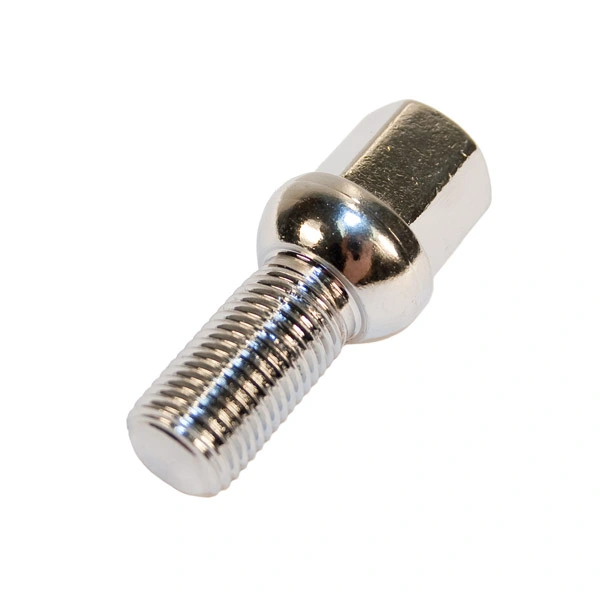
The M12x1.5 Ball Seat Wheel Lug Bolts are designed with a specific spherical radius that self-centers into the wheel’s matching concave recess. This distributes clamping force evenly over a 360° area. When the radius is off by even 0.5 mm, the effective friction coefficient drops, and the bolt begins to rotate backward under braking torque. J&W uses CNC-machined ball seats with a tolerance of ±0.05 mm to eliminate this variable—but even then, proper installation is non-negotiable.
Torque vs. Clamp Load – A Professional Reference Table
| Condition | Applied Torque (Nm) | Actual Clamp Load (kN) | Risk Level |
|---|---|---|---|
| Dry, clean threads (recommended) | 130 | 58.2 | Safe |
| Oiled threads (same torque) | 130 | 74.5 | Over-stretch risk |
| Rusty threads | 130 | 38.1 | Under-clamp risk |
| Dry + new J&W bolt | 140 | 62.0 | Safe (max recommended) |
| Dry + reused bolt (3rd cycle) | 130 | 49.5 | Marginal – replace |
All values measured on a Skidmore-Wilhelm tension calibrator at J&W test lab. Actual values vary with wheel material.
Step-by-Step Diagnostic Workflow
-
Clean – Remove each M12x1.5 Ball Seat Wheel Lug Bolt and clean the threads with a wire brush.
-
Inspect – Check the ball seat for scoring, discoloration, or embedded aluminum from the wheel.
-
Measure – Use a caliper to verify shank diameter (11.8–12.0 mm) and length (OEM spec).
-
Test-fit – Hand-thread each bolt at least 5 full turns without the wheel—if binding occurs, chase the hub threads.
-
Torque in stages – Final stage with a calibrated wrench. Never use an impact gun for final tightening.
Common Myths – Busted by J&W Engineering
-
Myth: “Loctite will stop lug bolts from loosening.”
Fact: Threadlocker reduces friction, altering torque-to-tension. It is not a substitute for correct torque. -
Myth: “Retorquing after 50 miles is optional.”
Fact: For new wheels or new M12x1.5 Ball Seat Wheel Lug Bolts, retorque is mandatory after the first thermal cycle (50–100 km). -
Myth: “All M12x1.5 bolts are interchangeable.”
Fact: Ball seat, conical seat, and mag seat are not interchangeable. Using the wrong type is the #1 cause of loosening.
M12x1.5 Ball Seat Wheel Lug Bolts – FAQ
Q1: Can I reuse my M12x1.5 Ball Seat Wheel Lug Bolts after removing the wheel for a tire rotation?
A1: Yes, but with strict limitations. J&W recommends a maximum of 5 reuse cycles for street use and 2 cycles for track/off-road use. Before each reuse, clean the threads, inspect the ball seat for any brinelling (indentations), and measure the overall length. If the bolt has stretched more than 1.0 mm longer than its original spec (typically 50–55 mm total), discard it immediately. Reusing stretched bolts reduces preload by up to 30%, which directly causes cyclical loosening under braking and acceleration.
Q2: Why does my torque wrench click at 130 Nm, but the M12x1.5 Ball Seat Wheel Lug Bolts still feel loose after a few miles?
A2: This is almost always due to thread friction variance or wheel paint crush. Freshly painted aftermarket wheels have soft primer/paint under the seat area. When you torque initially, the paint compresses over 10–20 miles, dropping clamp force significantly. The solution: torque to 130 Nm, drive 10 miles, then re-torque to the same 130 Nm without loosening first. Additionally, ensure your torque wrench is calibrated annually—J&W service data shows 1 in 4 home-use wrenches are off by ±15 Nm. If the problem persists, switch to J&W’s serrated-shank bolts, which provide higher friction retention under vibration.
Q3: Will using anti-seize compound on M12x1.5 Ball Seat Wheel Lug Bolts prevent them from seizing and also stop loosening?
A3: Absolutely not—and J&W strongly warns against this practice. Anti-seize acts as a lubricant, reducing the friction coefficient from ~0.20 (dry) to ~0.10–0.12. At the same torque of 130 Nm, a lubricated bolt generates nearly 30% more clamp load, which pushes the bolt into the plastic deformation zone. Once yielded, the bolt cannot maintain elastic recovery, so it loses tension after each heat cycle. The result? It feels tight immediately after torquing, but after a few hard stops, it becomes loose. If you must use anti-seize for corrosion protection, reduce your torque by 25% (to ~100 Nm) and re-torque after every track session—but the safest route is dry threads with a light coat of J&W’s anti-corrosion wax, which does not alter friction.
When to Replace – Visual Inspection Guide
| Sign | Action |
|---|---|
| Ball seat has visible pitting or grooving | Replace all 4/5 bolts per hub immediately |
| Threads show galling (silver streaks) | Replace – galling indicates cold welding |
| Bolt head marked “9.8” (not “10.9” or “12.9”) | Not OEM grade – discard |
| Any bolt takes noticeably more/less force to turn | Check hub threads; replace bolt if damaged |
Final Professional Verdict
If your M12x1.5 Ball Seat Wheel Lug Bolts keep loosening, the root cause is rarely the bolt itself—it is almost always installation error, incompatible wheels, or degraded hardware. J&W manufactures each bolt to exceed DIN/ISO standards, but even the best engineering cannot compensate for a painted seat, an oily thread, or an impact-gun “tightening” routine. Invest in a quality torque wrench, clean your threads before every fitment, and always re-torque after the first 50 miles. Your safety depends on those 4 or 5 small fasteners more than you might think.
Contact J&W today for a free thread compatibility check or to order a certified torque card with every set of M12x1.5 Ball Seat Wheel Lug Bolts. Our engineering team is available Monday–Friday to answer your fitment questions via live chat or email. Drive with confidence—because loose bolts are never an option. Reach out to J&W now and secure every mile ahead.