Why Do Diaphragm Seals with Screwed Process Connections Sometimes Fail Under Cyclic Pressure Loads
2026-07-10
In industrial pressure measurement, Diaphragm Seals protect sensitive transmitters from corrosive, viscous, or high-temperature media. When paired with a Screwed Process Connection, they offer a compact, cost-effective mounting solution. However, under cyclic pressure loads—repeated pressurization and depressurization cycles—these assemblies can fail prematurely. At CSHERUN, we have analyzed hundreds of field failures and identified the root causes. This article examines why these failures occur and how to prevent them.
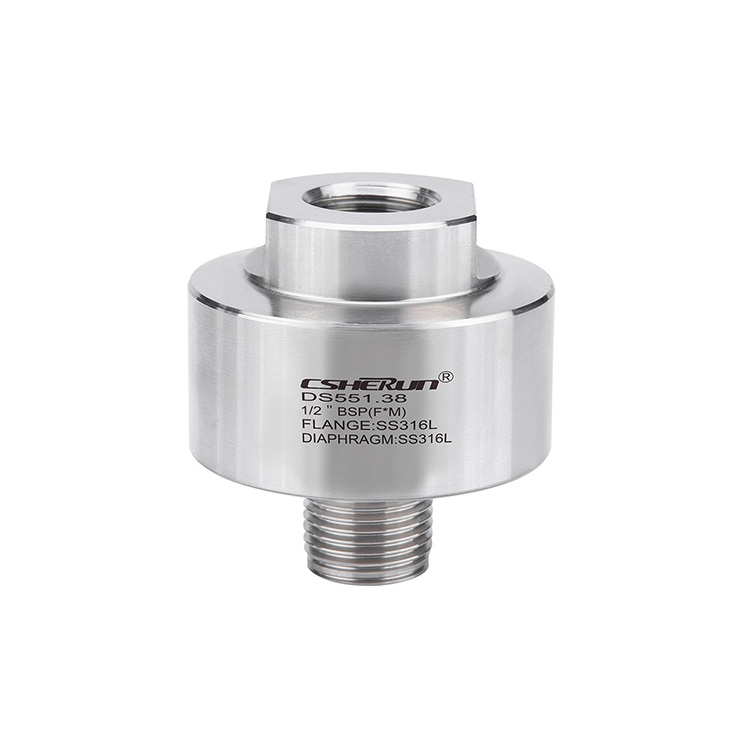
The Physics of Cyclic Loading on Threaded Joints
Cyclic pressure loads generate alternating stresses on the Screwed Process Connection. Each cycle produces a fluctuating axial force that acts on the thread flanks. Over time, this leads to:
-
Thread galling (especially with stainless steel-on-stainless threads)
-
Micro-motion between the male and female threads
-
Progressive loosening due to differential thermal expansion
The Diaphragm Seal itself experiences deflection reversals. When combined with a rigid threaded connection, the seal's capillary tube or fill fluid system can suffer from pressure spikes that exceed the design envelope.
Primary Failure Modes
| Failure Mode | Mechanism | Typical Cycle Count |
|---|---|---|
| Thread Fatigue Fracture | Crack initiation at thread root due to stress concentration | 10,000 – 50,000 cycles |
| Seal Diaphragm Rupture | Over-deflection from pressure spikes exceeding burst rating | 500 – 2,000 cycles (severe cases) |
| Fill Fluid Leakage | Thread loosening reduces clamping force, allowing process fluid ingress | Gradual, after 5,000+ cycles |
| Galling & Seizure | Adhesive wear between mating threads under high make-up torque | Single installation or early cycles |
Why Threaded Connections Are More Vulnerable Than Flanged Ones
Flanged connections distribute clamping force over a larger gasket area. A Screwed Process Connection, by contrast, concentrates all mechanical load onto the thread roots. Under cyclic pressure, the alternating load creates a "ratcheting" effect—each cycle slightly deforms the thread profile. Eventually, the preload (initial tightening force) diminishes, and the joint becomes loose. This loosening directly compromises the Diaphragm Seal’s isolation function, because the seal relies on a fixed, immovable connection to maintain its calibrated fill-volume.
Critical Factors That Accelerate Failure
-
Thread Form Mismatch – Using NPT vs. BSP threads without proper adapters creates incomplete engagement.
-
Inadequate Make-Up Torque – Under-torquing allows movement; over-torquing induces residual stresses.
-
Pressure Amplitude – Higher peak-to-trough differentials cause faster fatigue damage.
-
Temperature Synergy – Cyclic heating/cooling changes thread friction coefficients, accelerating loosening.
-
Vibration Overlay – External mechanical vibration amplifies the cyclic effect on the Screwed Process Connection.
Best Practices to Extend Service Life
-
Apply anti-seize lubricant (silver-grade or nickel-based) to minimize galling.
-
Use thread-locking compounds (medium-strength) after torque verification.
-
Select coarse threads (e.g., UNC) over fine threads for better fatigue resistance.
-
Incorporate a backing ring or jam nut to lock the Screwed Process Connection.
-
Specify a diaphragm with over-range stops to limit deflection under peaks.
At CSHERUN, we engineer our Diaphragm Seals with stress-relieved threaded adapters and offer optional weld-over-thread reinforcements for high-cycle applications.
FAQ – Common Questions About Screwed Process Connection, Diaphragm Seals
Q1: Can I use a standard pipe thread sealant on a Screwed Process Connection for a Diaphragm Seal under cyclic pressure?
A: No. Standard PTFE tape or pipe dope is not recommended for Diaphragm Seals under cyclic loads. These sealants act as lubricants during initial tightening, causing you to over-torque the joint. Under cycling, they degrade and allow micro-leakage. Instead, use a thread sealant specifically rated for dynamic loading, such as anaerobic curing compounds, and always combine it with a mechanical locking device. CSHERUN recommends anaerobic sealants that cure to a low-strength bond, preventing loosening while still allowing future disassembly.
Q2: How do I calculate the fatigue life of a Screwed Process Connection on a Diaphragm Seal?
A: Fatigue life estimation requires three inputs: (1) the mean pressure stress, (2) the alternating pressure amplitude, and (3) the thread geometry stress-concentration factor (Kt). For standard NPT 1/2" threads in 316L stainless steel, the endurance limit at 10⁷ cycles is approximately 25 MPa under fully reversed loading. However, for Diaphragm Seals, the connection sees a non-zero mean stress. Use the Goodman diagram to adjust the allowable alternating stress. As a rule of thumb, if your peak-to-peak pressure change exceeds 30% of the connection's rated working pressure, expect a 50–70% reduction in cycle life. CSHERUN provides customized fatigue calculations for each application upon request.
Q3: Does the fill fluid type affect the failure risk of a Screwed Process Connection under cycling?
A: Indirectly, yes. The fill fluid (silicone, glycerin, or halocarbon) has a different compressibility and thermal expansion coefficient. Under rapid cyclic pressure, the fluid generates internal hydraulic pressure spikes that are transmitted to the Diaphragm Seal and, through the seal housing, to the Screwed Process Connection. A high-viscosity fluid with poor response time can cause pressure overshoot, effectively multiplying the load on the threads. For cyclic applications, CSHERUN recommends low-viscosity silicone oil with a high bulk modulus, and we always match the fluid fill to the expected cycle frequency to avoid dynamic amplification effects.
Conclusion
Cyclic pressure loads expose the inherent weaknesses of a Screwed Process Connection when used with Diaphragm Seals—chiefly thread fatigue, loosening, and seal diaphragm over-stress. By understanding the failure mechanisms, selecting proper thread forms, applying correct torque, and using supplementary locking methods, you can significantly extend service life. Regular inspection intervals (every 5,000 cycles) with torque re-verification are also essential.
Contact CSHERUN today for a comprehensive application review. Our engineering team will analyze your pressure cycle profile, thread specification, and media conditions to deliver a Diaphragm Seal assembly that withstands the toughest cyclic demands. Reach out via our website or email us directly—we respond within 4 business hours with tailored recommendations and fatigue-life projections for your exact process conditions.