Which RS485 Hotel Roller Blinds Tubular Motor Meets the Demands of Modern Hotel Automation?
2026-11-13
Modern hotels increasingly rely on intelligent automation to improve guest comfort, simplify room management, and reduce daily operational workloads. Motorized roller blinds have become an important part of these systems, allowing guests and hotel management teams to control natural light and privacy with greater convenience. However, choosing the right RS485 Hotel Roller Blinds Tubular Motor requires more than simply comparing motor power or price.
This article explains how RS485 communication works, why it is valuable for hotel shading systems, which technical factors influence motor selection, and how to achieve reliable integration with room controllers and building automation platforms. It also covers installation, maintenance, purchasing considerations, and common questions to help hotel developers, contractors, and commercial buyers make informed decisions.
1. Why Hotel Roller Blind Automation Matters
A comfortable hotel room is built around many small details. Lighting, temperature, privacy, and ease of operation all influence how guests experience their stay. Window coverings are particularly important because they directly affect daylight, indoor comfort, and personal privacy.
Traditional manual roller blinds require guests or housekeeping staff to operate each window covering individually. In a hotel with hundreds of rooms, this approach can become inconvenient, especially when rooms contain multiple windows or several layers of shading.
Motorized roller blinds offer a more convenient solution. With an electric tubular motor installed inside the roller tube, the blind can move automatically through a wall panel, room controller, central management system, or other compatible control interface.
For hotel operators, automation can support several practical objectives:
- Better guest comfort: Guests can adjust daylight and privacy without manually pulling the blinds.
- Convenient room management: Staff can operate compatible shading systems through centralized controls.
- Consistent room presentation: Automated positioning helps maintain a uniform appearance across guest rooms.
- Flexible lighting scenes: Blinds can be coordinated with lighting and other room functions.
- Improved operational efficiency: Centralized control can reduce repetitive manual tasks.
These benefits become particularly valuable in luxury hotels, business hotels, serviced apartments, resorts, and large hospitality developments where multiple rooms need coordinated operation.
2. What Is an RS485 Hotel Roller Blinds Tubular Motor?
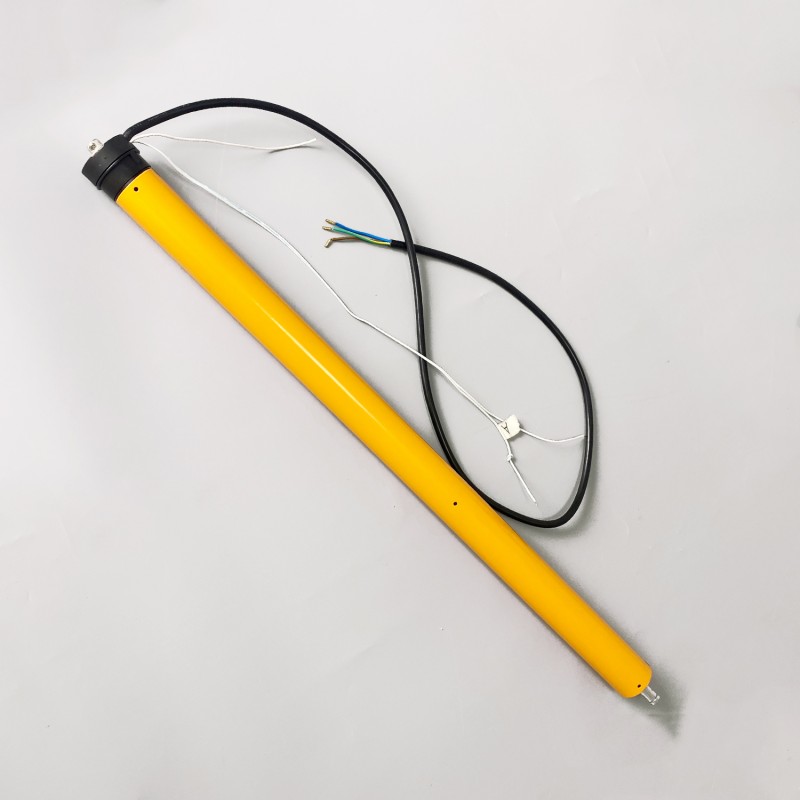
An RS485 Hotel Roller Blinds Tubular Motor is an electrically powered motor designed to fit inside a roller blind tube and communicate with compatible external control equipment through an RS485 serial communication interface.
Unlike a basic motor that may only respond to simple electrical switching commands, an RS485-enabled motor can support digital communication with a suitable controller. Depending on the motor design and communication protocol, the system may provide movement commands, position adjustment, operating status, and other feedback functions.
Understanding the Tubular Motor Structure
The motor is installed inside the roller tube, where its drive mechanism rotates the tube and raises or lowers the fabric. This compact arrangement keeps most mechanical components concealed, making it suitable for modern hotel interiors.
A typical motorized roller blind assembly includes:
- Tubular motor with an appropriate drive adapter.
- Roller tube compatible with the motor crown and drive wheel.
- Mounting brackets and supporting components.
- Roller blind fabric and bottom rail.
- Power supply and electrical connections.
- RS485 communication wiring and a compatible controller.
What Does RS485 Actually Do?
RS485 is a differential serial communication standard commonly used in industrial automation and building control applications. It transmits data through a differential signal pair, generally identified as A and B.
Its electrical characteristics make it suitable for communication over relatively long cable distances and in multi-device installations when the network is designed correctly. This is useful in hotel projects where motors may be distributed across multiple guest rooms, floors, or building zones.
RS485 defines the electrical communication interface, not a universal motor command language. Two motors may both use RS485 but still require different communication protocols, addressing methods, wiring arrangements, or controller configurations. Always confirm actual compatibility before purchasing.
3. How RS485 Communication Improves Hotel Control
The main advantage of RS485 in hotel roller blind applications is its ability to connect motorized shading equipment with centralized digital control systems. Instead of relying entirely on separate manual switches, the motors can become part of a coordinated automation environment.
3.1 Centralized Control of Multiple Blinds
Hotel rooms often contain several windows, and public areas may have extensive glass facades. Operating every blind separately can create unnecessary work.
With a compatible RS485 control architecture, multiple motors can be managed through a central controller. The exact number of motors supported depends on the controller, network topology, addressing system, and manufacturer specifications.
3.2 More Precise Position Management
Certain RS485 motor systems support intermediate positioning. This allows a blind to stop at a predefined position instead of moving only between fully open and fully closed limits.
For example, a hotel may configure different shading positions for morning daylight, daytime privacy, and evening relaxation. Where supported, position feedback can also help the control system identify the actual blind position.
3.3 Integration with Smart Hotel Scenes
A modern guest room may use a room control unit to coordinate lighting, air conditioning, curtains, and other electrical equipment.
A compatible RS485 tubular motor can participate in predefined scenes, such as:
- Welcome Scene: Adjust the blinds to a comfortable preset when a guest enters the room.
- Sleep Scene: Lower blackout blinds to improve room darkness.
- Morning Scene: Raise the blinds to allow natural daylight into the room.
- Departure Scene: Move blinds to a predefined position when the guest leaves.
- Meeting Scene: Reduce glare in hotel conference rooms and meeting spaces.
These scenes must be configured through the appropriate room controller or building management platform. Their availability depends on the selected motor and control system.
3.4 More Organized Wiring and Communication
RS485 networks can simplify communication wiring in projects involving multiple devices. However, the communication cable must follow the motor manufacturer's wiring instructions. Proper network topology, cable specifications, grounding practices, and termination arrangements are important for stable communication.
4. Key Features to Look for in a Hotel Tubular Motor
Not every tubular motor is designed for the same application. A motor intended for a small residential blind may not provide the performance required for a large hotel window or a commercial shading installation.
Before choosing a motor, hotel project buyers should evaluate the following characteristics.
4.1 Low-Noise Operation
Noise is a particularly important consideration in hospitality environments. Guests expect a peaceful atmosphere, especially during nighttime operation.
Motor noise can be influenced by the internal gear structure, motor speed, mounting accuracy, roller tube balance, fabric alignment, and the supporting bracket system.
Rather than evaluating the motor in isolation, buyers should request sound-level information under clearly defined test conditions and, where possible, test the complete blind assembly.
4.2 Suitable Torque and Load Capacity
Torque determines the motor's ability to rotate the roller tube and move the attached blind. An undersized motor may struggle with heavier fabrics, wider windows, or increased mechanical resistance.
A properly selected motor should match the total moving load, roller dimensions, friction conditions, and application requirements.
4.3 Accurate Electronic Limit Settings
Electronic limit settings define where the blind stops at its upper and lower travel positions. Accurate limits help prevent excessive fabric movement and maintain a consistent finished appearance.
For hotels with many identical rooms, reliable limit adjustment is particularly useful during commissioning and subsequent maintenance.
4.4 Communication and Position Feedback
If centralized monitoring is required, confirm whether the motor supports two-way communication and position feedback. Not every RS485 motor offers the same feedback capabilities.
Buyers should also check whether the motor supports individual addressing, group commands, and the specific communication protocol required by the project.
4.5 Protection and Operating Durability
Hotel blinds may operate repeatedly throughout the day. Appropriate thermal protection, mechanical durability, and a suitable operating cycle are therefore important.
Ask the supplier about the motor's rated operating time, cooling requirements, protection functions, and expected service conditions.
5. How to Choose the Right Motor Specifications
Selecting the correct RS485 Hotel Roller Blinds Tubular Motor begins with the actual window covering rather than the communication interface alone.
5.1 Calculate the Required Torque
Several factors influence the required motor torque:
- Width and height of the roller blind.
- Weight and thickness of the fabric.
- Weight of the bottom rail and other moving components.
- Roller tube diameter and mechanical resistance.
- Installation orientation and operating conditions.
A general engineering relationship is:
This simplified relationship helps explain why heavier blinds and larger roller radii require more torque. Actual motor selection must also account for friction, acceleration, mechanical efficiency, and the manufacturer's rated operating limits.
5.2 Compare Important Technical Parameters
| Parameter | What Buyers Should Check | Why It Matters |
|---|---|---|
| Rated Voltage | AC or DC voltage and frequency | Ensures compatibility with the electrical installation. |
| Motor Torque | Rated torque in Nm | Determines suitable blind load capacity. |
| Motor Speed | Rated rotational speed in RPM | Affects opening and closing time. |
| Motor Diameter | Motor body and compatible tube dimensions | Determines whether the motor fits the roller assembly. |
| Communication | RS485 protocol and controller compatibility | Ensures reliable system integration. |
| Position Control | Electronic limits and intermediate positions | Supports consistent blind positioning. |
| Noise Level | Measured operating noise | Important for guest comfort. |
| Protection | Thermal and overload protection, where available | Helps protect the motor during operation. |
5.3 Consider Different Hotel Areas
A single motor configuration may not be suitable for every area of a hotel.
| Application Area | Key Requirements | Selection Focus |
|---|---|---|
| Guest Rooms | Quiet operation and convenient positioning | Noise, torque, and scene compatibility. |
| Hotel Suites | Multiple windows and coordinated shading | Individual and group control. |
| Conference Rooms | Glare reduction and coordinated movement | Position accuracy and system integration. |
| Restaurants | Daylight adjustment and comfortable operation | Load capacity and control convenience. |
| Lobby Areas | Large windows and extended shading coverage | Torque, duty cycle, and control architecture. |
6. Integration with Hotel Room Control Systems
A motor can have excellent mechanical performance but still cause project difficulties if it cannot communicate correctly with the hotel's existing automation equipment.
System compatibility should therefore be confirmed before ordering motors in bulk.
6.1 Understand the Control Architecture
A typical hotel roller blind automation arrangement may contain the following components:
- RS485 tubular motor: Provides the mechanical movement of the blind.
- Communication cable: Transmits digital control signals between the motor and controller.
- Room controller or motor controller: Processes commands and manages motor operation.
- Guest control panel: Allows guests to operate the blinds.
- Central management system: Coordinates room functions where the project architecture supports it.
6.2 Confirm Protocol Compatibility
One of the most important purchasing checks is whether the motor's actual communication protocol matches the selected controller.
For example, some projects use Modbus RTU over an RS485 physical interface, while other manufacturers use proprietary communication protocols. The presence of an RS485 connection does not automatically mean that a motor can communicate with every RS485 controller.
Before confirming an order, request the following information:
- Communication protocol and supported command list.
- Device addressing and baud rate settings.
- Data format, parity, and stop-bit configuration.
- Wiring diagrams and connector details.
- Supported position and feedback functions.
- Compatible controller models and integration instructions.
6.3 Test the System Before Large-Scale Installation
A sample test is a practical way to identify compatibility issues before a complete hotel project begins.
Connect a sample motor to the intended controller and verify opening, closing, stopping, position adjustment, and feedback functions where supported. Also test multiple motors together if group control is part of the project.
Do not rely only on a product description stating that a motor supports RS485. Request the communication documentation and complete an integration test with the actual hotel control equipment.
7. Installation Factors That Affect Performance
Even a suitable motor can perform poorly if the roller blind assembly is installed incorrectly. Mechanical alignment and electrical installation are equally important.
7.1 Check Roller Tube Compatibility
The motor diameter alone does not determine whether it can fit a particular roller tube. The motor crown and drive adapter must also match the tube profile and dimensions.
Confirm the internal tube dimensions, drive components, bracket arrangement, and available installation space before assembly.
7.2 Ensure Correct Mechanical Alignment
The roller tube should be installed horizontally, with secure supporting brackets. Incorrect alignment may cause uneven fabric movement, additional friction, noise, and premature wear.
7.3 Follow the Correct Wiring Diagram
Power and communication connections must follow the specific motor manufacturer's instructions. Do not assume that different RS485 motor models use identical wire colors or terminal arrangements.
Qualified electrical technicians should complete the wiring, grounding, and power checks. The RS485 communication cable should be routed and terminated according to the approved network design.
7.4 Configure Motor Limits and Communication Settings
After installation, technicians should configure the upper and lower travel limits, motor direction, device address, and communication parameters as required by the system.
Each motor should be tested individually before group operation is enabled. This makes it easier to identify incorrect wiring, addressing conflicts, or mechanical installation problems.
8. Maintenance and Long-Term Reliability
Hotel automation equipment needs consistent maintenance to provide dependable service. Although tubular motors are generally concealed inside roller tubes, their performance still depends on the surrounding mechanical and electrical components.
Recommended Maintenance Checklist
- Inspect movement: Check whether the blind moves smoothly without unusual vibration or resistance.
- Check mounting brackets: Make sure the motor and roller tube remain securely supported.
- Verify travel limits: Confirm that the blind stops at the correct upper and lower positions.
- Check communication: Investigate delayed responses or intermittent communication errors.
- Inspect wiring: Look for loose connections or damaged cables.
- Monitor operating noise: Unusual sounds may indicate alignment or mechanical problems.
- Review control settings: Confirm that device addresses and scene configurations remain correct.
For larger hotels, keeping a record of motor locations, model numbers, installation dates, and controller addresses can make troubleshooting and replacement much easier.
Maintenance intervals should be determined according to operating frequency, environmental conditions, and the manufacturer's recommendations.
9. Common Purchasing Mistakes to Avoid
Choosing hotel tubular motors solely by price can create unexpected expenses during installation and long-term operation. The following mistakes are worth avoiding.
Mistake 1: Assuming All RS485 Motors Are Compatible
RS485 is an electrical interface standard, not a guarantee of protocol compatibility. Always confirm communication details with both the motor manufacturer and the control system supplier.
Mistake 2: Selecting Insufficient Torque
A motor with inadequate torque may struggle with wide or heavy roller blinds. Calculate the actual load and obtain the manufacturer's recommended motor selection before placing an order.
Mistake 3: Ignoring Operating Noise
A motor that performs acceptably in a showroom may still be unsuitable for a quiet hotel bedroom. Evaluate noise under realistic operating conditions.
Mistake 4: Overlooking Tube and Bracket Compatibility
Differences in tube profiles, drive adapters, motor diameters, and mounting brackets can complicate installation. Confirm the complete mechanical configuration in advance.
Mistake 5: Skipping Sample Testing
Installing hundreds of motors without first checking communication and mechanical compatibility increases project risk. A sample installation can help identify issues before bulk delivery.
Mistake 6: Failing to Consider After-Sales Support
Hotel projects may require technical documents, replacement components, installation guidance, and troubleshooting support. Supplier responsiveness can therefore be just as important as the initial quotation.
10. Why Work with an Experienced Motor Manufacturer?
Selecting a suitable tubular motor is only one part of a successful hotel automation project. Consistent product quality, technical communication, production coordination, and dependable supplier support also influence the final result.
Ningbo Futai Window And Door Automation Technology Co., Ltd. focuses on window and door automation technology and provides a professional manufacturing background for customers looking for motorized window covering solutions.
When evaluating a potential motor supplier, hotel developers, distributors, system integrators, and project contractors should pay attention to several important factors:
- Product selection support: Assistance with matching motor specifications to blind dimensions and application requirements.
- Technical documentation: Clear product specifications, wiring instructions, and installation information.
- Communication compatibility: Technical confirmation of RS485 protocols and controller integration requirements.
- Project coordination: Support for sample evaluation, product configuration, and bulk order planning.
- Quality consistency: Appropriate production inspection and product performance verification.
- Long-term cooperation: Responsive communication and technical assistance throughout the purchasing process.
For B2B buyers, choosing a manufacturer that understands both motor performance and project requirements can help reduce procurement uncertainty and simplify the development of reliable automated shading systems.
11. Frequently Asked Questions
Q1: What is an RS485 hotel roller blinds tubular motor?
It is an electric tubular motor installed inside a roller blind tube and equipped with an RS485 communication interface. It can connect to compatible controllers for automated blind operation. Depending on the model, it may support position adjustment and operating status feedback.
Q2: Why is RS485 suitable for hotel roller blind automation?
RS485 supports differential serial communication and is suitable for many multi-device control environments. It allows compatible motors to communicate with centralized controllers, making it useful for hotel rooms and larger commercial shading projects.
Q3: Can an RS485 tubular motor connect directly to a hotel room controller?
Not necessarily. The motor and controller must share a compatible communication protocol, wiring configuration, and parameter settings. Some systems also require an interface or gateway between the motor and the hotel automation platform.
Q4: Can multiple hotel roller blinds be controlled together?
Yes, if the motors and control equipment support group control. The maximum number of devices depends on the controller capacity, network design, addressing method, and manufacturer specifications.
Q5: Does every RS485 tubular motor support position feedback?
No. Some models provide only basic movement commands, while others support bidirectional communication and position feedback. Buyers should confirm the available functions in the product datasheet and communication protocol documentation.
Q6: How do I select the correct torque for a hotel roller blind motor?
Consider the blind dimensions, fabric weight, bottom rail weight, roller radius, and mechanical resistance. Consult the motor manufacturer's load recommendations to select an appropriate torque rating with a suitable operating margin.
Q7: Are RS485 hotel roller blind motors suitable for large hotel windows?
They can be suitable when the motor torque, tube dimensions, mechanical structure, and operating duty are properly matched to the application. Large or heavy blinds may require higher torque motors and a more robust supporting structure.
Q8: How can hotel operators reduce motor operating noise?
Select a motor designed for quiet operation, install the roller tube accurately, use compatible brackets, and ensure that the fabric moves without excessive friction. The complete assembly should be tested under actual operating conditions.
Q9: What information should buyers provide when requesting a quotation?
Useful information includes blind width and height, fabric type and weight, roller tube dimensions, required motor voltage, torque requirements, communication protocol, controller model, project quantity, and installation environment. Providing these details helps the manufacturer recommend a more suitable configuration.
Q10: Can RS485 tubular motors be integrated with Modbus RTU systems?
Yes, when the specific motor supports Modbus RTU over its RS485 interface and its communication settings and register definitions are compatible with the controller. An RS485 interface alone does not automatically mean Modbus RTU support.
12. Final Thoughts: Choosing a Reliable Solution for Hotel Automation
An RS485 Hotel Roller Blinds Tubular Motor can play an important role in creating a more comfortable, convenient, and intelligently managed hotel environment. By connecting motorized roller blinds to compatible room controllers and building automation systems, hotels can achieve more flexible shading control and a consistent guest experience.
However, the right solution depends on more than the RS485 interface. Motor torque, operating noise, tube compatibility, positioning accuracy, communication protocol, installation quality, and long-term maintenance all deserve careful consideration.
For hotel developers, wholesalers, contractors, and automation integrators, the best purchasing decision begins with clearly defined project requirements and technical compatibility testing. Working with an experienced manufacturer can further simplify product selection and project coordination.
Looking for a Reliable Hotel Roller Blind Motor Supplier?
Planning a hotel automation project or sourcing RS485 tubular motors for commercial roller blinds? Ningbo Futai Window And Door Automation Technology Co., Ltd. is ready to discuss your product requirements and project needs.
Whether you need technical specifications, motor selection assistance, communication compatibility information, or bulk purchasing support, our team welcomes your inquiry.
Contact us today to discuss your hotel roller blind motor requirements and explore a suitable automation solution for your next project.
Contact UsNote: Motor functions, electrical parameters, communication protocols, and installation requirements vary by model. Always refer to the manufacturer's official datasheet and installation instructions before specification, purchase, or installation.