Which Plastic Round Plant Pot Mould Is Best for Mass Production
2026-10-13
Selecting the right Plastic Round Plant Pot Mould is a critical decision for manufacturers aiming to scale nursery, greenhouse, and retail horticulture supply. A well-engineered mould determines cycle time, part consistency, and long-term tooling cost. ZHONGYUE has spent over two decades building Plastic Round Plant Pot Mould systems for injection molding lines across Asia, Europe, and North America, and this guide distills the technical criteria that separate a production-ready tool from an expensive prototype.
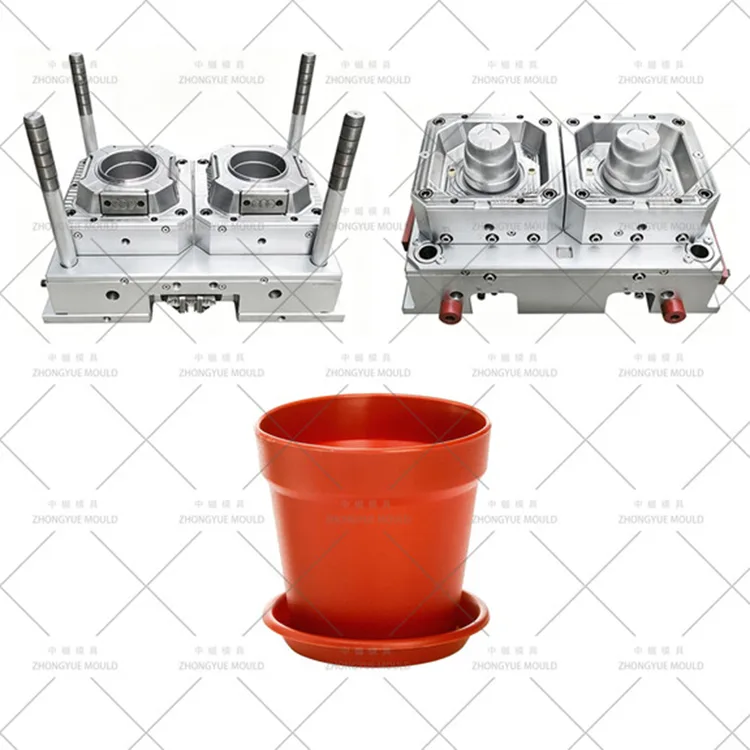
Key Criteria for Mass Production Moulds
Mass production demands more than a functional cavity. The following factors directly affect output per shift and cost per pot.
| Criterion | Why It Matters | Target Benchmark |
|---|---|---|
| Cavitation number | Determines pots per cycle | 4–32 cavities for thin-wall pots |
| Mould steel grade | Controls tool life | P20, 718H, or S136 for 500k–1M+ shots |
| Cooling design | Reduces cycle time | Beryllium copper inserts or conformal channels |
| Runner system | Minimizes scrap | Hot runner for large volumes |
| Ejection mechanism | Prevents rim deformation | Air-assisted or sleeve ejection |
ZHONGYUE typically recommends a hot-runner, multi-cavity Plastic Round Plant Pot Mould with balanced cooling for orders exceeding 200,000 units annually. This configuration reduces cycle time by 15–25% compared with a cold-runner alternative.
Mould Types Compared
| Mould Type | Best For | Cycle Time | Tool Life | Relative Cost |
|---|---|---|---|---|
| 2-plate cold runner | Low volume, prototyping | Longer | Moderate | Low |
| 3-plate cold runner | Medium volume | Moderate | Moderate | Medium |
| Hot runner multi-cavity | High volume mass production | Shortest | Long | High |
| Stack mould | Very high volume | Shortest | Long | Highest |
For most mass production programs, a hot-runner Plastic Round Plant Pot Mould delivers the best balance of speed, waste reduction, and part quality. Stack moulds make sense only when annual demand exceeds several million units and press capacity is constrained.
Design Features That Improve Output
-
Uniform wall thickness: 0.8–1.5 mm keeps cooling even and prevents warping.
-
Tapered draft angle: 1–3° allows clean release without scuffing the pot surface.
-
Reinforced rim geometry: Prevents cracking during ejection and stacking.
-
Interchangeable inserts: Lets one base handle multiple pot diameters.
-
Hardened gate area: Extends service life in abrasive plastic grades.
ZHONGYUE builds each Plastic Round Plant Pot Mould with CNC-machined cavities, EDM-finished details, and a trial run before shipment. Dimensional reports and sample pots accompany every tool.
Plastic Round Plant Pot Mould FAQ
Q: How many cavities should a Plastic Round Plant Pot Mould have for mass production?
A: For mass production, 8 to 32 cavities is typical. The exact number depends on press tonnage, shot weight, and annual demand; a 16-cavity hot-runner tool is a common starting point for medium-to-large nurseries.
Q: What steel is best for a Plastic Round Plant Pot Mould used in high-volume runs?
A: P20 works for moderate volumes, while 718H and S136 are preferred for runs above 500,000 shots. S136 offers superior corrosion resistance when molding recycled or filled plastics.
Q: How long does it take to manufacture a custom Plastic Round Plant Pot Mould?
A: Standard lead time is 25–45 days after design approval. Complex multi-cavity or stack moulds may require 50–70 days, including trial molding and dimensional verification.
Why Partner With ZHONGYUE
ZHONGYUE provides full-service Plastic Round Plant Pot Mould engineering, from DFM analysis and 3D mold flow simulation to steel procurement, machining, assembly, and after-sales support. Every tool is tested on production-grade resin before delivery, and spare parts remain available for the life of the mould.
Contact Us
Request a quotation, share your pot dimensions, or schedule a technical consultation with the ZHONGYUE engineering team today. Send your drawings and annual volume targets, and receive a detailed Plastic Round Plant Pot Mould proposal within 24 hours.