Which PEX-AL-PEX Press Fittings Configurations Are Needed for Complex Pipe Layouts?
2026-11-20
Choosing the right PEX-AL-PEX Press Fittings configurations is an important part of designing a reliable multilayer plumbing system. Straight runs are relatively simple, but real projects often include branches, changes in direction, connections to valves or manifolds, transitions to threaded equipment, and pipe terminations. Each change in the route affects which fitting is required, how much installation space is available, and how easily the system can be tested and maintained.
SUNPLAST supplies U-profile press fittings designed specifically for PEX-AL-PEX multilayer pipe. The range includes couplers, reducing couplers, elbows, tees, threaded connections, wall-plated female elbows and end caps in several nominal diameters. Understanding the role of each configuration helps plumbing contractors, wholesalers and project buyers prepare a more accurate bill of materials and avoid unnecessary joints, adapters or on-site modifications.
How Should a Pipe Layout Be Read Before Selecting Fittings?
Start with the pipe route rather than the fitting catalogue. A complex layout should be broken down into straight sections, direction changes, branch points, size transitions, equipment connections and terminal points. Marking these locations on the drawing makes it easier to identify the fitting function at each point. It also helps the installer consider access for the press tool, pipe support, insulation and future maintenance.
For residential and commercial plumbing, a layout may include hot and cold water distribution, bathroom groups, kitchen branches, plant-room connections and risers between floors. Heating installations can add connections to radiators, manifolds, pumps and control valves. Although the pipe material may remain the same throughout the system, the fitting configuration changes according to the direction of flow and the type of component being connected.
A useful way to review a drawing is to trace the route from the supply point to each outlet. At every junction, ask whether the pipe continues in the same direction, changes direction, branches into another line, changes diameter or connects to a threaded component. This simple review prevents the common mistake of ordering only straight couplers and standard elbows, then discovering that special branch or transition fittings are missing during installation.
Our project review process should also consider installation sequence. A fitting that is technically correct may be difficult to press if it is positioned too close to a wall, ceiling, joist or another pipe. The drawing should show enough clearance for the press tool and its U-profile jaw. Where access is restricted, the route may need to be adjusted before the pipework is installed rather than relying on improvised connections later.
Before finalising quantities, check these layout details:
- Pipe outside diameter and the size of each distribution branch.
- Number and angle of direction changes.
- Locations where a main line divides into two or more branches.
- Connections to valves, pumps, manifolds, taps and other threaded equipment.
- Wall outlet positions and required mounting arrangements.
- Dead ends, capped branches and future extension points.
- Available working space for pressing, inspection and pressure testing.
A well-prepared fitting schedule should identify each item by location, size, configuration and quantity. It is more useful than a general request for a mixed assortment because it allows the supplier to check the selected parts against the pipe sizes and installation plan. Ningbo Sunplast Pipe Co., Ltd. can use this information to help identify the relevant product configurations and discuss the required press tooling.
Which Fitting Configurations Handle Direction Changes and Branches?
Direction changes and branch connections account for many of the fittings used in a complicated pipe route. Selecting the correct geometry helps keep the installation orderly and avoids unnecessary bends in the pipe itself. These are the core planning choices when specifying PEX-AL-PEX Press Fittings for multi-branch layouts. The main configurations in this category are elbows, tees and their reducing versions.
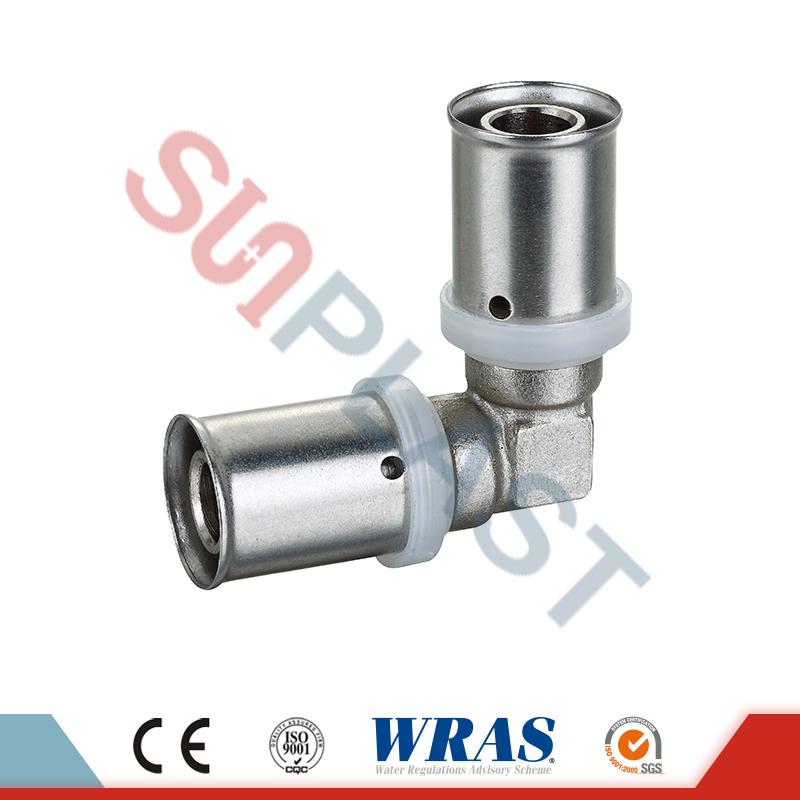
Elbows are used when the pipe route needs to turn. A standard elbow connects two pipe sections while changing the direction of the run. It is useful around corners, at risers, and where pipework must approach a fixture from a different direction. The fitting should be positioned so the press sleeve remains accessible and the connected pipe can be supported without placing excessive bending load on the joint.
Reducing elbows combine a direction change with a change in nominal pipe size. They can be useful where a smaller branch turns away from a larger distribution line or where a compact transition is needed near a fixture. Before specifying one, confirm which end corresponds to each pipe size. Reversing the intended orientation can complicate the installation or require an additional adapter.
Tees create a branch from a continuous pipe run. They are commonly used to feed bathrooms, kitchens, heating circuits or individual appliances from a main line. A standard tee connects three pipe ends of the same nominal size. A reducing tee allows one branch to use a different size from the main run, which can help match the pipe diameter to the expected demand and the system design.
For a branch connection, the fitting should be selected from the hydraulic design rather than by appearance alone. Pipe sizing depends on flow demand, pressure loss, route length, simultaneous use and the requirements of the local plumbing code. A smaller branch may be suitable for an individual outlet, but reducing a pipe simply to make the fitting easier to source can increase pressure loss or restrict the required flow.
| Configuration | Typical layout function | What to confirm before ordering |
| Coupler | Joins two pipe ends in a straight run | Both pipe ends use the same compatible size |
| Reducing coupler | Joins two different pipe diameters | Correct size at each end and flow direction in the drawing |
| Elbow | Changes the direction of a pipe run | Required route, tool access and pipe support |
| Reducing elbow | Changes direction while transitioning between sizes | Orientation and nominal size at both ends |
| Tee | Creates a branch from a main line | Three connection sizes and branch location |
| Reducing tee | Creates a branch with a different pipe diameter | Main-run sizes, branch size and design flow |
Our fitting selection should also account for the physical dimensions of the components around each junction. A tee installed behind a cabinet or inside a service void may leave little room for the press tool. A branch placed too close to another fitting can make the pressing sequence awkward. Reviewing the route in three dimensions, not only as a flat schematic, helps identify these constraints before materials arrive on site.
When several branches are close together, it may be possible to reposition a tee or adjust the route to create better access. This should be done in coordination with the designer because moving a branch can affect pipe length, pressure loss and support requirements. The goal is not to minimise fitting count at any cost, but to create a route that is hydraulically appropriate, practical to install and accessible for inspection.
When Are Threaded and Wall-Plate Configurations Required?
Multilayer pipe systems often need to connect to components that use a threaded inlet or outlet. These transition points are common at valves, pumps, manifolds, taps, mixing assemblies and other plumbing equipment. A threaded fitting provides the interface between the press-connected pipe and the threaded component, reducing the need to assemble several separate adapters.
Male-thread couplers and female-thread couplers are used for straight transitions between the pipe and a threaded connection. The correct choice depends on the thread arrangement of the receiving component. Buyers should confirm the thread standard, nominal size and sealing method rather than assuming that all threaded plumbing connections are interchangeable. BSP and NPT threads, for example, are not automatically compatible even when their nominal sizes appear similar.
Male-thread elbows and female-thread elbows combine a directional change with a threaded interface. They can simplify connections where equipment is mounted at an angle or where the pipe approaches from a side wall or service cavity. Their orientation should be checked on the drawing, especially when the connected valve or fitting has a fixed installation direction.
Wall-plated female elbows are intended for wall outlet arrangements. The wall plate provides a mounting point so the threaded outlet can be secured at a planned position, such as behind a tap or shower mixer. This is particularly useful when the pipework will be concealed and the final outlet needs to remain stable during fixture installation and use.
Threaded transitions deserve careful specification because the connection involves two different joining methods. The pipe side is mechanically pressed, while the threaded side relies on the specified thread form and sealing arrangement. Excessive tightening, incorrect thread engagement or unsupported equipment can place stress on the fitting body. The pipe should not be used as a lever to force a misaligned valve or tap into position.
Our order schedule should record the thread gender, thread size, thread standard and outlet orientation for every transition. It should also identify whether the component is intended for a wall-mounted fixture, an inline valve or equipment installed in a plant room. Where the project specification names a particular thread standard, the purchase order should repeat it clearly.
For example, a bathroom group may require a wall-plated female elbow at the concealed outlet, while a plant-room connection may need a female-thread coupler to join a press-connected pipe to a threaded valve. A pump connection may require a threaded elbow to accommodate the available space. These are different installation tasks, so they should not be grouped under a vague description such as threaded adapter.
Ningbo Sunplast Pipe Co., Ltd. offers male-thread and female-thread couplers, threaded elbows, threaded tees and wall-plated female elbows within its stated configuration range. Buyers should provide drawings or a connection schedule when the orientation or thread interface is not obvious. This reduces the risk of ordering a fitting that has the correct pipe diameter but the wrong threaded end.
How Should Sizes, Materials and Pressing Requirements Be Specified?
Once the layout functions are identified, the next step is to specify the physical and technical details of each fitting. SUNPLAST U-profile press fittings are designed for PEX-AL-PEX multilayer pipe and are available in 16 mm, 20 mm, 25 mm, 26 mm and 32 mm sizes. The range includes straight, reducing, angled, branch and threaded configurations, as well as end caps. A fitting schedule should connect each item to the exact pipe diameter and connection purpose.
| Product parameter | SUNPLAST product information | Specification note |
| Pipe compatibility | PEX-AL-PEX multilayer pipe | Not designed for ordinary single-layer PEX pipe |
| Press profile | U-profile | Use compatible U-profile jaws and the specified press tool |
| Available sizes | 16 mm, 20 mm, 25 mm, 26 mm and 32 mm | Match the actual pipe outside diameter |
| Body material options | 58-2 brass, DZR brass or lead-free brass | Confirm the selected alloy and applicable documentation |
| Press sleeve | Stainless steel | Designed for permanent deformation during pressing |
| Sealing elements | Double EPDM O-rings | Check compatibility with the operating medium and temperature |
| Insulating components | Included in the fitting assembly | Confirm construction details for the selected model |
| Surface finish | Natural brass or nickel-plated | Select according to project specification |
| Standard reference | Compatibility stated for pipe made to ASTM F1281 | Verify the pipe standard and project approval requirements |
Material choice should reflect the application. 58-2 brass is one of the offered body materials. DZR brass may be considered where resistance to dezincification is important, while lead-free brass is relevant where project or regulatory requirements restrict lead content. The actual alloy composition and approval status should be confirmed for the selected item and destination market. A material description alone is not a substitute for a declaration or certificate where one is required.
The double EPDM O-ring arrangement provides the sealing interface, while the stainless steel sleeve is permanently compressed using the designated press tool. The tool must have the correct U-profile jaw for the fitting system. A different press profile should not be substituted merely because it can be closed around the sleeve. Incorrect tooling can create an incomplete or unsuitable deformation and compromise the joint.
Before ordering PEX-AL-PEX Press Fittings, check the following details against the pipe layout:
- Exact fitting configuration and quantity at each location.
- Nominal pipe diameter at every end of a reducing fitting.
- Male or female thread, thread size and thread standard.
- Required finish, natural brass or nickel-plated.
- Preferred brass option and any required material documentation.
- Compatibility with the pipe specification and dimensional tolerances.
- Availability of the correct U-profile press tool and jaws.
- Installation instructions, inspection requirements and system test procedure.
ASTM F1281 relates to PEX-AL-PEX pressure pipe and includes connector-related provisions. It is important to distinguish pipe conformity from product-specific approvals for a fitting. Where a project requires a particular certification or local listing, request evidence covering the actual fitting and intended application instead of assuming that a reference to the pipe standard establishes every approval.
Our technical review is most effective when the buyer supplies a pipe schedule, drawings, operating conditions and the required connection standards. This allows the fitting selection to be checked as a system rather than as a list of unrelated catalogue items. It also gives the supplier a chance to identify missing transitions, incorrect thread assumptions or sizes that do not correspond to the specified pipe.
What Should Buyers Check Before Finalising a Complex Fitting Schedule?
A final review should confirm that every change in the pipe route has a corresponding connection detail. Start at the source and follow each branch to its terminal point. Count straight joints, direction changes, tees, reductions, threaded transitions and capped ends. Compare the schedule with the drawing and check that the fitting quantities include the actual installation arrangement, not just the idealised route.
Pay particular attention to concealed connections. Wall outlets, service risers and pipework behind fixtures may be difficult to access after completion. The fitting type, orientation and pressing clearance should be resolved before the wall or ceiling is closed. Where possible, avoid placing joints in inaccessible locations unless the design and local code permit them.
Installation planning should include the following practical checks:
- Confirm that the selected fitting is intended for PEX-AL-PEX pipe.
- Check all nominal sizes against the pipe manufacturer's dimensional data.
- Verify every reducing connection and threaded interface.
- Allow sufficient room to position and operate the U-profile press tool.
- Provide suitable pipe support near fittings and equipment connections.
- Keep O-rings and fitting bores clean during storage and installation.
- Prepare pipe ends and complete pressing according to the manufacturer's instructions.
- Pressure-test the installed system before concealing pipework.
End caps are useful where a compatible pipe connection needs to be closed, including a planned termination or a branch reserved for a future extension. They should not be treated as a substitute for an isolation valve where the design requires controlled access or shut-off. The designer should determine whether a permanent cap, removable threaded plug or valve arrangement is appropriate for the specific point.
Our factory can discuss the available fitting configurations, dimensions, brass options, finishes and dedicated press tools based on the project requirement. For larger orders, it is sensible to agree on the product codes and sample configuration before mass procurement. A confirmed schedule helps the contractor receive the right parts in a usable sequence and reduces the likelihood of last-minute substitutions.
In complex plumbing work, the best fitting schedule is not necessarily the one with the greatest number of specialised components. It is the schedule that provides the required route, flow distribution and equipment interfaces with a practical installation sequence. Ningbo Sunplast Pipe Co., Ltd. can support product selection when buyers provide the pipe sizes, connection drawings and project requirements. Contact SUNPLAST to review your layout, confirm suitable configurations and request a quotation for the required fittings and U-profile press tools.
Frequently Asked Questions
Which fitting should be used when a PEX-AL-PEX pipe run needs both a direction change and a diameter reduction?
A reducing elbow is the configuration intended to combine a change in direction with a transition between two nominal pipe sizes. Before ordering, confirm the diameter at each end and check the orientation shown on the drawing. The pipe sizes must match the fitting specification, and the selected connection should be suitable for the system's flow demand and installation space.
When should a wall-plated female elbow be specified instead of a standard female-thread elbow?
A wall-plated female elbow is generally selected for a fixed wall outlet, such as a concealed connection behind a tap or shower mixer. Its mounting plate provides a means of securing the outlet at the planned position. A standard female-thread elbow provides a threaded directional transition but does not necessarily provide the same wall-mounting arrangement. The choice depends on fixture layout, support requirements and the required outlet position.
Can a U-profile press fitting connect PEX-AL-PEX pipes from different manufacturers?
Compatibility should be confirmed against the pipe construction, standard, outside diameter and dimensional tolerances. SUNPLAST states compatibility with PEX-AL-PEX multilayer pipes manufactured to ASTM F1281, but buyers should still verify the actual pipe specification and fitting dimensions before installation. The correct U-profile press jaw and installation procedure must also be used to produce the intended mechanical connection.