When Should You Choose Double Row Full Complement Cylindrical Roller Bearings for Heavy Load Applications
2026-10-26
Heavy machinery rarely fails gradually—it fails when a bearing can no longer carry the load. Double Row Full Complement Cylindrical Roller Bearings from BMT are engineered for exactly those moments: maximum roller count, two rows of load-sharing capacity, and a structure built to withstand radial forces that standard bearings simply cannot handle. This guide explains, from an engineering standpoint, when these bearings are the correct specification choice—and when they are not.
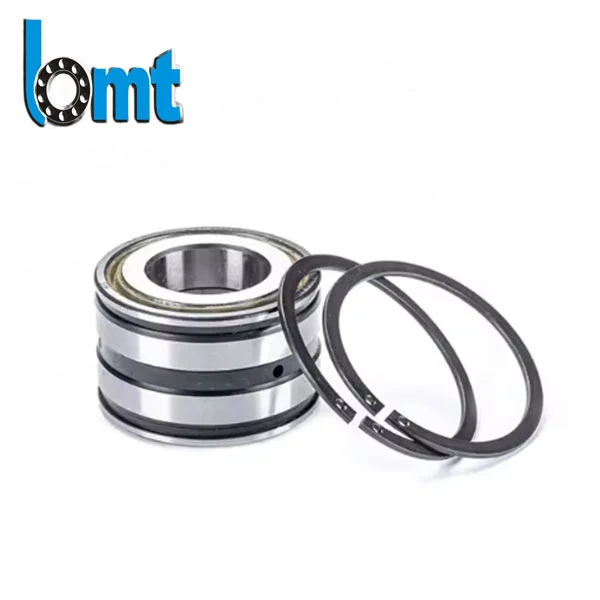
What Makes Double Row Full Complement Cylindrical Roller Bearings Different
A full complement design removes the cage and fills the available space with the maximum number of rollers. Doubling the rows multiplies radial load capacity while maintaining a relatively compact radial envelope. The trade-off is speed: more rollers mean more friction, so lubrication and thermal management become critical selection factors.
| Design Feature | Standard Caged Bearing | Double Row Full Complement Cylindrical Roller Bearing |
|---|---|---|
| Roller quantity | Limited by cage | Maximum possible |
| Radial load capacity | Moderate | Very high |
| Speed capability | High | Moderate to low |
| Rigidity | Standard | High |
| Axial location | Depends on configuration | Requires paired or locating arrangement |
Selection Criteria: When to Specify Them
Use the following checklist as a specification gate. If most boxes are ticked, the Double Row Full Complement Cylindrical Roller Bearings are likely the right answer.
-
Radial load dominates. The application carries sustained radial loads beyond the capacity of caged bearings of the same envelope.
-
Shock and impact loads exist. Crushers, mill drives, and rolling equipment impose peak loads that demand roller-to-roller load sharing.
-
Radial space is constrained. You need high capacity without increasing shaft diameter or housing size.
-
Stiffness matters. Machine accuracy or gear mesh integrity depends on minimal shaft deflection.
-
Speed is moderate. Operating speeds stay within the thermal limits defined by the lubrication regime.
-
Axial displacement is managed. The bearing arrangement (locating plus non-locating positions) is designed to accommodate thermal expansion.
When They Are Not the Right Choice
Engineering credibility requires stating limits. Avoid full complement double row designs where:
-
High-speed continuous operation is the primary duty—caged bearings dissipate heat more effectively.
-
Axial loads are significant—cylindrical roller bearings do not carry substantial thrust on their own.
-
Misalignment is expected—these bearings tolerate very little angular error; spherical roller bearings are preferable.
-
Contamination is uncontrolled—full complement bearings are less forgiving of debris ingress and require robust sealing.
Application Fit by Industry
| Industry | Typical Duty | Suitability |
|---|---|---|
| Mining and aggregate | Crusher eccentric shafts, conveyor drives | High |
| Steel processing | Mill stands, roll necks | High |
| Wind energy | Gearbox low-speed stages | High |
| Heavy gearboxes | Industrial reduction units | High |
| High-speed spindles | Machine tool main spindles | Low |
Specification and Verification
Confirm bore and outer diameter limits, dynamic and static load ratings, lubrication method (oil or grease), operating temperature range, and mounting tolerances before ordering. BMT provides dimensional drawings and load calculations to verify the selection against actual duty cycles rather than catalogue averages.
FAQ: Double Row Full Complement Cylindrical Roller Bearings
Q: What is the maximum radial load a Double Row Full Complement Cylindrical Roller Bearing can carry?
A: Capacity depends on bore size, roller count, and material, but these bearings typically achieve 20–40% higher dynamic radial ratings than caged equivalents of the same envelope, with static ratings rising further—always verify against the specific BMT datasheet for your size.
Q: Can Double Row Full Complement Cylindrical Roller Bearings operate at high speeds?
A: They are suited to moderate speeds; the absence of a cage increases roller-to-roller friction and heat generation, so permissible speed is governed by lubrication and cooling—oil circulation or forced lubrication extends the limit considerably.
Q: Do these bearings require special mounting or alignment procedures?
A: Yes—they demand precise shaft and housing alignment, typically with press-fit or controlled interference mounting, and the bearing arrangement must include a locating position to manage axial displacement; misalignment beyond a few arcminutes accelerates edge loading and shortens service life.
Conclusion
Choose Double Row Full Complement Cylindrical Roller Bearings when radial capacity, rigidity, and shock resistance outweigh speed considerations. For applications that meet these criteria, BMT delivers verified load ratings, application engineering support, and reliable delivery. Contact us today to discuss your duty cycle and receive a specification recommendation from our engineering team.