

What Tools Are Required to Manufacture a Swaged Hose Fitting
2026-03-10
Manufacturing a reliable Swaged Hose Fitting requires precision, experience, and the correct industrial equipment. Unlike reusable fittings, swaged fittings are permanently attached through a radial compression process that demands specialized machinery. At Xindu Hydraulic, we utilize advanced manufacturing protocols to ensure every component meets international safety standards. Below, we break down the essential tools required to produce a high-integrity Swaged Hose Fitting.
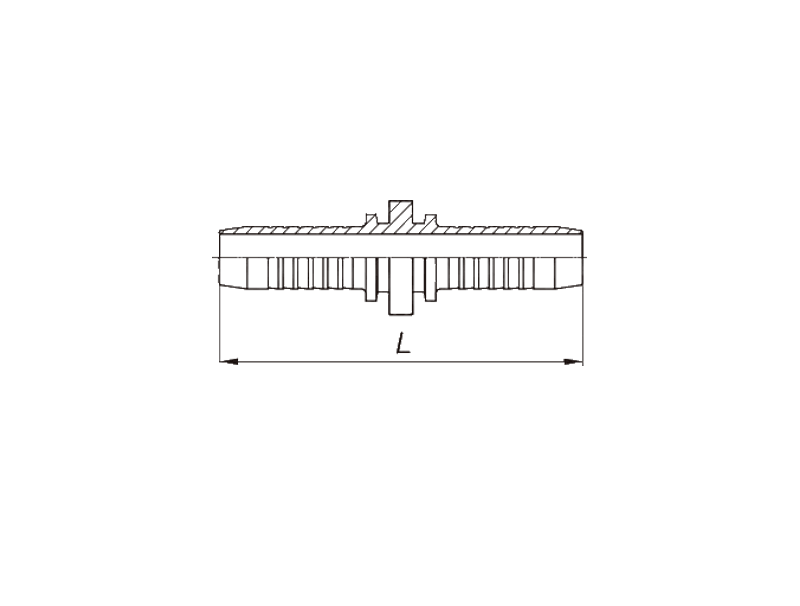
Essential Machinery for Swaging
The core of production lies in the swaging machine itself. Depending on the hose diameter and material, manufacturers use different types of equipment. The table below outlines the primary machinery categories:
| Equipment Type | Application | Typical Operation |
|---|---|---|
| Rotary Swaging Machine | Used for large-diameter hoses and heavy industrial applications | Hammering dies rotate around the fitting to compress it evenly |
| Bench Crimper | Common for small to medium hose assemblies in workshops | Hydraulic or manual press with interchangeable die sets |
| Die Sets | Customized for specific fitting profiles and sizes | Precision-machined tooling that shapes the fitting shell |
Critical Support Tools and Measurement Devices
Beyond the primary swaging unit, a professional setup requires precision measurement tools to guarantee that the finished Swaged Hose Fitting meets performance specifications.
-
Vernier Calipers: To measure the crimp diameter after swaging, ensuring the compression falls within engineering tolerances.
-
Go/No-Go Gauges: Used to verify the internal diameter of the fitting after swaging to prevent hose restriction.
-
Hydraulic Power Units: For production lines requiring consistent, high-pressure output for the swaging machine.
-
Cut-Off Saws and Skivers: Essential for preparing the hose end, removing the outer cover to expose the wire reinforcement for better grip.
The Role of Quality Control
At Xindu Hydraulic, we emphasize that tools alone are insufficient without rigorous inspection. After the swaging process, assemblies are often tested with proof-testing equipment to validate the connection. A quality Swaged Hose Fitting must withstand pressures that often exceed the hose's own rating.
Frequently Asked Questions
What is the most important tool for a Swaged Hose Fitting?
The die set is arguably the most critical component. Dies must be precisely matched to the specific Swaged Hose Fitting profile. Even the best swaging machine will produce defective assemblies if the dies are worn or incorrectly sized. Regular inspection and certification of die condition are standard practice at Xindu Hydraulic.
Can I manufacture Swaged Hose Fittings without a hydraulic machine?
While small, manually operated swaging tools exist for field repairs, they are not suitable for manufacturing. Industrial production requires the consistent, high compression force provided by hydraulic swaging machines to ensure the Swaged Hose Fitting does not blow off under surge pressures. Manual tools cannot guarantee the uniformity required for safety.
How do I know which tooling is right for my hose and fitting?
Tooling selection is determined by the hose diameter, the fitting series, and the material of the fitting shell. Manufacturers provide specification charts that match part numbers to specific die part numbers. Xindu Hydraulic provides detailed technical documentation for every Swaged Hose Fitting to ensure you select the correct tooling for a leak-proof assembly.
Partner with Xindu Hydraulic
Selecting the right tools and components is vital for operational safety and efficiency. Whether you require standard components or custom-engineered solutions, our team is ready to support your projects.
Contact Us today to discuss your requirements or request a detailed catalog of our Swaged Hose Fitting range.
