What Should You Consider When Designing a Plastic Air Conditioner Panel Mould for Injection Molding
2026-11-11
Designing a Plastic Air Conditioner Panel Mould is a complex engineering task that directly affects part quality, production efficiency, and long-term tooling cost. Whether you are developing a new appliance platform or replacing an aging tool, the decisions made during the design phase determine how well the mould performs over hundreds of thousands of cycles. At Zhongyue, we have supported appliance manufacturers through every stage of mould development, and the following guide reflects the practical factors our engineers evaluate on each project.
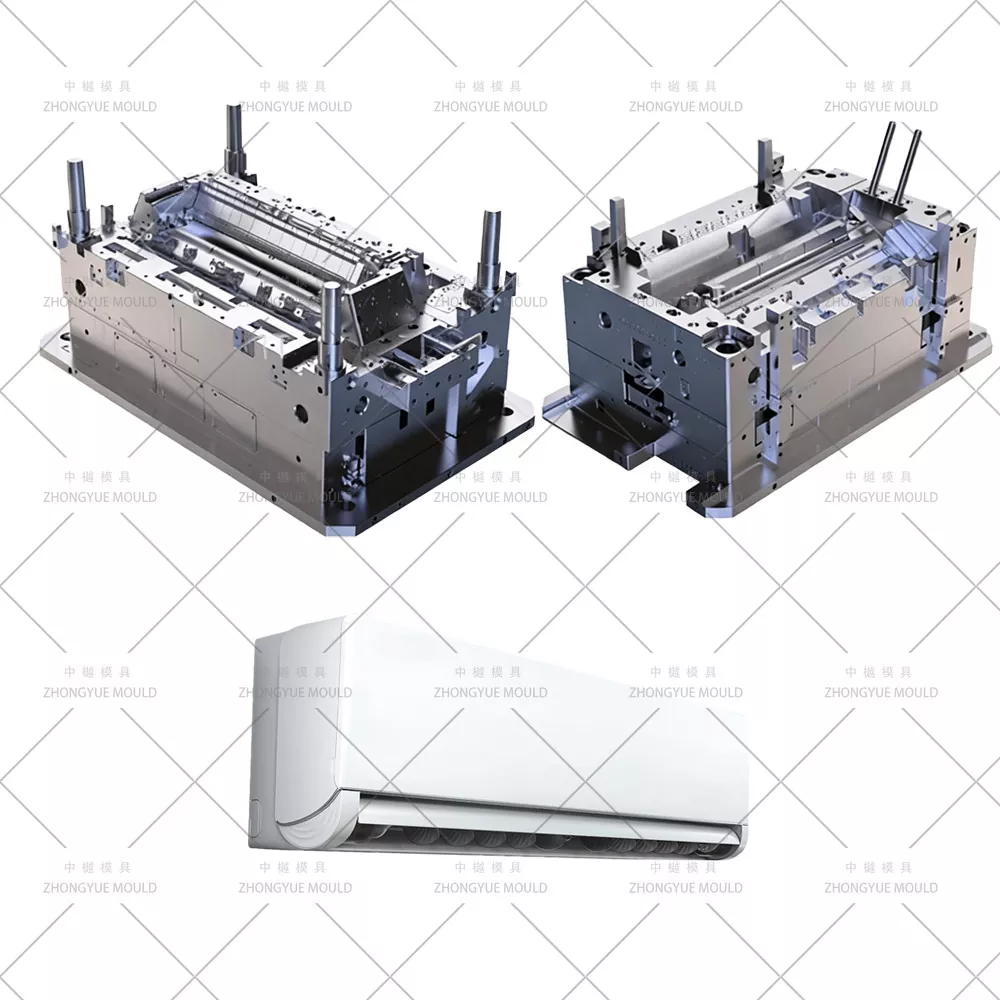
1. Part Design and Wall Thickness
Air conditioner panels are large, visible cosmetic parts. Uniform wall thickness prevents sink marks, warpage, and internal stress. Ribs and bosses should be designed with proper draft and thickness ratios, typically 50–60% of the nominal wall.
| Design Element | Recommended Practice | Risk If Ignored |
|---|---|---|
| Wall thickness | 2.0–3.0 mm, uniform | Sink marks, warpage |
| Draft angle | 1–2° minimum on vertical walls | Scratches, ejection damage |
| Rib thickness | 50–60% of wall | Sink marks on visible surface |
| Corner radii | Generous fillets | Stress concentration, cracking |
2. Material Selection
The Plastic Air Conditioner Panel Mould must be matched to the resin. Common choices include ABS, HIPS, and PC/ABS blends. ABS offers good flow and surface finish; PC/ABS provides better heat resistance and impact strength. Material shrinkage rates vary significantly and must be factored into cavity dimensions.
3. Gating and Runner System
For large panels, gate location controls weld line position, flow length, and packing efficiency. A hot runner system is often preferred for high-volume production, while a cold runner with a fan gate may suit lower volumes. Zhongyue engineers use mould flow analysis to validate gate placement before steel is cut.
4. Cooling System Design
Cooling channels should follow the part contour at a uniform distance, typically 10–15 mm from the cavity surface. Baffles and bubblers may be required in core areas. Effective cooling can reduce cycle time by 20–30%.
5. Ejection and Demoulding
Large panels require balanced ejection to avoid distortion. Ejector pins, sleeves, and air poppets should be positioned on non-cosmetic surfaces. Sufficient ejection stroke and reliable return mechanisms are essential.
6. Steel Selection and Surface Finish
| Production Volume | Recommended Steel | Surface Finish |
|---|---|---|
| < 100,000 shots | P20 / 718H | SPI B-1 |
| 100,000–500,000 shots | 718H / S136 | SPI A-2 |
| > 500,000 shots | S136 / H13 | SPI A-1 |
7. Tolerance and Venting
Aerodynamic and assembly interfaces demand tight tolerances, often ±0.1 mm. Proper venting at the parting line and ejector pins prevents burn marks and short shots.
FAQ
Q: How long does it take to design and manufacture a Plastic Air Conditioner Panel Mould?
A: A typical Plastic Air Conditioner Panel Mould requires 4–8 weeks for design, mould flow analysis, steel procurement, machining, and trial runs. Complex tools with hot runners or multi-cavity layouts may take 10–12 weeks. Zhongyue provides a detailed project schedule at the quotation stage.
Q: What is the typical lifespan of a Plastic Air Conditioner Panel Mould?
A: Lifespan depends on steel grade, maintenance, and production conditions. A P20 tool may last 100,000–300,000 shots, while S136 or H13 tools can exceed 500,000–1,000,000 shots with proper care. Regular polishing and cooling channel cleaning extend service life significantly.
Q: Can you customize a Plastic Air Conditioner Panel Mould for different AC models?
A: Yes. Zhongyue designs and builds custom Plastic Air Conditioner Panel Mould solutions for split, window, and cabinet air conditioners. We support reverse engineering, 3D part optimization, and rapid prototyping before committing to production tooling.
Contact Us
Ready to discuss your next appliance tooling project? Contact Zhongyue today for a technical review, mould flow analysis, and a competitive quotation on your Plastic Air Conditioner Panel Mould. Our engineering team will respond within 24 hours with a tailored solution.