What material and surface finish options are available for DIN 7967 Self-Locking Pal Nut
2026-11-26
DIN 7967 Self-Locking Pal Nut manufactured by Zhenhua is a stamped all-metal counter nut that relies on internal spring teeth to grip bolt threads and resist loosening under vibration. It is widely used for agricultural machinery, automotive assemblies, hydraulic fittings and general industrial equipment. The base material directly defines its spring locking performance, while surface finishes add corrosion protection for different working environments.
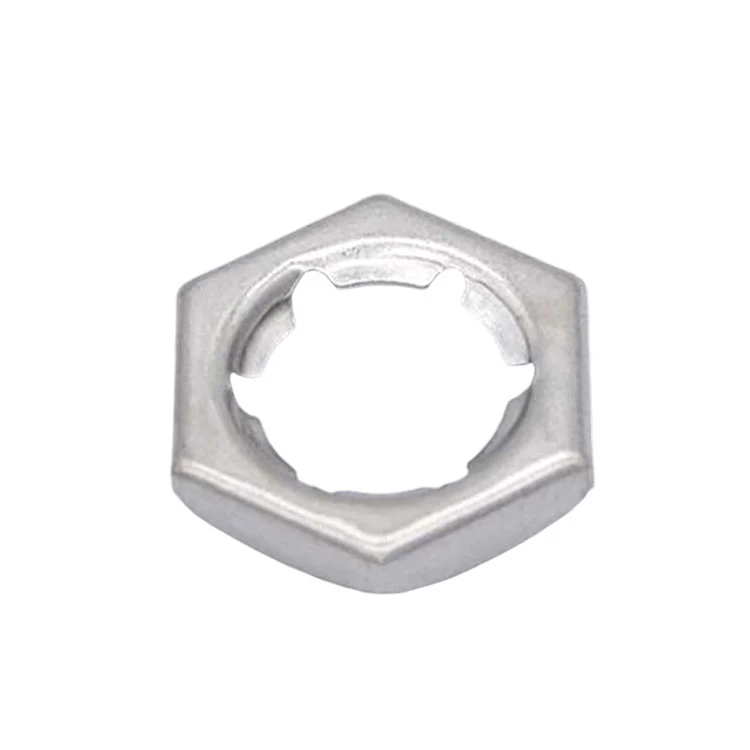
Material & Finish Selection Table
| Base Material | Common Grade | Typical Surface Finishes | Primary Application |
|---|---|---|---|
| Spring Steel | 65Mn / C67S | Zinc plating, black oxide, Dacromet | Standard vibration locking, most indoor machinery |
| Stainless Steel A2 | 304 | Plain / passivated, electropolished | Mildly corrosive, wet environments, food equipment |
| Stainless Steel A4 | 316 | Plain / passivated | Salt spray, coastal, chemical exposure |
| Carbon Steel | C45 | Zinc plating, hot-dip galvanizing | Low-vibration, heavy structural assemblies |
Material and Finish Specification Checklist
- Confirm spring steel hardness; insufficient hardness will weaken the self-locking tooth grip
- Match coating thickness to the thread pitch; thick HDG may interfere with thread fit
- Select Cr3 trivalent zinc plating if RoHS compliance is required
- Avoid high-temperature coatings on thin spring steel that risk temper loss
- Verify salt spray test hours for outdoor or coastal projects
- Check dimensional tolerance after plating, as coatings add measurable thickness
FAQ for DIN 7967 Self-Locking Pal Nut
Q1: Why is spring steel 65Mn the most common material for DIN 7967 Self-Locking Pal Nut? A1: The locking function depends on elastic deformation of the internal teeth. 65Mn spring steel delivers the ideal balance of hardness and springback after stamping and heat treatment. It maintains consistent prevailing torque after repeated assembly cycles. Zhenhua uses precision-tempered 65Mn for standard stock, which is the preferred grade for vibration-prone machinery. Carbon steel versions are cheaper but lack the reliable spring recovery needed for anti-loosening.
Q2: Can I get the same locking performance from stainless steel DIN 7967 Self-Locking Pal Nut? A2: Stainless A2 and A4 grades offer far better rust resistance, but they have lower spring elasticity compared to 65Mn. Stainless pal nuts are suitable for static or low-vibration corrosion environments, but they are not the first choice for heavy cyclic vibration. If corrosion and strong anti-loosening are both required, Dacromet-coated spring steel is usually a better compromise solution.
Q3: What is the difference between zinc plating, black oxide and Dacromet for DIN 7967 Self-Locking Pal Nut? A3: Black oxide is only a cosmetic finish with almost no corrosion protection, used for dry, indoor assemblies. Ordinary zinc plating (Cr3) provides basic rust protection and is cost-effective for most general applications. Dacromet offers superior salt spray resistance without hydrogen embrittlement risk, which is critical for spring steel fasteners. Hot-dip galvanizing provides excellent corrosion protection but is generally limited to coarser threads because of the thick zinc layer.
Additional Practical Notes
Material and coating choice is a trade-off between locking torque, corrosion resistance and cost. Changing the finish will not fix a poor material selection. Stainless steel pal nuts should not be substituted blindly for spring steel pal nuts in high-vibration designs, as the anti-loosening effect will degrade.
If you need salt spray test reports, material certificates or bulk pricing for DIN 7967 Self-Locking Pal Nut, share your vibration level and exposure environment with our fastener engineering team. Zhenhua supplies spring steel and stainless pal nuts with a full range of compliant surface treatments. Contact us today to get matched fastener solutions.