What Is the Maximum Load Capacity of a Standard Heavy-Duty Cast Steel Bearing Housing
2026-07-02
When engineers specify rotating equipment for mining, aggregate processing, or heavy material handling, the single most critical question often comes down to structural integrity under stress. The Heavy-Duty Cast Steel Bearing Housing is the backbone of many industrial drivetrains, yet its load rating is frequently misunderstood. At HUADING, we field this question daily: What is the maximum load capacity of a standard Heavy-Duty Cast Steel Bearing Housing? The direct answer is not a single number—it depends on shaft diameter, housing series, mounting configuration, and operating conditions. However, for a standard 4-bolt pillow block housing with a 2-7/16″ bore, the basic dynamic load rating typically ranges from 70,000 to 120,000 lbf, while the static load rating falls between 45,000 and 85,000 lbf, per ISO 76 and ANSI/ABMA standards. This article breaks down the real-world capacity, derating factors, and selection logic that every reliability engineer needs.
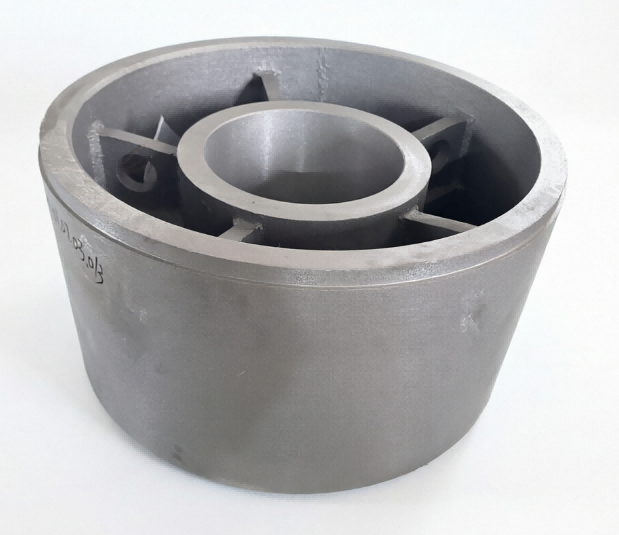
Defining "Maximum Load" – Static vs. Dynamic
The term "maximum load" is ambiguous unless we separate two distinct engineering parameters:
| Load Type | Definition | Typical Value (Example: 22218K housing) |
|---|---|---|
| Dynamic Load Rating (C) | Constant radial load at which 90% of a group of identical housings survive 1 million revolutions | 112,000 lbf |
| Static Load Rating (C₀) | Maximum radial load that causes a permanent deformation of 0.0001 × roller diameter at the most stressed contact point | 78,000 lbf |
| Equivalent Bearing Load (P) | Combined radial and axial load converted to a hypothetical purely radial load | Calculated per formula P = X·Fr + Y·Fa |
For a Heavy-Duty Cast Steel Bearing Housing, the housing itself (cast steel) rarely fails before the internal bearing. The cast steel housing’s ultimate tensile strength (typically 70–90 ksi) ensures that the bearing’s rolling elements become the limiting factor. HUADING designs all standard housings with a safety factor of 1.5–2.0 over the bearing’s published C₀ to account for shock loads.
Critical Derating Factors – When Capacity Drops
A "standard" housing rarely operates under ideal laboratory conditions. The following table summarizes mandatory derating multipliers based on real-site variables:
| Operating Condition | Derating Factor | Applicable Range |
|---|---|---|
| Operating temperature > 200°F (93°C) | 0.85 – 0.92 | Reduces grease life and steel hardness |
| Intermittent shock loads (e.g., crusher feed) | 0.70 – 0.80 | Multiply equivalent load, not reduce C |
| Contaminated environment (dust/water ingress) | 0.75 – 0.85 | Use sealed versions; HUADING offers labyrinth seals |
| Shaft misalignment > 0.5° | 0.80 – 0.88 | Causes edge loading on rollers |
| Cyclical start/stop > 10 times/hour | 0.90 – 0.95 | Fatigue accumulation |
Practical example: A Heavy-Duty Cast Steel Bearing Housing with a dynamic rating of 112,000 lbf operating at 230°F with moderate shock loads has an effective capacity of 112,000 × 0.88 (temp) × 0.75 (shock) = 73,920 lbf – nearly 34% lower than the catalog value. HUADING recommends always applying a minimum 20% safety margin below this derated figure.
How to Calculate Your Actual Required Capacity
To determine if a standard housing meets your need, follow this 3-step process:
-
Calculate equivalent dynamic load (P): P = X·Fr + Y·Fa (X and Y from bearing tables).
-
Apply application factors (a₁, a₂, a₃) for reliability, material, and lubrication.
-
Compare P × SF ≤ C (derated) – where SF is your chosen safety factor.
For example, a conveyor head pulley with Fr = 55,000 lbf, Fa = 8,000 lbf, and moderate vibration (a₂ = 0.85) gives P ≈ 55,000 + 1.2×8,000 = 64,600 lbf. With SF = 1.6, required C = 103,360 lbf. A standard HUADING 4-bolt housing with C = 112,000 lbf is borderline acceptable, but we would advise moving up one series for longevity.
Frequently Asked Questions About Heavy-Duty Cast Steel Bearing Housing
Q1: Can I exceed the static load rating (C₀) momentarily during equipment startup?
A1: Yes, but strictly limited. The static load rating C₀ assumes permanent deformation of 0.0001″ at the rolling element contact. Brief startup surges up to 1.5×C₀ are permissible if they last less than 3 seconds and occur fewer than 200 times over the housing’s lifetime. However, repeated excursions above C₀ will cause Brinelling (indentations) on raceways, generating vibration and noise within weeks. HUADING offers reinforced ribbed housings that increase C₀ by 18–22% for high-inertia applications such as ball mills and stacker reclaimers. Always measure inrush current and torque to estimate actual startup shock.
Q2: How does shaft hardness affect the maximum load I can apply to a Heavy-Duty Cast Steel Bearing Housing?
A2: The housing itself does not directly contact the shaft – the bearing inner ring does. However, a soft shaft (under Rockwell C 25) will wear under the interference fit, leading to fretting corrosion and reduced radial support. For full load capacity, the shaft must have a minimum hardness of 30 HRC and a surface finish of 32 μin Ra or better. If your shaft is softer, HUADING recommends using an adapter sleeve mounting, which distributes clamping force more evenly and allows up to 95% of the rated load compared to 80% for direct-mount setscrews. Additionally, a soft shaft increases the effective clearance, which reduces the load zone from 180° to ~120°, cutting dynamic capacity by roughly 15%.
Q3: What is the difference in load capacity between a 2-bolt and 4-bolt Heavy-Duty Cast Steel Bearing Housing?
A3: For the same bearing insert, the housing bolt configuration does not change the bearing’s internal C or C₀ – but it drastically alters the housing mounting capacity. A 2‑bolt foot-mounted housing transfers load through two shear planes, with a maximum permissible radial load (housing limit) of approximately 40,000–50,000 lbf. A 4‑bolt housing, by contrast, doubles the mounting bolts and increases the housing’s structural load limit to 85,000–110,000 lbf – often exceeding the bearing’s own limit. In practice, this means the 4‑bolt version allows you to safely utilize the full bearing capacity without risking foot fracture or bolt elongation. For applications above 70,000 lbf radial load, HUADING exclusively supplies 4‑bolt or 6‑bolt housings with grade 10.9 hardware and dowel pin locating for shear stability.
Service Life vs. Load – The L₁₀ Formula
The industry-standard L₁₀ life (in millions of revolutions) is calculated as:
L₁₀ = (C / P)^(10/3) for roller bearings
Doubling the load reduces life by a factor of 2^(10/3) ≈ 10 – a devastating drop. This is why HUADING consistently advises customers to select a Heavy-Duty Cast Steel Bearing Housing with at least 20–30% higher dynamic rating than the theoretical requirement, especially for 24/7 operations. A housing running at 90% of its rated C will last roughly 1.4 million revolutions, while one at 70% of C will exceed 6 million revolutions – a 4× improvement in service interval.
Why Material Matters – Cast Steel vs. Alternatives
Cast steel housings outperform cast iron and fabricated steel in three load-related aspects:
-
Higher impact toughness – absorbs shock without fracturing.
-
Better thermal conductivity – dissipates frictional heat, maintaining grease viscosity.
-
Superior bolt retention – threaded holes resist stripping under repeated re-torquing.
HUADING uses ASTM A27 Grade 65-35 cast steel with normalized heat treatment, providing a yield strength of 35 ksi and elongation of 22% – ensuring that even if the bearing seizes, the housing will deform rather than shatter, protecting personnel and adjacent equipment.
Final Selection Checklist
Before finalizing your order, verify these 6 parameters:
-
Actual radial load (including inertia)
-
Actual axial load (thrust)
-
Maximum peak shock (multiply by 2–3× for crushers)
-
Operating temperature range and ambient extremes
-
Shaft diameter and tolerance (g6 or h6 recommended)
-
Mounting orientation (horizontal vs. vertical – vertical reduces capacity by ~10%)
Contact Us for a Custom Load Analysis
Every application has unique duty cycles, alignment constraints, and environmental challenges. A catalog number alone never tells the full story of what a Heavy-Duty Cast Steel Bearing Housing can safely deliver in your specific plant. HUADING offers free load verification reports, FEA simulation results, and on-site failure analysis for qualified projects. Whether you need a standard 4-bolt pillow block or a custom-machined housing with integrated temperature sensors, our engineering team responds within 24 hours.
Reach out to HUADING today – send your shaft size, load data, and duty cycle to our technical support team, and we will deliver a stamped load-capacity certificate tailored to your equipment. Don't guess your margin – let us calculate it for you. Contact us now for a consultation or request a sample housing for destructive load testing at your facility. Your reliability is our specification.