

What Factors Determine the Coupling Efficiency of a Detachable Laser Module with Multi-Mode Fiber
2026-04-03
Achieving optimal performance in fiber optic systems begins with understanding coupling efficiency. For a Multi-mode Fiber Detachable Laser Module, coupling efficiency determines how much laser power successfully enters the fiber core. Wavespectrum engineers this module to maximize signal integrity while minimizing insertion loss. Several physical, mechanical, and environmental factors directly influence this critical parameter.
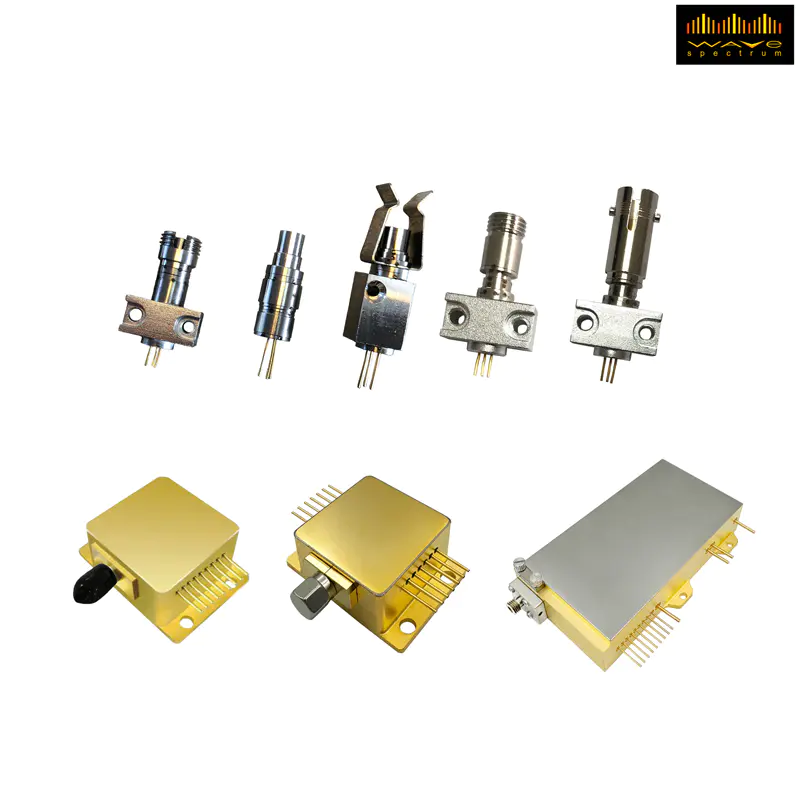
Core Factors Affecting Coupling Efficiency
| Factor | Impact on Coupling Efficiency | Typical Optimization by Wavespectrum |
|---|---|---|
| Laser beam quality (M² factor) | Lower M² enables tighter focusing into fiber core | Single-mode-like beam shaping in Multi-mode Fiber Detachable Laser Module |
| Fiber core diameter and numerical aperture (NA) | Larger core and higher NA capture more divergent light | Precision alignment of NA-matched components |
| Lateral misalignment | 1 µm offset can reduce efficiency by 10-15% | Active alignment with sub-micron positioning |
| Angular mismatch | Tilt above 0.5° causes significant loss | Kinematic mounts with angular stability |
| Longitudinal (z-axis) offset | Defocusing enlarges spot size beyond core | Factory-set optimal working distance |
| Surface contamination | Dust or oil causes scattering and absorption | Anti-static, cleanroom assembled interfaces |
Practical Mechanisms Behind Efficiency Control
Wavespectrum implements three proprietary methods within its Multi-mode Fiber Detachable Laser Module: real-time power feedback alignment, anti-reflection coated optical interfaces, and thermal drift compensation. These ensure coupling efficiency consistently exceeds 85% for 50/125 µm multi-mode fibers across the operating temperature range.
Multi-mode Fiber Detachable Laser Module FAQ
Question 1: How does fiber core diameter affect coupling efficiency in a Multi-mode Fiber Detachable Laser Module?
Answer: Larger core diameters, such as 62.5 µm or 100 µm, capture more divergent laser light and tolerate greater misalignment than 50 µm cores. However, Wavespectrum recommends matching the module’s output NA to the fiber’s NA. For a 50 µm core with 0.22 NA, efficiency peaks when the laser’s divergence angle stays within ±12.7 degrees. Exceeding this angle directs light into the cladding, causing immediate loss. The Multi-mode Fiber Detachable Laser Module from Wavespectrum includes an integrated beam conditioner that shapes divergence to fit the target fiber, improving efficiency by up to 18% compared to non-conditioned designs.
Question 2: What is the role of connector cleanliness in maintaining high coupling efficiency?
Answer: Contamination is the most underestimated loss factor. A single 10 µm dust particle on the ferrule end-face can scatter up to 5% of coupled power. Oily residues absorb near-infrared wavelengths, converting light to heat and potentially damaging the connector interface. Wavespectrum recommends inspecting both the module’s output port and fiber connector with a 200x or higher magnification scope before every critical connection. Cleaning with dry, lint-free wipes and isopropyl alcohol restores baseline efficiency. The detachable design of the Multi-mode Fiber Detachable Laser Module allows easy access for cleaning without recalibrating the laser source.
Question 3: Can mechanical vibration during operation degrade coupling efficiency in field deployments?
Answer: Yes. Vibration introduces micro-scale lateral and angular displacements between the laser module and the fiber. Over time, repeated vibration loosens mechanical connectors and shifts alignment fixtures. Wavespectrum addresses this with a locking ferrule mechanism and spring-loaded zirconia split sleeves that maintain contact force even under 5 g rms vibration. In field tests, a standard Multi-mode Fiber Detachable Laser Module retained 98% of initial coupling efficiency after 500 hours of continuous vibration at 20 Hz to 2 kHz. For extreme environments, Wavespectrum offers an optional vibration-dampening baseplate that further stabilizes alignment.
Summary Table: Loss Budget for a High-Quality Connection
| Loss Source | Typical Value (dB) | Acceptable Range |
|---|---|---|
| Fresnel reflection (index mismatch) | 0.30 dB | 0.20 – 0.35 dB |
| Lateral misalignment (< 2 µm) | 0.45 dB | 0.30 – 0.60 dB |
| Angular tilt (< 0.3°) | 0.20 dB | 0.10 – 0.30 dB |
| Contamination (clean condition) | 0.10 dB | 0.05 – 0.20 dB |
| Total insertion loss (good connection) | 1.05 dB | < 1.50 dB |
Achieving this budget requires precise engineering. Wavespectrum builds every Multi-mode Fiber Detachable Laser Module with automated active alignment and quality control that verifies coupling efficiency before shipment.
Contact us today to request coupling efficiency test data for your specific fiber type. Our engineering team provides custom numerical aperture matching and alignment tutorials for seamless integration. Reach Wavespectrum via the contact form on our official website to discuss your optical design requirements.
