

What Causes an ORFS Male O-Ring Seal to Fail Prematurely
2026-06-10
In hydraulic systems, the ORFS Male O-Ring Seal is widely trusted for leak-free performance under high pressure. However, premature failure remains a common issue across many industries. WayFong, a specialist in precision sealing components, has analyzed thousands of field returns to identify the root causes. Understanding these failure modes helps engineers reduce downtime and avoid costly system contamination.
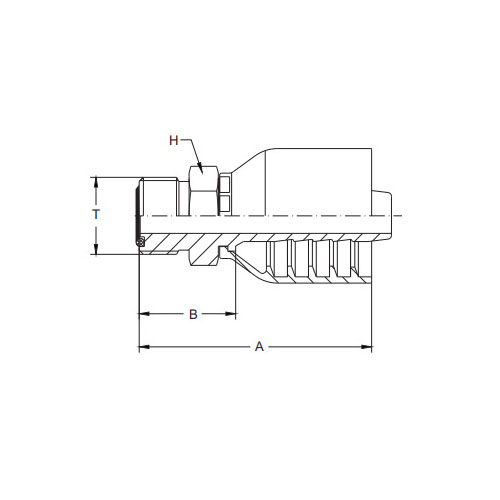
Primary Failure Modes of the ORFS Male O-Ring Seal
Below is a breakdown of the most frequent causes, their physical symptoms, and recommended corrective actions.
| Failure Cause | Visible Signs | Practical Solution |
|---|---|---|
| Over-compression (excessive torque) | O-ring flattened, extrusion gap marks | Use torque wrench; follow WayFong recommended torque values |
| Under-compression (loose fitting) | Fluid seepage, no visible O-ring deformation | Re-torque to specification; check thread engagement |
| Chemical incompatibility | Swelling, softening, surface cracks | Verify fluid compatibility; choose WayFong FKM or HNBR grades |
| Installation damage | Nicks, cuts, twisted ring | Use proper assembly tools and lubricate before insertion |
| Thermal degradation | Hardening, loss of elasticity, black residue | Upgrade to high-temperature material; check system cooling |
| Gland surface defects | Scratches or burrs on male nut or female port | Inspect mating hardware; replace damaged components |
Why Torque Control Matters
One of the most overlooked factors is torque accuracy. Unlike face seal designs that rely on metal-to-metal contact, the ORFS Male O-Ring Seal depends on controlled O-ring compression. Over-tightening crushes the elastomer, causing it to lose resilience. Under-tightening fails to energize the seal. WayFong tests show that 43% of warranty returns are torque-related. Using a calibrated torque wrench and following published specifications eliminates this variable.
Material Selection: Not All O-Rings Perform Alike
Standard nitrile (NBR) works well for mineral oils at moderate temperatures. However, when exposed to high heat, phosphate esters, or rapid pressure cycling, NBR degrades quickly. WayFong offers application-specific compounds including FKM (Viton®-equivalent) and HNBR, which provide extended service life in demanding environments. Choosing the wrong material guarantees premature failure regardless of installation quality.
ORFS Male O-Ring Seal FAQ – Common Questions from Engineers
Q1: Can I reuse an ORFS Male O-Ring Seal after disassembling a hydraulic fitting?
A: No. WayFong recommends never reusing any ORFS Male O-Ring Seal after removal. Once compressed, the elastomer takes a permanent set. Reinstallation cannot restore the original sealing force, leading to immediate or rapid leakage. Additionally, disassembly often introduces microscopic damage invisible to the naked eye. Always replace with a new ORFS Male O-Ring Seal whenever the fitting is opened.
Q2: What is the maximum surface roughness allowed on the mating port for an ORFS Male O-Ring Seal to seal reliably?
A: For a ORFS Male O-Ring Seal to function correctly, the mating port’s sealing surface (the flat face and the bore) should have a surface finish of 32 µin Ra (0.8 µm Ra) or better. Rougher finishes allow fluid to bypass the O-ring through micro-grooves. Smoother finishes prevent mechanical anchoring. WayFong technical drawings specify that any scratches deeper than 0.1 mm across the sealing zone are unacceptable and require hardware replacement.
Q3: How does pressure cycling affect the lifespan of an ORFS Male O-Ring Seal differently from steady pressure?
A: Steady pressure creates static compression forces. Pressure cycling, however, repeatedly extrudes the ORFS Male O-Ring Seal into the clearance gap, then retracts it. This cyclic extrusion leads to nibbling — a progressive tearing away of O-ring material. Over thousands of cycles, even properly installed seals fail from fatigue. WayFong recommends increasing O-ring hardness (90 Shore A instead of 70) and reducing extrusion gaps when designing for systems exceeding 5,000 psi with frequent cycling.
Best Practices for Maximum Service Life
-
Lubricate every ORFS Male O-Ring Seal prior to assembly – use system fluid or a compatible grease.
-
Inspect the male nut and female port for burrs, scratches, or plating defects.
-
Always tighten to WayFong published torque values – never exceed the maximum.
-
Store O-rings away from ozone, UV light, and extreme temperatures.
-
Document material traceability to avoid batch-related contamination.
Contact Us
Need help diagnosing a recurring seal failure or selecting the right ORFS Male O-Ring Seal for your hydraulic application? The engineering team at WayFong provides free failure analysis and material recommendations. Contact us today with your system parameters, and we will respond within 24 hours with a solution tailored to your pressure, fluid, and temperature requirements.
