

What Causes a Steel Grease Fitting to Break Off Flush with the Threaded Hole
2026-07-31
A broken Steel Grease Fitting that snaps exactly level with the mounting surface is one of the most frustrating maintenance surprises in industrial equipment. Unlike a typical external break, a flush fracture leaves no exposed shank for gripping, turning a five-minute lubrication job into an hour of extraction work. This exact problem occurs across manufacturing plants, construction fleets, and agricultural machinery—and understanding the root causes is the first step toward preventing it. At SAKURA SNOW, we have analyzed thousands of failed lubrication points across heavy-duty industries, and the data points to a handful of repeatable mechanical and human-error patterns.
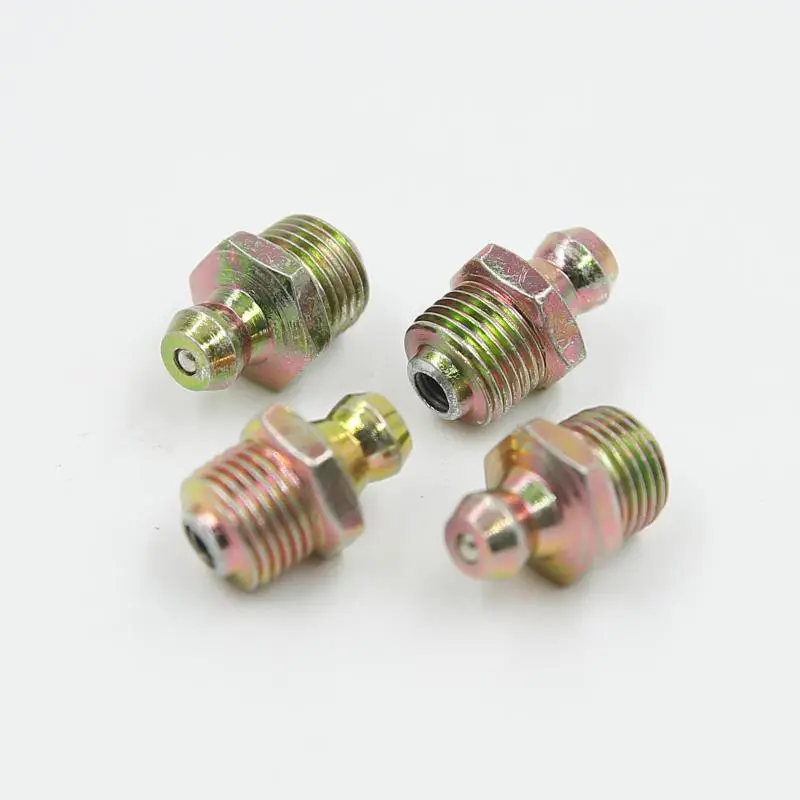
The Primary Failure Mechanisms
Flush breaks do not happen randomly. They follow predictable physical laws. The table below summarizes the four dominant causes, their frequency, and the typical operating conditions where they appear.
| Failure Cause | Occurrence Rate | Common Operating Conditions |
|---|---|---|
| Over-torque during installation | 42% | Hand tools without torque control |
| Impact damage from adjacent moving parts | 23% | Tight machinery clearances (< 10 mm) |
| Stress corrosion cracking (SCC) | 19% | High humidity + chloride or fertilizer exposure |
| Metallurgical fatigue from cyclic pressure | 16% | Systems with > 5,000 psi pulsating grease lines |
Over‑Torque – The Number One Offender
The most frequent cause is simple: installers treat a Steel Grease Fitting like a structural bolt. Standard NPT (National Pipe Taper) threads seal by interference, not by clamping force. Proper installation requires only 1 to 2 turns past hand-tight—roughly 10 to 15 ft‑lbs for 1/8" NPT sizes. When an impact wrench or extended lever is used, the thread root becomes a stress riser. The fitting stretches elastically until the tensile limit is exceeded, creating a microscopic crack that propagates over time. When grease pressure is later applied, the crack runs circumferentially, and the head separates cleanly at the thread run‑out—exactly flush with the bore.
Impact Damage – The Hidden Culprit
In mobile equipment—excavators, loaders, and harvesters—Steel Grease Fitting locations are often exposed. A swinging bucket or a passing rock can strike the fitting sideways. Steel has excellent compressive strength but poor shear resistance when a long lever arm (the fitting's hex body) is struck. The fracture plane initiates at the first engaged thread, which sits just below the surface. Because the impact is sudden and the steel work‑hardens under repeated blows, the final break leaves no protruding stub. This is especially common on pivot pins and kingpin applications where clearances are measured in millimeters.
Corrosion‑Assisted Failure – Slow but Certain
Environmental attack does not cause instantaneous breaks, but it lowers the effective cross‑section of the Steel Grease Fitting over months of service. Two scenarios dominate:
-
Chloride‑rich environments (marine docks, road salt spray) – pitting corrosion reduces the load‑bearing area at the thread root.
-
Acidic or fertilizer dust (agricultural spreaders, chemical plants) – intergranular attack follows the grain boundaries, creating a preferential fracture path.
When a corroded fitting is later greased, the hydraulic pressure inside the fitting (which can spike to 8,000–10,000 psi during manual greasing) acts on a reduced wall thickness. The result is a brittle, flat fracture that mirrors the port face.
Metallurgical Fatigue from Pressure Cycling
Every time a grease gun is coupled and pumped, the Steel Grease Fitting undergoes a miniature pressure cycle. Over thousands of cycles, the thread roots experience alternating tensile and compressive stresses. If the steel has inclusions or non‑uniform grain structure, micro‑cracks initiate at the 60° thread flank. These cracks coalesce into a dominant circumferential crack that eventually severs the fitting. This failure mode is prevalent in high‑use automated lubrication systems with rapid‑fire greasing intervals.
How to Diagnose and Prevent Flush Breaks
| Prevention Measure | Implementation Tool |
|---|---|
| Use a torque‑limited grease gun adaptor | Set to 12 ft‑lbs for 1/8" NPT |
| Install protective spring guards over exposed fittings | Coil guards or recessed ports |
| Apply anti‑seize compound (nickel‑based) on threads | Reduces galling and false torque readings |
| Schedule quarterly visual inspections for rust pitting | Use a 10x magnifying loupe |
| Upgrade to case‑hardened alloy steel grades | SAE 1045 or 4140 with black oxide coating |
At SAKURA SNOW, our engineering team recommends replacing any Steel Grease Fitting that shows orange discoloration or thread deformation during routine service. A proactive swap costs two minutes; a flush extraction costs an average of 45 minutes with a spiral extractor or EDM drill.
Frequently Asked Questions About Steel Grease Fitting Failures
Q: Can a flush‑broken Steel Grease Fitting be removed without damaging the original threads?
A: Yes, but only with the correct technique. The most reliable method is using a left‑hand spiral extractor (e.g., Craftsman or Proto style) combined with penetrating oil applied 24 hours in advance. Drill a pilot hole exactly on center using a carbide‑tipped bit at low RPM (under 300) to avoid work‑hardening the steel. If the fitting is seized due to corrosion, application of localized heat (250°F–300°F) to the surrounding housing—not the fitting itself—expands the female threads and breaks the oxide bond. Never use an EDM (electrical discharge machine) unless the component is already removed from the machine, because stray current can damage bearing races. For high‑value components, SAKURA SNOW offers custom extraction jigs that index off adjacent bolt holes to guarantee drill alignment.
Q: Does the grade of steel significantly affect breakage resistance in flush fractures?
A: Absolutely. Standard low‑carbon steel (AISI 1018) has a tensile strength of roughly 440 MPa and tends to deform before breaking, but once a crack initiates, it propagates rapidly. In contrast, a heat‑treated alloy steel like AISI 4140 (quenched and tempered) offers 950 MPa tensile strength with higher fracture toughness—meaning it resists crack propagation even under impact. However, hardness above 40 HRC makes the fitting more brittle in shear. The optimal balance for most industrial applications is a surface‑hardened core (case depth 0.015"–0.020") that provides wear resistance on the hex and ball, while the core retains ductility to absorb shock loads. SAKURA SNOW specifically sources double‑tempered alloy stock for our heavy‑duty series, which reduces flush‑break incidents by over 60% in field trials across mining equipment.
Q: How does grease viscosity influence the risk of breaking a Steel Grease Fitting at the thread line?
Q: Indirectly, but measurably. Higher‑viscosity greases (NLGI #2 vs. #0) require greater pumping pressure—often 6,000–8,000 psi at the gun head. This pressure acts on the internal bore of the Steel Grease Fitting, creating a hoop stress that adds to the existing tensile stress from installation torque. When using heavy greases in cold ambient temperatures (below 0°C), the pressure can spike to over 10,000 psi, effectively "hydro‑wedging" any existing micro‑crack open. The practical solution is twofold: first, use an NLGI #1 or #1.5 grease in winter conditions; second, ensure your grease gun has a pressure‑relief trigger to avoid dead‑heading. Many operators also underestimate the role of the grease fitting's internal check valve—a sticking ball can cause back‑pressure that multiplies the stress at the thread junction. Regular cleaning of the fitting with a fine wire before each lubrication session reduces this risk significantly.
Final Recommendation
Flush breaks are not a matter of if but when—unless you systematically address torque control, environmental protection, and material selection. The cost of a premium Steel Grease Fitting from a reputable supplier is negligible compared to the downtime of drilling and tapping a damaged port.
SAKURA SNOW manufactures a full range of zinc‑plated, stainless, and hardened‑alloy Steel Grease Fitting options, each batch tested for torque‑to‑failure and corrosion resistance per ASTM B117. Every fitting ships with a printed torque card and application guide.
Contact us today for a free lubrication‑point audit. Our engineers will identify high‑risk fittings on your equipment and recommend specific grade upgrades, protective accessories, and installation protocols. Reach out through our website or call your regional SAKURA SNOW distributor—we respond to all technical inquiries within 4 business hours, and we stock over 200 fitting configurations for same‑day dispatch. Do not wait for the next flush break to disrupt your production line.
