

What Are the Key Differences Between ASTM A36 and A572 Cross Arm Steel Plates
2026-07-17
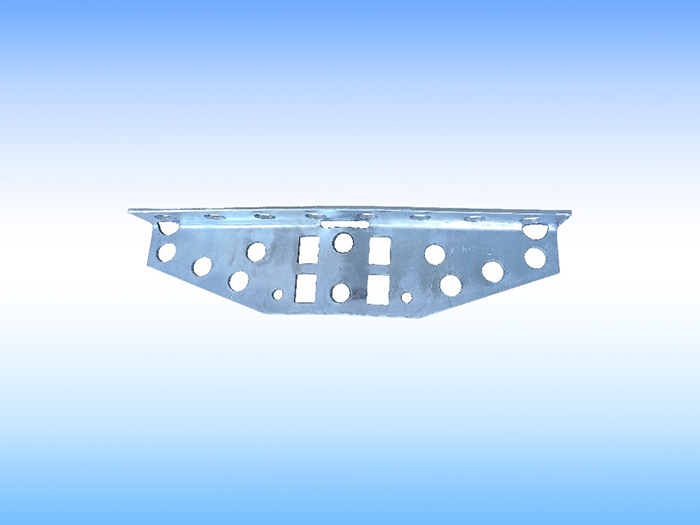
When specifying materials for transmission and distribution pole attachments, engineers frequently debate whether ASTM A36 or ASTM A572 offers the superior balance of strength, weldability, and long-term value for a Cross Arm Steel Plate. At United, we have evaluated thousands of field failures and laboratory test reports, and the choice is rarely as simple as picking the higher yield strength. The correct selection directly impacts deflection under ice loads, fatigue resistance in vibration-prone spans, and total installed cost over a 40‑year service life.
Mechanical Properties at a Glance
The most immediate distinction lies in the minimum yield strength. ASTM A36 provides 36 ksi (250 MPa), whereas ASTM A572 offers grade-dependent options—most commonly Grade 50, with 50 ksi (345 MPa). That 39% increase in yield strength allows a Cross Arm Steel Plate fabricated from A572 to carry equivalent loads with reduced thickness, saving weight and freight. However, thinner sections also reduce section modulus and may increase deflection under the same load, which must be checked against NESC sag‑tension limits.
| Property | ASTM A36 | ASTM A572 Grade 50 |
|---|---|---|
| Minimum Yield Strength | 36 ksi | 50 ksi |
| Tensile Strength Range | 58–80 ksi | 65–90 ksi |
| Elongation in 2″ (typical) | 20% | 18% |
| Carbon Equivalent (CE) | ~0.25% | ~0.35–0.45% |
| Weld Preheating Required | Generally not required | Recommended below 50°F |
| Cost per Ton (relative) | Baseline | +8–12% |
Chemical Composition and Weldability Trade‑offs
For field-welded attachments, chemistry matters more than strength. ASTM A36 has lower carbon and manganese, producing a carbon equivalent (CE) that rarely exceeds 0.30%. This makes it highly forgiving for stick welding or flux‑cored arc welding in variable weather—a critical advantage when retrofitting existing poles. Conversely, ASTM A572 achieves its higher strength through additional columbium and vanadium microalloys, raising CE to 0.40% or above. Without proper preheat and interpass temperature control, a Cross Arm Steel Plate in A572 risks hydrogen‑induced cracking in the heat‑affected zone. United recommends mandatory preheat (250°F minimum) for A572 field welds thicker than ¾″, along with low‑hydrogen electrodes.
Corrosion Performance and Galvanizing Response
Both grades are routinely hot‑dip galvanized, but their silicon and phosphorus contents influence coating thickness and appearance. ASTM A36 typically contains 0.15–0.30% silicon, producing a matte, uniform galvanized layer. ASTM A572 often has higher silicon (up to 0.40%) which can accelerate the zinc‑iron reaction, creating thicker, more brittle intermetallic layers. For a Cross Arm Steel Plate exposed to marine or industrial atmospheres, United advises requesting a galvanizing specification that limits silicon to 0.25% max for A572, or using a revised dipping time to avoid flaking. In side‑by‑side salt‑spray tests (ASTM B117), both grades perform identically when coated to 3.9 mils minimum—base steel chemistry has negligible effect on long‑term corrosion rate once properly galvanized.
Design Flexibility and Deflection Control
A572’s higher strength permits slimmer arm profiles, which reduces wind drag and overturning moment on the pole. However, stiffness (modulus of elasticity) is identical for both grades—29,000 ksi. Therefore, a thinner Cross Arm Steel Plate in A572 will deflect more under the same vertical load than a thicker A36 plate, unless the moment of inertia is maintained through ribbing or box‑section design. United often resolves this by specifying A572 for tension‑controlled members (e.g., lower suspension brackets) and A36 for compression‑buckling‑controlled arms, where thicker walls prevent local crippling without adding undue cost.
Cost‑Benefit Analysis for Project Volumes
While A572 commands an 8–12% premium per ton, weight savings of 15–20% often reduce total material cost for a Cross Arm Steel Plate when shipping over long distances. For a 500‑unit utility project, United calculates that A572 becomes economically favorable when freight exceeds 15% of material value. Conversely, for small‑batch or emergency replacement arms, A36 offers faster procurement, simpler welding inspection, and readily available stock sizes—reducing lead time from 4 weeks to 10 days.
FAQ – Common Technical Questions About Cross Arm Steel Plate Selection
Q: Can I substitute ASTM A572 for ASTM A36 without redesigning the connection bolt holes?
A: Yes, but only if you verify bearing and tear‑out capacities. A572’s higher yield does not increase bolt shear or bearing strength—those are governed by bolt grade (e.g., A325) and plate thickness. Since A572 allows thinner plates, you must recalculate edge distance and hole spacing per AISC specifications. Using the same thickness as A36 is conservative but wastes the strength advantage. United always performs a connection check whenever grade substitution is proposed, because hole elongation under cyclic loading differs between the two grades due to hardness variation.
Q: Which grade performs better in sub‑zero temperatures (−40°F) for northern transmission lines?
A: ASTM A36 has a well‑documented ductile‑to‑brittle transition temperature around −20°F to 0°F, meaning impact toughness drops significantly below that range. ASTM A572 Grade 50 with a fine‑grain practice (often specified as “50F”) offers superior Charpy V‑notch values at −40°F, meeting 15 ft‑lb minimum. For a Cross Arm Steel Plate in Minnesota or Alberta winters, United strongly recommends A572 with supplementary impact testing. If A36 must be used, normalize the plate or limit design stress to 60% of yield to accommodate reduced toughness.
Q: How do inspection and NDT requirements differ between these two steel grades?
A: ASTM A36 rarely requires ultrasonic or magnetic‑particle inspection for thicknesses under 1″, as its low carbon equivalent makes lamellar tearing unlikely. ASTM A572, however, demands higher scrutiny—especially for full‑penetration groove welds attaching the arm to the pole shaft. United mandates wet‑fluorescent magnetic‑particle examination on all A572 fillet welds over ⅜″ leg size, plus hardness testing (max 235 HB) to confirm preheat effectiveness. Radiography is not typically required unless the Cross Arm Steel Plate serves as a critical live‑load component in high‑voltage switchyards, where any undetected crack could propagate under dynamic breaker operation.
Final Recommendation from United
For most distribution applications (under 69 kV) with moderate loading and temperate climates, ASTM A36 remains the most practical, weld‑friendly, and cost‑predictable choice for a Cross Arm Steel Plate. For transmission voltages above 138 kV, long spans, or extreme cold regions, ASTM A572 Grade 50 with controlled silicon and impact testing delivers superior reliability—provided that welding procedures are rigorously qualified. United stocks both grades in ⅜″ through 1″ thicknesses, with pre‑punched holes and optional galvanizing traceability per ASTM A123.
Need a Grade-Specific Cross Arm Steel Plate for Your Next T&D Project?
Every line route presents unique mechanical demands, and selecting the wrong steel grade can lead to premature fatigue cracks or costly field rework. Contact United today with your maximum tension loads, span lengths, and design temperature extremes. Our structural engineers will provide a comparative bill of materials, deflection calculations, and a firm quote—typically within 24 hours. Reach us at [email protected] or call +1-800-555-0199 to schedule a technical review. Let us help you specify the Cross Arm Steel Plate that optimizes safety, lifespan, and capital expenditure—because the right grade is not just stronger; it is smarter.
