What Are the Differences Between Aluminum Alloy and Stainless Steel Impellers?
2026-11-19
Material selection has a direct influence on how Impellers perform, how much the rotating assembly weighs and how well the component withstands its working environment. Aluminum alloy and stainless steel are two commonly considered metal options, but they serve different engineering priorities. Aluminum alloy is generally selected when low weight and efficient machining are important, while stainless steel is often preferred when corrosion resistance, mechanical strength and durability in demanding environments take priority. Neither material is automatically better for every machine. The correct choice depends on operating speed, mechanical loading, fluid or air characteristics, temperature and maintenance expectations.
For equipment manufacturers, the decision should begin with the operating conditions rather than the material name alone. A lightweight component may reduce the mass carried by a rotating assembly, but it must still meet the required strength and dimensional stability. A stainless steel component may offer better resistance to certain corrosive conditions, but its higher density can affect rotational inertia and drive requirements. Zhejiang Hawen Electromechanical Co., Ltd. provides material options including aluminum alloy and stainless steel, allowing buyers to evaluate the component against the intended equipment design.
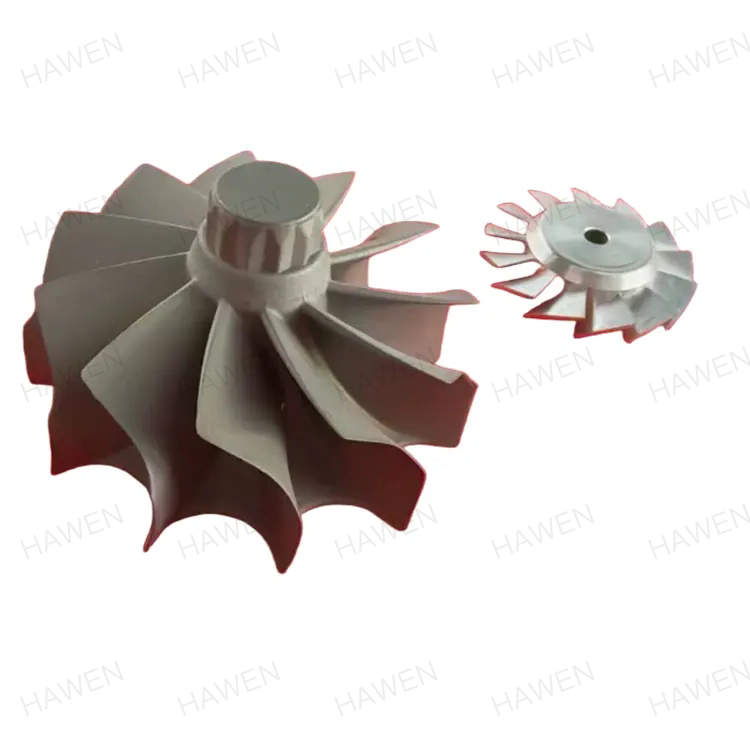
How Do Aluminum Alloy and Stainless Steel Compare in Physical and Mechanical Properties?
The most immediate difference is density. Aluminum alloys are substantially lighter than stainless steels, making them useful where reducing rotating mass is a design priority. Stainless steel is denser and generally offers higher elastic modulus and, depending on the grade and condition, higher strength. These differences influence more than the weight of an individual part. They can affect shaft loading, bearing selection, starting torque, dynamic response and the structural design of the complete rotating assembly.
Aluminum alloy is particularly useful in applications where a lower component mass can support compact equipment design or reduce the inertia that the drive system needs to accelerate. However, the actual benefit depends on the geometry. A thin-walled aluminum component and a thick stainless steel component cannot be compared by material density alone. Engineers must consider the complete design, including blade thickness, hub dimensions, reinforcement and the loads expected during operation.
Stainless steel is often selected for applications where mechanical robustness and resistance to environmental exposure are important. Its strength characteristics vary considerably by grade, heat treatment and manufacturing condition. Austenitic grades such as 304 and 316 are widely used in industrial equipment, but they do not have identical corrosion resistance. Grade 316 generally performs better than 304 in many chloride-containing environments, although neither grade is immune to pitting or crevice corrosion.
| Comparison factor | Aluminum alloy | Stainless steel |
| Density | Lower density and lighter component weight | Higher density and heavier component weight |
| Mechanical strength | Depends on alloy, temper and component geometry | Depends on grade, condition and manufacturing process; many grades offer high strength |
| Corrosion resistance | Can form a protective oxide layer; performance depends on alloy and environment | Generally strong corrosion resistance; grade selection is important |
| Thermal behaviour | Generally higher thermal conductivity and greater thermal expansion than stainless steel | Generally lower thermal conductivity and lower thermal expansion than aluminum alloys |
| Machining | Often easier to machine, depending on alloy and geometry | Can require more demanding cutting conditions and tool management |
| Typical selection priority | Weight reduction and manufacturing efficiency | Corrosion resistance, strength and demanding service conditions |
Thermal behaviour also deserves attention. Aluminum alloys generally conduct heat more readily and expand more as temperature rises than many stainless steel grades. In a rotating assembly, temperature changes can influence clearances and dimensional relationships between the component, shaft and housing. The design should therefore account for the operating temperature range rather than relying only on room-temperature measurements.
Our material assessment should consider the actual alloy designation and its mechanical condition. The term aluminum alloy covers a wide family of materials with different strength, corrosion and casting characteristics. Stainless steel is equally broad, with different grades designed for different service conditions. A meaningful comparison requires the exact material grade, product form and relevant mechanical data, not simply a comparison between the two material families.
Which Operating Conditions Suit Aluminum Alloy or Stainless Steel?
Aluminum alloy is often a practical choice for fans, ventilation equipment and other rotating systems where reducing mass is valuable. Lower weight can help limit the inertia of the rotating component and may support a more compact drive arrangement. It can also simplify handling during installation and maintenance. However, the component must still withstand centrifugal loading, aerodynamic or hydraulic forces, vibration and the stresses created around the hub and blade roots.
Stainless steel is commonly considered for equipment exposed to moisture, cleaning agents, process fluids or corrosive atmospheres. Its suitability depends on the specific chemical environment. For example, a stainless grade that performs well in a clean water application may not be appropriate for a process containing concentrated chlorides, acidic compounds or other aggressive substances. Temperature, concentration, exposure time and surface condition all affect corrosion behaviour.
Application selection should also account for the type of material contact. A component handling clean air in a dry indoor environment has different requirements from one exposed to humid air, salt spray, washdown chemicals or liquid process media. A material that performs adequately in one environment may experience surface degradation in another. Buyers should provide the manufacturer with the actual medium and environmental conditions so that material suitability can be reviewed before production.
Typical selection considerations include:
- Ventilation and air movement: Aluminum alloy may be attractive where low rotating mass and efficient handling are important.
- Corrosive atmospheres: Stainless steel may be preferable when the selected grade is compatible with the chemicals and moisture present.
- High mechanical loading: Compare the strength and fatigue characteristics of the exact alloy and component design.
- Frequent cleaning: Evaluate chemical compatibility, surface finish and the effect of cleaning procedures.
- High rotational speed: Consider density, geometry, stress distribution, shaft capacity and dynamic balance together.
- Elevated temperature: Review strength retention, thermal expansion and the clearances of the complete assembly.
Neither material should be selected solely because it is described as lightweight, strong or corrosion-resistant. For example, aluminum alloy may be unsuitable for a particular chemical environment even if its mechanical properties are adequate. Stainless steel may resist the environment but add unnecessary rotating mass where a lighter material would meet all design requirements. Our engineering review should balance these factors against the equipment's operating profile and expected service life.
Zhejiang Hawen Electromechanical Co., Ltd. offers aluminum alloy, stainless steel and engineering plastic material options for different product requirements. Our factory can review the proposed material against the component drawing and application information. The final selection should be confirmed against the specific alloy or stainless steel grade, rather than assuming that every material within a category has the same performance.
How Do Manufacturing Processes and Product Specifications Affect Material Selection?
Material selection is closely connected to manufacturing. Aluminum alloy components can be produced through casting and subsequent machining, depending on the required geometry and production volume. Casting is useful for forming complex shapes, while machining can finish critical interfaces such as shaft bores, mounting faces and locating features. Process planning must account for casting variation, machining allowance, fixture design and the dimensional requirements of the finished part.
Stainless steel components may be produced through casting, machining, forming or a combination of processes, depending on the design and material grade. Stainless steel machining can require careful control of cutting speed, tool condition and heat generation. Some grades work-harden during machining, so an unsuitable process can increase tool wear and affect surface quality. The selected production route should match the required geometry, mechanical properties and batch quantity.
Hawen's published Alloy Fan Impeller specification provides a concrete example of an aluminum alloy product. It identifies C355 Al-Zn alloy as the material, gives a product dimension of Φ35 × 15.44 mm and specifies die casting followed by machining. The listed machining accuracy is ≤0.01 mm. This figure applies to the stated product specification and should not be interpreted as a universal tolerance for every feature or for all custom designs.
| Product parameter | Published aluminum alloy example | Information to confirm for a custom order |
| Material | C355 Al-Zn alloy | Exact alloy designation and material condition |
| Product dimension | Φ35 × 15.44 mm | Whether the example dimension applies to the requested drawing |
| Manufacturing process | Die casting plus machining | Required process route and critical finishing operations |
| Machining accuracy | ≤0.01 mm as listed for the example product | Which dimensions and geometric features carry this requirement |
| Structural options | Different blade and enclosure configurations are available across the product range | Blade profile, number of blades, hub design and overall geometry |
| Stainless steel specification | Stainless steel is listed as a material option | Exact grade, dimensions, manufacturing route and mechanical requirements |
The published aluminum alloy specification should be treated as a reference for that particular model, not as a specification for every aluminum alloy component. Likewise, the availability of stainless steel does not establish a universal stainless grade, dimensional range or machining tolerance. These details need to be agreed for the individual project and recorded in the approved technical drawing.
For a custom enquiry, buyers should provide the following information:
- A 2D drawing with dimensions, tolerances and datum references.
- A 3D model showing the blade geometry and mounting interfaces, where available.
- The required material grade or the operating conditions needed for material selection.
- Rotational speed, operating temperature and expected mechanical loading.
- The working medium and any exposure to moisture, chemicals or cleaning agents.
- Required surface finish, inspection criteria and dynamic balance specification.
- Expected order quantity and any repeat-production requirements.
These details help establish whether the proposed material and manufacturing route can meet the functional requirements. They also help prevent a common sourcing problem: receiving a component that matches the general shape but does not fit the shaft, housing or mounting arrangement. Our drawing review should identify critical dimensions before production begins, while inspection requirements should be agreed before the first batch is completed.
How Should Buyers Balance Cost, Maintenance and Long-Term Performance?
Purchase price is only one part of the material decision. A lower-cost component may become more expensive if it requires frequent replacement, creates additional maintenance work or affects the efficiency of the equipment. Conversely, choosing a higher-cost material without a clear operational benefit can increase procurement costs without improving service performance. A lifecycle assessment should consider the initial price, manufacturing complexity, expected operating conditions, inspection requirements and replacement interval.
Aluminum alloy may offer manufacturing and handling advantages because of its lower density and machinability. However, the surface condition and corrosion protection requirements must be considered for the intended environment. Depending on the alloy and application, additional surface treatment may be specified. Any coating or treatment should be compatible with the working medium, operating temperature and dimensional requirements, especially where close-fitting interfaces are involved.
Stainless steel may reduce corrosion-related maintenance in suitable environments, but it is not maintenance-free. Deposits, crevices, incompatible chemicals and galvanic contact with dissimilar metals can still create problems. Inspection should focus on areas where moisture or process residue can accumulate, as well as joints, surface defects and regions exposed to repeated cleaning. Correct grade selection is more important than relying on the general description stainless steel.
For both materials, maintenance planning should include inspection of the hub, blade surfaces, mounting interfaces and signs of mechanical damage. Operators should check for unusual vibration, noise, visible cracking, corrosion, deformation and evidence of contact with the housing. Any abnormal condition should be assessed before continued operation, particularly where the component rotates at high speed.
Dynamic balance should also be considered separately from material selection. A lighter aluminum alloy component is not automatically better balanced than a stainless steel one. Balance depends on mass distribution, geometry, manufacturing consistency and the condition of the assembled rotating system. The required balance grade and test conditions should be specified according to the machine design and operating speed.
When comparing quotations, our procurement team should ask suppliers to identify the exact material grade, manufacturing process, critical tolerances and inspection scope. A quotation that states only aluminum alloy or stainless steel may not provide enough information for a technically sound comparison. The buyer should also confirm whether the quoted component includes machining, surface treatment, balancing and inspection documentation.
For OEMs managing several equipment models, maintaining an approved material and drawing record can improve replacement compatibility. If a material change is proposed, engineering should review the effect on mass, strength, thermal expansion, corrosion resistance and mounting interfaces. Zhejiang Hawen Electromechanical Co., Ltd. can discuss drawing-based requirements and available material options for project evaluation. The objective is to select a configuration that meets the actual service conditions without adding unnecessary manufacturing or lifecycle costs.
Conclusion: Which Material Is the Better Choice for Your Application?
Aluminum alloy and stainless steel serve different engineering priorities. Aluminum alloy is generally attractive where low weight, easier machining and reduced rotating mass are important. Stainless steel is often more suitable where the selected grade must withstand demanding mechanical or corrosive conditions. The final decision should account for the complete operating environment, including speed, temperature, mechanical loading, chemical exposure, dimensional requirements and maintenance expectations.
There is no universal material choice for every machine. Buyers should confirm the exact grade, product dimensions, manufacturing route, critical tolerances and balance requirements before approving production. Zhejiang Hawen Electromechanical Co., Ltd. supports material and drawing-based discussions for customized rotating components. Contact our team with your application details and engineering drawing to review a suitable material option, confirm manufacturing requirements and request a quotation for your project.
Frequently Asked Questions
Is aluminum alloy or stainless steel better for high-speed impeller applications?
Neither material is automatically better for every high-speed application. Aluminum alloy has lower density, which can reduce rotating mass and inertia, while stainless steel may provide higher strength depending on its grade and condition. The correct choice depends on rotational speed, component geometry, centrifugal stress, fatigue requirements, shaft capacity and dynamic balance. Engineers should verify the design stress and balance requirements for the complete rotating assembly before selecting the material.
Can stainless steel impellers be used in corrosive environments?
Yes, provided the selected stainless steel grade is compatible with the working environment. Different grades have different resistance to acids, chlorides, moisture and cleaning chemicals. Grade 316 generally offers better resistance than 304 to many chloride-related conditions, but it is not immune to pitting or crevice corrosion. Buyers should provide the chemical composition, concentration, temperature and exposure conditions so that the material can be assessed for the actual application.
What product information should buyers compare when sourcing aluminum alloy and stainless steel impellers?
Buyers should compare the exact material grade, component dimensions, shaft bore and mounting tolerances, blade geometry, manufacturing process, surface treatment, inspection requirements and dynamic balance criteria. The operating speed, temperature and working medium should also be included because they affect material suitability. A model-specific drawing and technical specification provide a more reliable basis for comparison than a general material description or nominal outside dimension.