What Are the Common Failure Modes of a Large Lead Rolled Ball Screw and How Can They Be Prevented
2026-03-23
In high-speed linear motion systems, the Large Lead Rolled Ball Screw is widely recognized for its ability to deliver rapid positioning with remarkable efficiency. However, even the most precisely engineered components are susceptible to failure when operating under demanding conditions. At Maitu, we have spent years analyzing field failures and refining our manufacturing processes to ensure that every Large Lead Rolled Ball Screw we produce delivers maximum reliability. Understanding the common failure modes—and how to prevent them—is essential for maintaining system uptime and long-term performance.
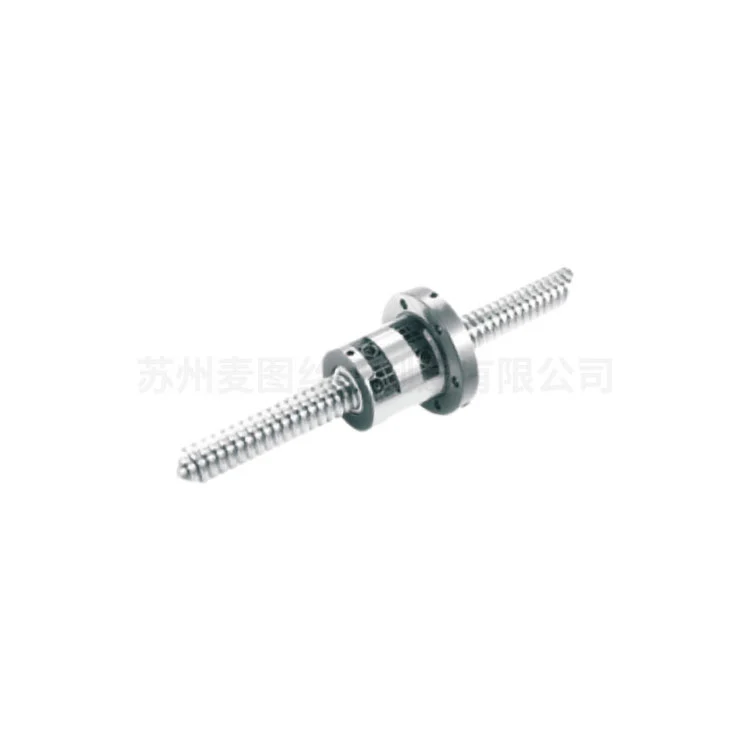
Common Failure Modes and Prevention Strategies
| Failure Mode | Primary Cause | Prevention Strategy |
|---|---|---|
| Surface Fatigue (Spalling) | Excessive cyclic stress beyond material endurance limit | Select appropriate load rating; avoid oversizing or undersizing; use Maitu’s precision heat treatment process |
| Wear and Clearance Growth | Contamination or inadequate lubrication | Implement effective sealing systems; schedule regreasing intervals; use high-quality EP grease |
| Brinelling and Indentation | Shock loads during operation or improper handling | Apply controlled mounting procedures; use soft starting drives; avoid impact during assembly |
| Thread Galling | Insufficient lubrication or material mismatch during installation | Ensure proper lubricant film; use anti-galling coatings; follow Maitu’s torque specifications |
| Screw Whipping | Critical speed exceeded due to excessive length-to-diameter ratio | Optimize screw diameter; use end supports; apply rotational speed limits based on Large Lead Rolled Ball Screw specifications |
Common Failure Mechanisms in Detail
Surface fatigue, often visible as spalling or flaking on the raceways, is typically the result of underestimating actual load demands. A Large Lead Rolled Ball Screw operates with high helix angles, which magnifies the effect of dynamic loads. Maitu addresses this through finite element analysis during the design phase, ensuring that material selection and case depth align with real-world operating conditions.
Contamination remains another leading cause of premature failure. Even microscopic particles can act as abrasives, accelerating wear between the balls and screw threads. In rolled screws, the surface finish, while smoother than in non-ground alternatives, still requires protection. Maitu recommends integrating wiper seals and using filtered lubrication systems to extend service life significantly.
Installation errors, such as misalignment or improper preload settings, frequently contribute to irregular load distribution. This leads to localized stress and uneven wear. Adhering to Maitu’s installation guidelines—particularly for Large Lead Rolled Ball Screw assemblies with longer lengths—ensures that the screw remains concentric and operates within its intended mechanical envelope.
Large Lead Rolled Ball Screw FAQ
What lubrication method works best for a Large Lead Rolled Ball Screw in high-speed applications?
For high-speed applications involving a Large Lead Rolled Ball Screw, oil circulation systems are generally preferred over grease. Oil provides superior cooling, flushes away fine wear particles, and maintains a consistent film thickness under rapid acceleration. If grease is used, select a lithium-based or polyurea-based high-speed grease with NLGI grade 1 or 2, and reapply at intervals no longer than every 2,000 operating hours. Maitu provides detailed lubrication schedules tailored to each screw’s lead, speed, and load profile.
How can I determine whether a failed Large Lead Rolled Ball Screw can be repaired or must be replaced?
The decision depends on the failure type and extent of damage. If the screw shows minor surface wear or contamination but no deformation, reconditioning—including polishing, ball replacement, and new seals—may restore functionality. However, if the screw exhibits spalling on the raceway, significant material loss, or any measurable shaft bending, replacement is the safer option. Maitu offers inspection services to assess damage depth and provide a clear repair-or-replace recommendation based on dimensional analysis and functional testing.
What is the most common mistake made during installation of a Large Lead Rolled Ball Screw?
The most frequent installation error is failing to account for thermal expansion and end fixation misalignment. A Large Lead Rolled Ball Screw expands during operation, and if both ends are rigidly fixed without proper float bearings, axial stress builds up rapidly, leading to premature wear or even buckling. Additionally, using incorrect bolt torque on the end supports can induce micro-deflections. Maitu supplies installation manuals with torque tables and alignment procedures to help integrators avoid these critical errors.
Maximizing Service Life Through Proactive Maintenance
Preventive maintenance remains the most effective approach to extending the operational life of a Large Lead Rolled Ball Screw. Regular vibration analysis can detect early-stage spalling, while periodic inspection of wiper seals and lubrication ports prevents contamination-related failures. Maitu’s engineered solutions include standardized maintenance intervals based on application type—whether semiconductor handling, automated assembly, or heavy-duty material transfer.
By combining proper selection, correct installation, and disciplined maintenance, engineers can achieve millions of trouble-free cycles from their Large Lead Rolled Ball Screw systems. The upfront investment in quality components and best practices consistently delivers lower total cost of ownership compared to reactive replacements.
For application-specific guidance or to request a customized Large Lead Rolled Ball Screw solution tailored to your performance requirements, contact us today. Maitu’s engineering team provides comprehensive support—from design review to after-sales service—ensuring your motion systems operate with precision, durability, and confidence.