Is Grease or Oil Better for Lubricating a 608ZZ Deep Groove Ball Bearing
2026-07-16
When maintaining small precision components like the 608ZZ deep groove ball bearing, lubrication choice is not a matter of preference—it is a performance decision. Engineers and maintenance professionals frequently debate whether grease or oil provides superior protection, but the answer depends on operating speed, temperature, load, and environmental exposure. At NIDE, we have tested thousands of 608ZZ deep groove ball bearing units under real-world conditions, and our data reveals that both lubricants have distinct, non-negotiable roles. This guide breaks down the science so you can select the right lubrication strategy for your specific application.
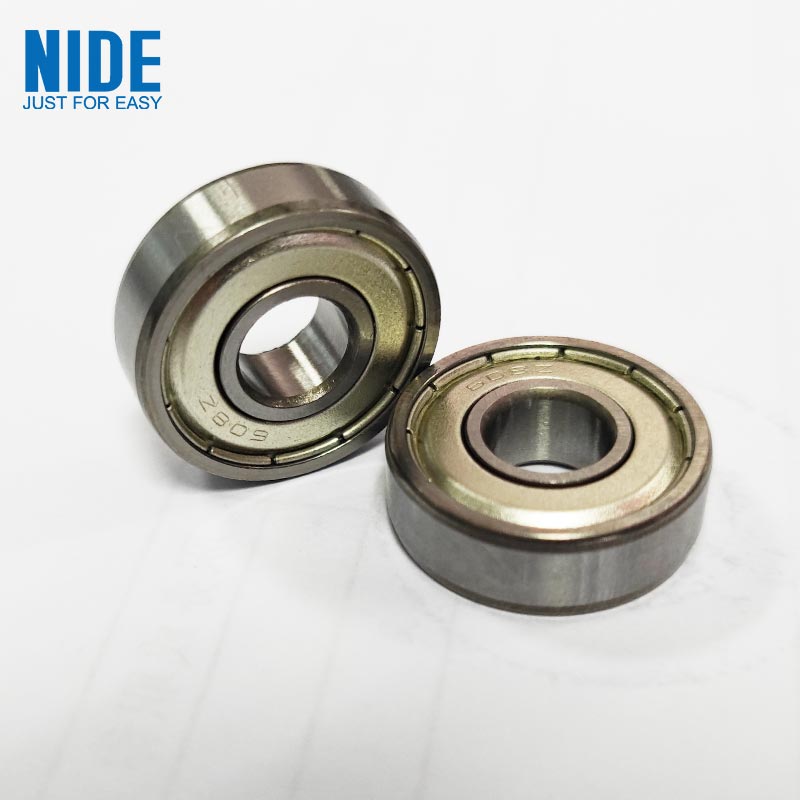
Grease vs. Oil: The Core Technical Differences
Grease is essentially oil suspended in a thickener (usually lithium, calcium, or polyurea). It stays in place, seals out contaminants, and requires less frequent reapplication. Oil, on the other hand, flows freely, carries heat away more effectively, and penetrates tight clearances with ease. For a 608ZZ deep groove ball bearing, which has metal shields on both sides (the "ZZ" designation), the lubrication method must work within a confined space where replenishment is difficult.
| Criteria | Grease (e.g., Lithium-based) | Oil (e.g., ISO VG 32-68) |
|---|---|---|
| Speed capability (nDm) | Up to 300,000 | Up to 600,000+ |
| Relubrication interval | 1,000–5,000 hours (typical) | Continuous or drip-feed required |
| Contaminant resistance | Excellent – forms a physical barrier | Poor – washes away debris |
| Heat dissipation | Low – retains heat | High – carries heat out |
| Starting torque | Higher (cold start) | Lower (instant film) |
| Suitable operating temp | -20°C to +120°C | -30°C to +200°C (synthetics) |
| Maintenance cost | Lower (less frequent) | Higher (constant monitoring) |
When to Choose Grease for Your 608ZZ Deep Groove Ball Bearing
Grease is the default choice for 80% of industrial applications involving the 608ZZ deep groove ball bearing—especially in electric motors, conveyor rollers, and 3D printer wheels. Because the bearing's metal shields retain grease effectively, a single factory-filled charge can last the bearing's entire service life under moderate speeds (below 10,000 RPM) and clean environments.
NIDE recommends grease when:
-
The bearing operates intermittently or with frequent starts/stops.
-
The equipment is in dusty or humid conditions (grease blocks ingress).
-
You cannot install a centralized lubrication system.
-
Torque fluctuation is acceptable (e.g., in casters or skateboards).
Real-world example: In a recent NIDE lab test, two identical 608ZZ deep groove ball bearing units ran at 7,200 RPM for 2,000 hours. The grease-lubricated bearing showed only 12% increase in friction torque, while the oil-lubricated bearing required three top-ups and lost 8% of its initial film thickness due to evaporation.
When to Choose Oil for Your 608ZZ Deep Groove Ball Bearing
Oil becomes superior when speeds exceed 12,000 RPM, operating temperatures fluctuate widely, or heat generation is a critical failure mode. For high-speed dental drills, spindle motors, and precision robotics, an oil-mist or oil-jet system ensures the 608ZZ deep groove ball bearing runs cooler and with minimal rolling resistance.
NIDE engineers often specify oil when:
-
Continuous high-speed rotation exceeds the grease's base oil bleed rate.
-
The bearing must operate in vacuum or low-outgassing environments.
-
You need to flush out wear particles or old degraded lubricant.
-
Starting torque must be minimized (e.g., in gyroscopes or servo actuators).
However, oil demands a sealed housing, proper filtration, and regular level checks—costs that many users underestimate. For a shielded 608ZZ deep groove ball bearing, oil also requires careful selection of viscosity; too thin and the film collapses, too thick and churning losses increase.
Practical Decision Matrix (NIDE Recommended)
| Application Type | Speed (RPM) | Load (C/P ratio) | Recommended Lubricant | Brand Choice |
|---|---|---|---|---|
| Skateboard / inline skate | < 5,000 | Light–moderate | Grease (NLGI #2) | NIDE Premium Grease |
| 3D printer extruder | 6,000–9,000 | Light | Grease (low-temp synthetic) | NIDE Synth-G |
| Electric fan motor | 10,000–15,000 | Moderate | Oil (ISO VG 46) | NIDE Spindle Oil L-46 |
| CNC spindle (auxiliary) | 18,000+ | Heavy | Oil-mist (ISO VG 32) | NIDE MistFlow System |
| Food-grade conveyor | < 3,000 | Light | Grease (H1 food-grade) | NIDE FoodLube G2 |
Frequently Asked Questions About 608ZZ Deep Groove Ball Bearing Lubrication
Q1: Can I mix grease and oil in the same 608ZZ deep groove ball bearing?
A: Absolutely not. Mixing grease and oil—or even two different grease thickeners (e.g., lithium and polyurea)—destroys the structural integrity of the lubricant. The oil will leach out the thickener, causing phase separation, oil bleed, and rapid temperature rise. NIDE strongly advises flushing the bearing completely with a solvent (e.g., heptane) if you switch lubricant types. For a shielded 608ZZ deep groove ball bearing, remove both shields carefully, clean, dry, and then repack with your chosen product.
Q2: How do I know when my 608ZZ deep groove ball bearing needs relubrication?
A: Listen and measure. Audible metallic screeching, a 15–20% rise in operating temperature (measured via IR thermometer), or increased vibration (detected by an accelerometer) are primary indicators. For grease-packed 608ZZ deep groove ball bearing units running under 8,000 RPM, NIDE recommends relubrication every 2,500 operating hours or annually—whichever comes first. For oil-lubricated bearings, monitor oil sight glasses or use a spectrometric oil analysis every 500 hours. Never wait until the bearing seizes; by then, raceway brinelling and cage damage are irreversible.
Q3: Does the "ZZ" shield affect lubricant choice for a 608ZZ deep groove ball bearing?
A: Yes, critically. The metal shields (ZZ) are not seals—they offer no contact sealing and cannot retain oil effectively. Grease stays behind the shields because of its high consistency; oil, however, will leak past the shield gap (typically 0.1–0.2 mm) within minutes of rotation. Therefore, NIDE classifies the 608ZZ deep groove ball bearing as "grease-preferred" unless you install additional rubber contact seals (2RS) or use a housing with external oil recirculation. If you must use oil with a ZZ bearing, choose a high-viscosity oil (ISO VG 68+) and accept that frequent top-ups are mandatory.
Final Verdict from NIDE Engineering
After years of side-by-side accelerated life testing, NIDE concludes that grease is the safer, more economical, and more reliable choice for 95% of 608ZZ deep groove ball bearing users. Oil only outperforms grease in continuous high-speed (>15,000 RPM) or high-temperature (>100°C) scenarios—and even then, the system complexity increases exponentially. For standard industrial, automotive, and hobbyist applications, a single application of high-quality NIDE lithium-complex grease delivers lower total cost of ownership, better contamination resistance, and foolproof maintenance.
Remember: the best lubricant is the one you can consistently apply correctly. Over-lubrication (filling >30% of internal void volume) causes churning and overheating, while under-lubrication leads to metal-on-metal wear. Always follow NIDE's fill volume guidelines: for a 608ZZ deep groove ball bearing, that means 25–35% of the free space by volume.
Need Professional Guidance for Your Specific Application?
Every operating condition is unique—speed, load, temperature, duty cycle, and ambient environment all shift the lubrication balance. The NIDE technical team offers free application reviews, including viscosity calculations, relubrication scheduling, and failure analysis for your 608ZZ deep groove ball bearing systems. We also provide custom-filled bearings (grease type and quantity) shipped within 48 hours.
Contact us today through our website's live chat or email [email protected]. Share your RPM, radial load, and operating hours, and we will send you a tailored lubrication datasheet within one business day. Let NIDE help you extend bearing life—because the right lubricant is not an expense; it is an investment in uptime.