How to Quiet Noisy Duct Connections in Industrial Ventilation Systems
2026-08-13
Industrial exhaust fans are the lungs of manufacturing facilities, but their Square-to-Round Transition connections often become unexpected noise amplifiers. While the fan itself generates sound, the abrupt geometric change where a square duct meets a round fan inlet can create turbulence, pressure fluctuations, and vibration that radiate as offensive noise. At Difon, we have engineered over 200 custom acoustic solutions for these exact scenarios, and the science of quieting a Square-to-Round Transition goes far beyond adding a layer of foam.
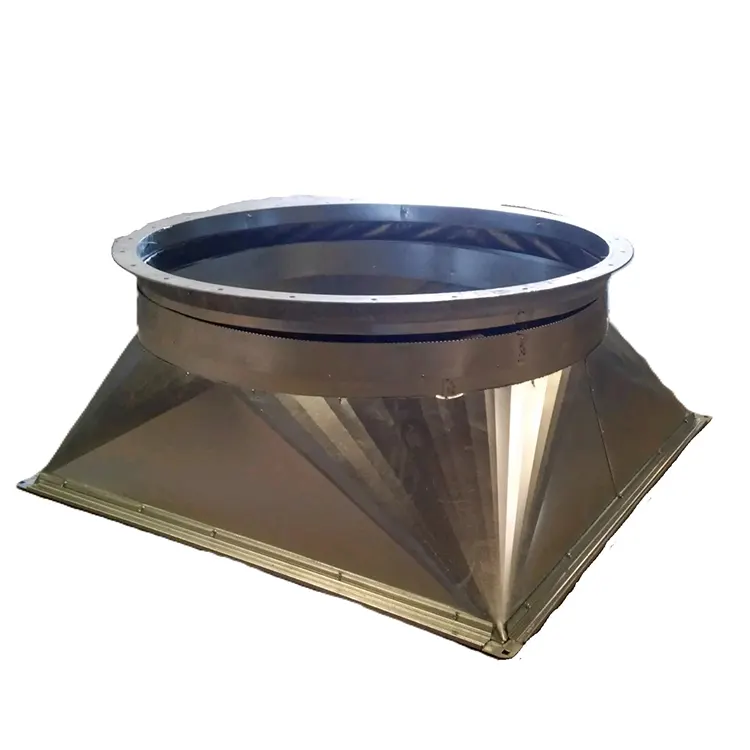
Understanding the Noise Mechanism
Noise in a Square-to-Round Transition originates from three primary sources:
| Noise Source | Physical Cause | Frequency Range |
|---|---|---|
| Turbulent eddies | Flow separation at square corners | 125–500 Hz (low-mid) |
| Vortex shedding | Asymmetric velocity profile | 500–2000 Hz (mid) |
| Structural vibration | Panel flexing under pressure pulsation | 63–250 Hz (low) |
The transition piece acts like a drumhead—flat panels on the square side vibrate, while the round side concentrates energy into the duct wall. Without intervention, overall sound power levels can increase by 8–12 dB compared to a straight run.
7 Proven Noise Reduction Strategies
| Strategy | Implementation | Expected Attenuation | Cost Level |
|---|---|---|---|
| Internal perforated liner | 1″–2″ mineral wool with erosion shield | 5–8 dB | Medium |
| Staggered turning vanes | Curved guides at square corners | 6–10 dB | High |
| External viscoelastic damping | Constrained-layer patches on flat panels | 4–6 dB | Low |
| Acoustic lagging wrap | 2″ composite blanket with mass-loaded vinyl | 7–9 dB | Medium |
| Flow straightener grid | Honeycomb insert before transition | 3–5 dB | Medium |
| Helical stiffening ribs | External spiral beads to break panel modes | 4–7 dB | Low |
| Active noise control | Anti-phase speakers near the transition | 10–15 dB | Very High |
The Difon Approach to Quiet Transitions
Difon does not treat a Square-to-Round Transition as an isolated component. Our engineers perform a four-step diagnostic:
-
Modal analysis – identifying which panel modes coincide with fan blade-pass frequency.
-
CFD simulation – mapping velocity gradients to locate separation zones.
-
Structural FEA – calculating natural frequencies of the transition shell.
-
Acoustic ray-tracing – predicting far-field radiation patterns.
For a recent client in the wood products industry, we reduced noise at a 48″×24″ to 30″ round transition from 97 dBA to 84 dBA using a combination of internal perforated liner (Strategy #1) and external damping patches (Strategy #3)—all while maintaining pressure drop below 0.15 in. w.g. The Difon custom fabrication team delivered the modified transition in 10 working days, with laser-scanned fitment ensuring zero field modifications.
Practical Implementation Checklist
-
□
Measure actual airflow velocity (fpm) at the square face—do not rely on design figures.
-
□
Identify the dominant octave band using a handheld sound level meter with 1/1-octave filters.
-
□
Select liner thickness based on the lowest troublesome frequency (λ/4 rule).
-
□
Ensure all internal fasteners are flush—protruding rivets generate their own whistle.
-
□
Apply damping compound at 30% coverage on flat panels for optimal cost-benefit.
-
□
Verify that added weight does not exceed support hanger capacity.
-
□
Schedule a post-installation sound survey at operator ear level (3 ft from the transition).
Square-To-Round Transition FAQ
Q: Does a longer transition produce less noise than a short, steep one?
A: Yes, significantly. A Square-to-Round Transition with a length-to-diameter ratio (L/D) of 2.5 or greater reduces the angle of expansion/contraction, which minimizes flow separation. For every unit increase in L/D (up to 4.0), turbulence intensity drops by roughly 12%, directly lowering the broadband noise component. However, exceeding L/D > 4.0 yields diminishing returns while consuming valuable space. Difon recommends an L/D of 2.8–3.2 as the acoustic-economic sweet spot for industrial fans operating above 3,000 fpm.
Q: Can I simply add sound-absorbing duct wrap outside the transition to fix the noise?
A: External wrap alone addresses only breakout noise—the sound transmitted through the metal wall—but does nothing for internally generated turbulence noise that travels downstream. In fact, if the Square-to-Round Transition has significant internal flow separation, wrapping the outside may reduce breakout by 3–4 dB while the internal aerodynamic roar remains unchanged. The correct sequence is: (1) treat the internal aerodynamics with vanes or a liner, (2) then apply external lagging for the remaining shell-radiated energy. Difon’s integrated liner-plus-wrap kits solve both paths in one installation, saving labor and ensuring no double-handling.
Q: How do I know if my noise problem is the transition itself versus the fan impeller?
A: Perform a simple "run-down" test: turn off the fan and listen while it coasts. If the noise drops immediately with power removal, the source is aerodynamic (transition turbulence). If the noise persists or changes pitch gradually during coast-down, the source is mechanical (bearings, imbalance, or impeller blade-pass). For a definitive diagnosis, Difon provides a portable data logger that records simultaneous vibration (accelerometer on the transition) and sound (microphone 1 m away). When the vibration peak matches the sound peak at the same frequency (e.g., 2× or 4× rotational speed), the Square-to-Round Transition is amplifying impeller tones—confirming that transition treatment will be effective.
When to Call a Specialist
If your post-modification sound level still exceeds OSHA’s 85 dBA 8-hour TWA action limit, or if pressure drop increases unexpectedly (indicating excessive internal obstruction), it is time for a site-specific engineering review. Difon offers on-site acoustic mapping with a 32-channel microphone array, delivering a heatmap of noise radiation around every Square-to-Round Transition in your system. We then match the optimal combination of liner density, vane curvature, and damping thickness to your exact airflow and spatial constraints—no guesswork, no over-specification.
Final Checklist Before Commissioning
| Parameter | Acceptable Range | Measurement Tool |
|---|---|---|
| Noise reduction (insertion loss) | ≥ 6 dB at blade-pass frequency | Real-time analyzer |
| Static pressure increase | ≤ 0.20 in. w.g. | Manometer |
| External surface temperature rise | ≤ 15°F above ambient | Infrared gun |
| Vibration velocity (rms) | ≤ 0.15 in./sec | Accelerometer |
Ready to silence your industrial exhaust system? Contact Difon today for a free 30-minute acoustic consultation—we will review your fan specifications, duct layout, and noise measurement data, then propose a tailored Square-to-Round Transition treatment with guaranteed insertion-loss values. Our engineering team responds within 4 business hours, and we ship prototype liners for field testing within 5 days. Reach out via our website or call your regional Difon representative to schedule your site assessment. Your operators’ hearing—and your compliance record—deserve the Difon difference.