How Tight Can Tolerances Be in a Precision Injection Mold for Small High-Cavity Remote Control Housings
2026-10-19
When specifying a Precision Injection Mold for Small High-Cavity Remote Control Housings, tolerance capability is one of the first questions engineering teams raise—and for good reason. Wall thickness on a remote control housing often runs between 0.8 mm and 1.5 mm, while cavity counts can reach 16, 32, or even 64 drops. At Weishuo, tolerance discussions start with the part function, not with a generic number, because the achievable window depends on steel grade, cavity layout, thermal management, and metrology. This article breaks down what is realistic, what is aggressive, and where cost curves bend.
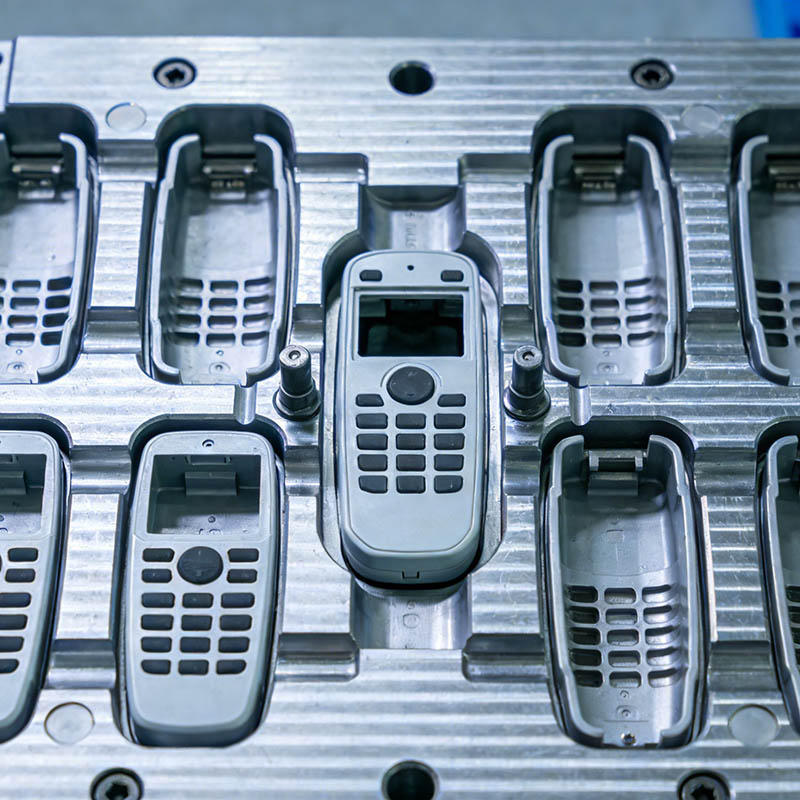
Tolerance Bands by Feature Type
The table below reflects typical capability for a Precision Injection Mold for Small High-Cavity Remote Control Housings built to Class 101–102 standards, measured on a CMM at 20 °C.
| Feature | Standard Capability | High-Precision Capability | Notes |
|---|---|---|---|
| Cavity-to-cavity dimension | ±0.05 mm | ±0.02 mm | Requires matched electrode or wire EDM program |
| Mating shut-off surfaces | ±0.03 mm | ±0.01 mm | Depends on insert grinding and fit trials |
| Core/cavity steel fit | ±0.02 mm | ±0.005 mm | Achievable with jig grinding and temperature control |
| Part flatness (housing base) | 0.10 mm | 0.05 mm | Influenced by gate location and ejection balance |
| Gate vestige | 0.10 mm | 0.05 mm | Valve gate recommended for tight cosmetic zones |
What Drives the Limit
-
Cavity count and balance: More cavities amplify thermal and flow variation. A 32-cavity Precision Injection Mold for Small High-Cavity Remote Control Housings needs runner balancing within 2–3% to hold ±0.02 mm repeatability.
-
Steel and heat treatment: H13 and S136 with vacuum hardening hold dimension better than pre-hardened stock; dimensional drift after heat treat must be budgeted.
-
Thermal design: Baffles and conformal cooling reduce cycle-time gradient, which directly protects tolerance on thin walls.
-
Metrology loop: In-process CMM and steel-safe correction keep the mold inside band without recutting.
FAQ
Q: Can a Precision Injection Mold for Small High-Cavity Remote Control Housings hold ±0.01 mm on all cavities?
A: Yes, but selectively. Weishuo achieves ±0.01 mm on critical shut-offs and fit features, while general housing dimensions typically run ±0.02 mm. Full-cavity ±0.01 mm on every dimension requires tighter steel fits, slower EDM, and 100% CMM verification, which raises tooling cost by roughly 20–35%.
Q: Does high cavity count reduce achievable tolerance in a Precision Injection Mold for Small High-Cavity Remote Control Housings?
A: It does if thermal and runner balance are neglected. With balanced melt delivery, uniform cooling, and per-cavity insert adjustment, 32- and 48-cavity tools still hold ±0.02 mm. Beyond 64 cavities, cavity-to-cavity variation grows and should be validated with a capability study before release.
Q: How is tolerance verified before mass production of a Precision Injection Mold for Small High-Cavity Remote Control Housings?
A: Weishuo runs a first-article inspection on all cavities, a 30-shot capability study (Cpk ≥ 1.33 target), and a steel-safe correction pass. Reports include CMM data, gate vestige photos, and flatness maps so the customer can approve the band before ramp-up.
Closing
Tolerance is a system outcome, not a single machining number. Define critical features, agree on the band, and validate with data. Contact us at Weishuo to review your housing drawings and receive a cavity-by-cavity tolerance feasibility report.