How Does Epoxy Sealing Protect Automotive Relays in Harsh Engine Compartments?
2026-09-18
1. What Are the Primary Failure Modes for Unsealed Relays in Engine Compartments?
There are four primary failure modes for an unsealed Automotive Relays in an engine compartment. The first is moisture ingress. Water vapor enters the relay housing through the gaps between the case and the base. When the temperature drops, the vapor condenses on the contacts and the coil. Over time, this causes corrosion and increases contact resistance. The second is contamination. Oil, coolant, and road salt can enter the relay and deposit on the contact surfaces. This can cause sticking, welding, or high contact resistance. The third is vibration fatigue. The relay contains moving parts (the armature and the contacts) that are subject to vibration. Over time, vibration can cause the contacts to wear or the return spring to weaken. The fourth is thermal cycling. The expansion and contraction of the materials inside the relay can cause cracks in the housing or the internal connections.
The table below summarizes these failure modes and their effects.
| Failure mode | Root cause | Effect on relay performance | Typical time to failure |
| Moisture ingress | Condensation on contacts | Corrosion, increased contact resistance | 6 – 18 months |
| Contamination | Oil, salt, or coolant entering housing | Contact sticking or welding | 3 – 12 months |
| Vibration fatigue | Constant mechanical stress | Contact wear, spring weakening | 12 – 24 months |
| Thermal cycling | Differential expansion | Cracks in housing or solder joints | 18 – 36 months |
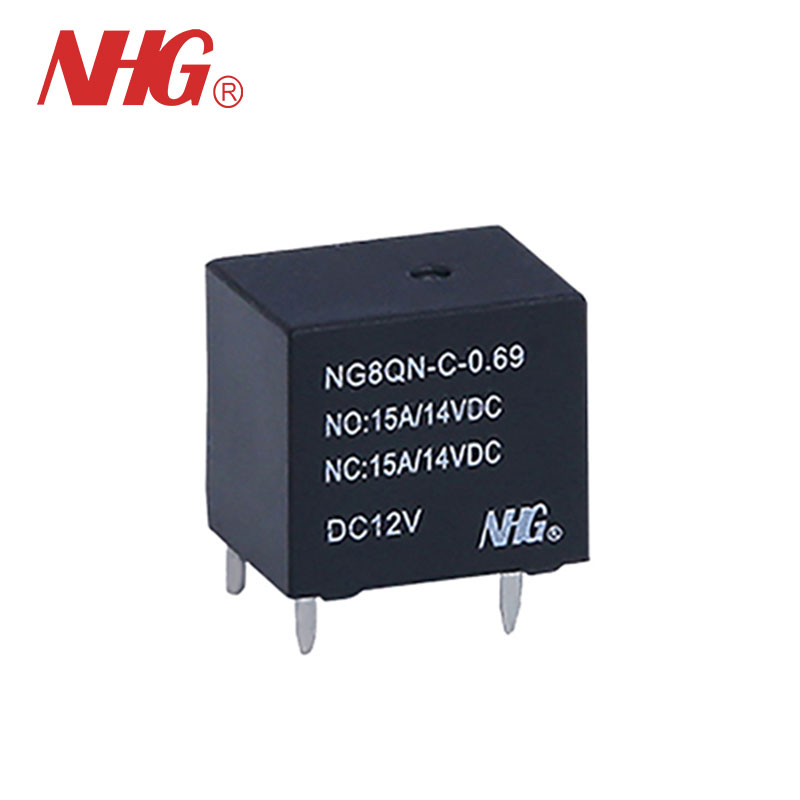
Ningbo Huaguan Electronics Co., Ltd. manufactures Automotive Relays with epoxy sealing that addresses all four of these failure modes. Our factory uses a vacuum-assisted epoxy filling process that eliminates air pockets and ensures complete encapsulation of the internal components.
2. How Does Epoxy Sealing Block Moisture and Contaminant Ingress?
Epoxy sealing works by completely filling the internal cavity of the relay with a thermosetting polymer. Once cured, the epoxy forms a solid, non-porous barrier that prevents moisture, oil, and other contaminants from reaching the internal components. The key properties of the epoxy that determine its effectiveness are the moisture vapor transmission rate (MVTR), the adhesion to the housing and the internal components, and the thermal expansion coefficient. The MVTR should be below 10 g/m²/day. The adhesion should be strong enough to prevent delamination during thermal cycling. The thermal expansion coefficient should be close to that of the metal components to minimize stress. The table below shows the properties of the epoxy used in our Automotive Relays.
| Property | Our epoxy specification | Industry requirement |
| Moisture vapor transmission rate | < 5 g/m²/day | < 10 g/m²/day |
| Thermal expansion coefficient | 35 x 10⁻⁶ /°C | < 50 x 10⁻⁶ /°C |
| Adhesion strength to PBT housing | > 8 MPa | > 5 MPa |
| Operating temperature range | -40°C to +150°C | -40°C to +125°C |
| Dielectric strength | > 15 kV/mm | > 10 kV/mm |
| Cure time (at 120°C) | 60 minutes | 90 minutes |
Our factory uses a two-component epoxy that is mixed and dispensed under vacuum. The vacuum eliminates air bubbles that could create paths for moisture. The epoxy is cured at 120°C for 60 minutes, which achieves full cross-linking and maximum adhesion. We also perform a 100 percent inspection of the sealed relays using a helium leak detector to verify that the seal is complete.
3. How Does Epoxy Sealing Improve Vibration and Thermal Cycling Resistance?
Epoxy sealing does more than just block moisture. It also provides mechanical support to the internal components. The armature, the contacts, and the coil are all embedded in the cured epoxy, which reduces their movement under vibration. This reduces the wear on the contact surfaces and the fatigue on the return spring. The epoxy also helps to distribute heat more evenly, which reduces the thermal gradient across the relay. The table below shows the effect of epoxy sealing on vibration and thermal cycling performance.
| Test condition | Unsealed relay | Epoxy sealed relay | Improvement |
| Vibration test (10 g RMS, 10-2000 Hz, 8 hours) | Contact resistance increased by 25% | Contact resistance increased by 3% | 8x better |
| Thermal cycling (-40°C to +125°C, 1000 cycles) | Housing cracked in 15% of units | No cracks | Complete elimination |
| Salt spray test (5% NaCl, 500 hours) | Severe corrosion on contacts | No corrosion | Complete protection |
| Humidity test (85°C, 85% RH, 1000 hours) | Contact resistance increased by 40% | Contact resistance increased by 5% | 8x better |
Ningbo Huaguan Electronics Co., Ltd. performs these tests on every batch of epoxy sealed Automotive Relays. Our factory has a vibration test system, a thermal cycling chamber, and a salt spray chamber. We provide the test reports with each shipment so that our customers can verify the reliability of the relays.
4. What Are the Key Process Controls for Epoxy Sealing?
The reliability of an epoxy sealed relay depends on the process controls. There are four critical control points. The first is the mixing ratio of the two epoxy components. An incorrect ratio will result in incomplete curing and poor adhesion. The second is the vacuum level during dispensing. Insufficient vacuum will leave air bubbles in the epoxy. The third is the curing temperature and time. Insufficient curing will result in a soft epoxy that does not provide adequate protection. The fourth is the inspection. A helium leak test or a pressure decay test is required to verify that the seal is complete. In our factory, we monitor all four control points with automated systems and record the data for each batch. We also retain samples from each batch for destructive testing.
Frequently Asked Questions About Epoxy Sealing for Automotive Relays
Summary for Automotive Electronics Engineers
Epoxy sealing is the most effective way to protect Automotive Relays in harsh engine compartment environments. It blocks moisture and contaminant ingress, provides mechanical support to reduce vibration fatigue, and improves thermal cycling resistance. The key to reliability is the epoxy formulation and the process controls. The MVTR, adhesion strength, and thermal expansion coefficient are the critical material properties. The mixing ratio, vacuum level, and curing profile are the critical process parameters. Ningbo Huaguan Electronics Co., Ltd. has been manufacturing epoxy sealed Automotive Relays for over 15 years and supplies to automotive OEMs and Tier 1 suppliers worldwide.
Ningbo Huaguan Electronics Co., Ltd. manufactures epoxy sealed Automotive Relays with a vacuum-assisted filling process and 100 percent helium leak inspection. We provide full test reports and process control data for all of our products.