How Does Bearing Steel Grade Affect Deep Groove Ball Bearing Life?
2026-11-03
A maintenance engineer compares two replacement records for the same motor. The motor uses a 6208 Deep Groove Ball Bearings. The first bearing, from supplier A, lasted 8,200 hours. The second bearing, from supplier B, lasted 31,000 hours. Both bearings have the same bore, the same outer diameter, the same width, and the same dynamic load rating printed in the catalog. The load, the speed, and the lubrication are identical. The engineer asks why the life differs by a factor of nearly four. The answer is in the steel. The two bearings are made from different steel grades, with different cleanliness levels and different heat treatment. The catalog rating assumes a certain steel quality, and the actual life depends on whether that quality is delivered. This guide explains the relationship between steel grade and bearing life.
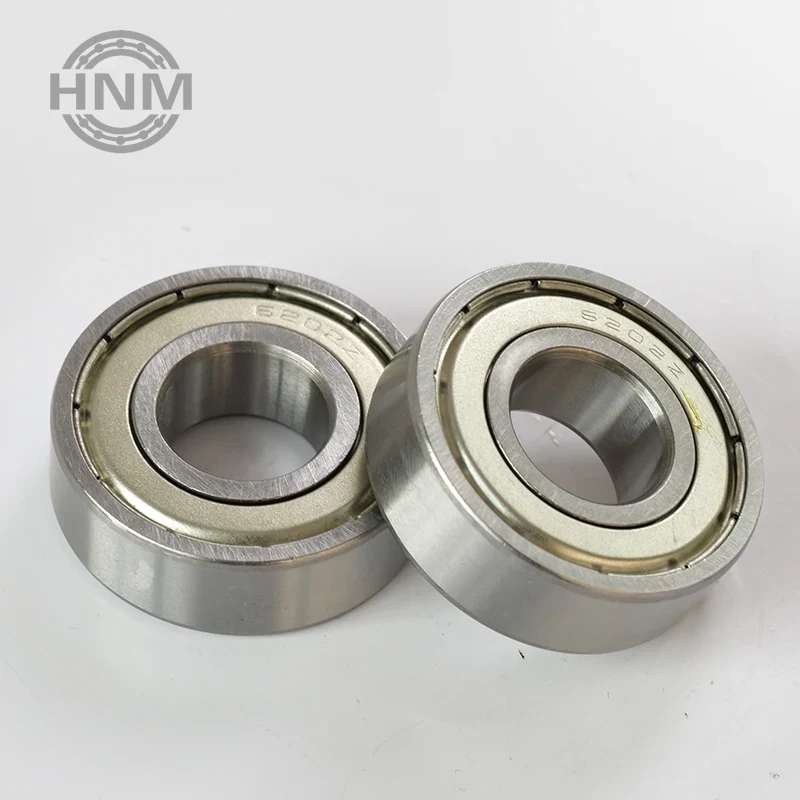
1. Why Does the Same Bearing Size Fail at 8,000 Hours in One Application and 30,000 Hours in Another?
The catalog life of a bearing is calculated from the dynamic load rating, which is based on the geometry and a reference steel quality. The reference quality assumes a certain level of non-metallic inclusions and a certain heat treatment. If the actual steel has more inclusions or a poorer heat treatment, the actual life is lower than the catalog life. The difference is not random. It is determined by the steel grade and by the steelmaking process. In our factory, we source bearing steel from mills that provide the inclusion rating and the oxygen content for each heat. Cixi Hengji Bearing Co., Ltd has been manufacturing Deep Groove Ball Bearings for over 12 years, and we specify the steel grade for each customer application.
The life difference is most visible in applications with high load or with marginal lubrication. In these applications, the fatigue initiation site is often a non-metallic inclusion. A cleaner steel has fewer inclusions and a longer fatigue life. A dirtier steel has more inclusions and a shorter life. The catalog rating does not distinguish between the two.
2. What Do the Steel Grade Designations Actually Specify?
The common bearing steel grades are GCr15 (equivalent to 100Cr6 and SUJ2), GCr15SiMn, and the higher-alloy grades for special applications. The grade designation specifies the chemical composition, but it does not specify the steelmaking process. Two heats of GCr15 can have very different cleanliness levels depending on whether the steel was produced by conventional electric arc melting, by vacuum degassing, or by electroslag remelting. The cleanliness is measured by the oxygen content and by the inclusion rating according to ISO 4967 or ASTM E45. The table below shows the relationship between the steelmaking process and the cleanliness.
| Steelmaking process | Oxygen content (ppm) | Inclusion rating (ISO 4967) | Relative life factor |
| Conventional electric arc | 20 – 30 | 2.0 – 3.0 | 1.0 (baseline) |
| Vacuum degassing | 10 – 15 | 1.0 – 1.5 | 1.5 – 2.0 |
| Vacuum degassing + electroslag remelting | 5 – 8 | 0.5 – 1.0 | 2.5 – 3.5 |
| Vacuum induction melting | 3 – 5 | < 0.5 | 3.5 – 5.0 |
The relative life factor is the ratio of the life of the cleaner steel to the life of the baseline steel under the same load and lubrication. The factor is not a guarantee. It is an average from accelerated life testing. In our factory, we use vacuum degassed steel as the standard for our general purpose bearings and electroslag remelted steel for our long life bearings. Cixi Hengji Bearing Co., Ltd provides the steel certificate with the oxygen content and the inclusion rating for each production lot.
3. How Do Non-Metallic Inclusions Become Fatigue Initiation Sites?
A non-metallic inclusion is a particle of oxide, sulfide, or nitride that is trapped in the steel during solidification. When the bearing rolls under load, the stress field around the inclusion is higher than the stress in the surrounding steel. The inclusion can debond from the matrix or crack, and the crack propagates into the bearing raceway. The result is a spall, which is the fatigue failure mode of a bearing. The size and the location of the inclusion determine whether it becomes a failure site. A large inclusion near the raceway surface is more dangerous than a small inclusion deep in the section. The table below shows the effect of the inclusion type, size, and location on the fatigue life.
| Inclusion type | Typical size | Location effect | Relative fatigue life impact |
| Oxide (alumina) | 10 – 50 µm | Surface or subsurface | Severe (life reduction 50 – 80%) |
| Sulfide (MnS) | 20 – 100 µm | Subsurface | Moderate (life reduction 20 – 40%) |
| Nitride (TiN) | 5 – 20 µm | Surface | Severe (life reduction 40 – 70%) |
| Globular oxide | < 10 µm | Subsurface | Low (life reduction < 10%) |
Bearing engineer's note: The oxide inclusions are the most harmful because they are hard and brittle. They do not deform with the steel matrix, so they create a stress concentration. The sulfide inclusions are softer and deform with the matrix, so they are less harmful. The nitride inclusions are hard and are often located at the surface, where the stress is highest. In our factory, we specify an oxide inclusion rating of 1.5 or better according to ISO 4967 for our long life bearings. Hengji verifies the inclusion rating by metallographic examination of a sample from each heat.
4. Why Does Heat Treatment Determine Whether the Steel Grade Reaches Its Potential?
The heat treatment converts the annealed steel into the hardened structure that gives the bearing its load capacity. The quenching temperature, the holding time, and the cooling rate determine the amount of retained austenite and the uniformity of the martensite. A high retained austenite content reduces the dimensional stability and can cause the bearing to change size in service. A non-uniform martensite causes a variation in hardness and a variation in fatigue life. The tempering temperature determines the balance between hardness and toughness. In our factory, we control the heat treatment in a sealed quench furnace with a carbon potential controller. We measure the hardness and the retained austenite on a sample from each lot.
We also control the case depth for the bearings that are case hardened. The case depth must be deep enough to support the load but not so deep that the core becomes brittle. The case depth is measured by microhardness traverse on a cross section. Our heat treatment records are kept for five years and are available for review during a customer audit.
5. How Should Buyers Specify and Verify Bearing Steel Grade for Long Life Applications?
The specification should include five items. The first is the steel grade and the steelmaking process. The second is the oxygen content limit. The third is the inclusion rating limit according to ISO 4967 or ASTM E45. The fourth is the heat treatment hardness and the retained austenite limit. The fifth is the life test requirement. The verification should include four checks. The first is the steel certificate review. The second is the metallographic examination. The third is the hardness and case depth measurement. The fourth is the accelerated life test on a sample. In our factory, we perform these checks on every lot and provide the test report with the shipment. Cixi Hengji Bearing Co., Ltd also offers a life test service for critical applications.
We recommend that the buyer specify the steelmaking process, not just the grade. A purchase order that says "GCr15" allows the supplier to deliver conventional electric arc steel, which may have an oxygen content of 25 ppm and an inclusion rating of 2.5. A purchase order that says "GCr15, vacuum degassed, oxygen max 15 ppm, ISO 4967 oxide rating max 1.5" specifies the quality that the application requires.
Frequently Asked Questions About Bearing Steel Grade and Deep Groove Ball Bearing Life
Summary for Bearing Buyers and Maintenance Engineers
The bearing steel grade affects the life of Deep Groove Ball Bearings through the steel cleanliness and the heat treatment. The grade designation specifies the chemical composition, but the steelmaking process determines the oxygen content and the inclusion rating. The inclusions, especially the oxide and nitride types, become fatigue initiation sites and reduce the life. The heat treatment determines whether the steel reaches its potential hardness and dimensional stability. The specification should include the steelmaking process, the oxygen content limit, the inclusion rating, and the heat treatment requirements. The verification should include the steel certificate, the metallographic examination, the hardness measurement, and the life test. Cixi Hengji Bearing Co., Ltd has been manufacturing Deep Groove Ball Bearings for over 12 years and provides full steel grade and life verification support for our customers.