

How Does a Screw Part Rolling Machine Improve Production Efficiency?
2025-12-11
A Screw Part Rolling Machine is an automated cold-forming system engineered to produce threaded fasteners, precision screws, and other cylindrical components by applying high-pressure deformation rather than cutting. This process enhances structural integrity, dimensional accuracy, and manufacturing throughput. The following article examines how such a machine supports industrial-scale production, the operational framework behind thread rolling, critical technical parameters, selection considerations, and emerging technological trajectories. The core objective is to help readers understand how the right machine configuration accelerates output quality and cost performance in competitive manufacturing environments.
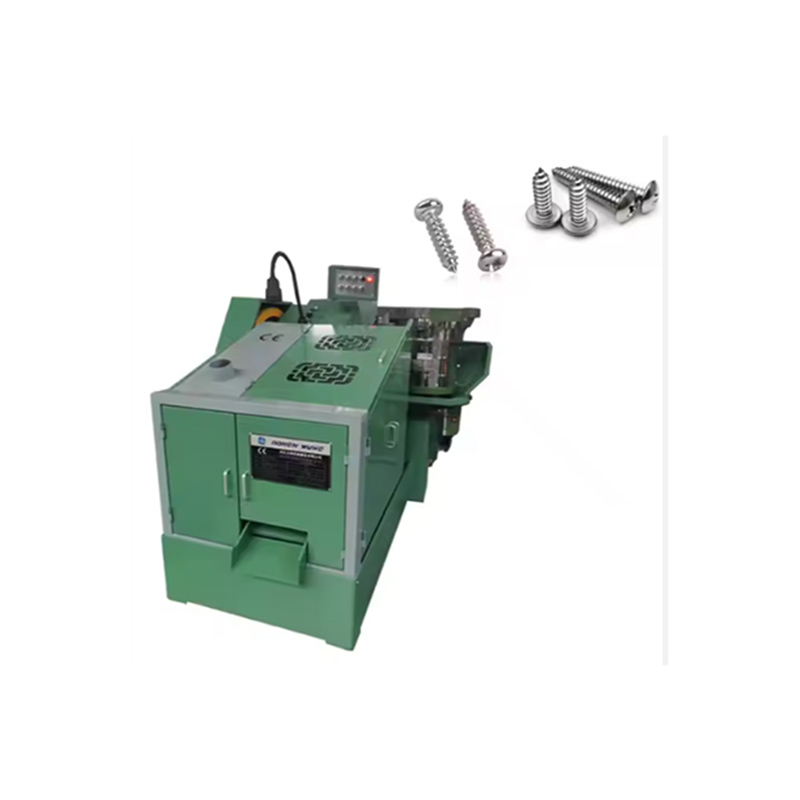
To support professional evaluation, the primary technical specifications for a typical high-precision Screw Part Rolling Machine are shown below.
Key Technical Parameters
| Parameter | Specification Description |
|---|---|
| Rolling Capacity | Suitable for screw diameters from 1.5 mm to 12 mm depending on model variant |
| Max Rolling Length | 5 mm–120 mm standard; extended configurations available |
| Spindle Speed | 0–150 rpm adjustable through variable-frequency control |
| Feeding System | Automatic hopper + vibration feeder for stable, continuous part loading |
| Rolling Die Type | Flat dies or round dies (single-spindle or double-spindle) depending on application |
| Rolling Force | 3–15 tons based on material hardness and thread profile |
| Motor Power | 3–7.5 kW depending on model |
| Production Output | Up to 150–350 pieces per minute based on size and thread pitch |
| Material Compatibility | Carbon steel, alloy steel, stainless steel, copper, aluminum |
| Dimensional Tolerance | ±0.01 mm depending on die quality and machine calibration |
This foundational overview establishes the platform for a deeper exploration of how a Screw Part Rolling Machine strengthens production lines and how industries can strategically adopt this equipment to sustain throughput consistency, accuracy, and product reliability.
How Does a Screw Part Rolling Machine Optimize Manufacturing Throughput?
A Screw Part Rolling Machine enhances production throughput through a mechanical deformation process known as cold rolling. Unlike cutting-based threading, which removes material, cold rolling displaces material along a die cavity to form threads with improved strength and geometrical uniformity. The absence of chip formation shortens cycle time, reduces tool wear, and ensures consistent screw profiles. Manufacturers in sectors such as automotive, electronics, construction hardware, and appliance assembly benefit from the machine’s ability to perform continuous, repeatable operations with minimal downtime.
Thread rolling also creates a superior grain flow pattern within the screw body. This refined metallurgical structure increases tensile strength—sometimes by as much as 30 percent—allowing the same material grade to achieve higher mechanical performance compared with cut threads. Production operations therefore benefit from both higher throughput and stronger finished products.
Automated feeding systems further optimize throughput by ensuring that blank screws are consistently supplied to the rolling area. High-precision servo controls synchronize die movement with the feeding cycle, enabling stable high-speed production. As a result, output quality is not only maintained but improved over manual or semi-automatic threading systems.
Power consumption efficiency also plays a role in throughput optimization. Because the rolling process relies on pressure rather than cutting, operational energy draw remains comparatively low. This contributes to lower per-unit manufacturing costs, expanding competitive advantages for producers seeking to lower waste and increase efficiency.
How to Evaluate the Technical Performance and Operational Stability of a Screw Part Rolling Machine?
Evaluating the performance of a Screw Part Rolling Machine involves reviewing several interrelated indicators that determine accuracy, repeatability, durability, and operational smoothness. Understanding these factors helps industrial buyers select machinery aligned with production requirements and cost objectives. Key evaluation dimensions include mechanical stability, die quality, automation systems, environmental adaptability, and long-term maintenance implications.
Mechanical Frame Stability
The structural rigidity of the machine body governs vibration resistance, die alignment, and rolling accuracy. Heavy-duty, high-density cast iron machine frames offer superior resistance to deformation, enabling stable rolling force even under high-pressure loads. This structural integrity supports sustained accurate threading across continuous cycles.
Die Configuration and Material Quality
Die quality directly influences surface finish, thread profile precision, and die longevity. High-grade tool steel or cemented carbide dies provide long service life, withstand high rolling forces, and maintain thread form accuracy. Machine compatibility with both flat and round dies broadens production flexibility across screw types and thread standards, such as metric, UNC, UNF, ACME, and special custom threads.
Feeding and Control System Accuracy
Servo-driven feeding systems ensure consistent material flow, preventing skewed alignment or thread deformation. Vibration feeders support small-diameter or lightweight parts, reducing production interruptions. Programmable logic control (PLC) systems allow users to configure speed, torque limits, feeding intervals, and emergency stoppage protocols. This enhances operational safety while enabling precise control over the rolling process.
Environmental and Material Adaptability
Production environments vary widely, and machine adaptability ensures stable performance regardless of ambient temperature, humidity, or material hardness variations. For example, rolling stainless steel or high-carbon steel requires higher rolling force and greater die durability. Machines optimized for these conditions maintain thread integrity without compromising die lifespan.
Maintenance Accessibility
Routine maintenance considerations—such as lubrication points, die replacement access, and real-time diagnostics—affect long-term operating costs. Machines with modular components simplify part replacement and reduce downtime, contributing to higher machine utilization rates.
These evaluation criteria frame how industrial users can objectively assess a Screw Part Rolling Machine’s long-term performance, operational continuity, and expected return on investment.
How Does a Screw Part Rolling Machine Compare to Conventional Thread Cutting Equipment?
Comparing thread rolling with thread cutting illustrates clear distinctions in strength, cost efficiency, and cycle performance. Thread cutting machines physically remove material using taps, dies, or cutting inserts, whereas rolling machines displace material through compression. This fundamental difference produces significant downstream impacts.
Mechanical Strength and Product Durability
Rolled threads possess a denser grain structure that follows the contour of the thread. This improves shear strength, fatigue resistance, and wear resistance. Cut threads, in contrast, have interrupted grain flow, making them more susceptible to structural weaknesses under tensile loads.
Cycle Time and Production Speed
Thread cutting requires multiple strokes or rotational passes to remove material gradually. Thread rolling accomplishes full thread formation in a single pass, resulting in significantly faster cycle times. In high-volume operations, this speed difference equates to thousands of additional parts produced per shift.
Tooling Wear and Replacement Cost
Cutting tools dull quickly due to friction and material removal, particularly when processing hardened materials. Rolling dies experience slower wear rates because they form rather than cut. Although die sets may require higher upfront investment, the extended service life often results in lower cost per thread.
Surface Finish and Dimensional Precision
Rolling creates a naturally burnished surface with low roughness values. Cut threads typically require secondary finishing steps to achieve similar smoothness. Dimensional precision is consistently high in rolling systems because the forming process naturally follows die geometry.
Material Waste and Sustainability
Cutting generates metal chips that require disposal and occasionally recapture through recycling processes. Rolling eliminates chip waste entirely, reducing environmental impact and contributing to sustainable production practices.
The comparative assessment demonstrates why many industries shift to rolling technology for improved efficiency, reduced operating cost, and enhanced product reliability. These advantages establish thread rolling as a preferred solution for modern mass production.
How Will Screw Part Rolling Machine Technology Evolve in the Future?
The future of Screw Part Rolling Machines is defined by automation, intelligent monitoring, higher material adaptability, and integrated smart manufacturing ecosystems. These advancements align with global trends in Industry 4.0 and digital transformation.
Integration with Smart Factory Platforms
Screw Part Rolling Machines increasingly incorporate real-time data collection through sensors and industrial IoT modules. Parameters such as spindle temperature, die load, vibration metrics, output rates, and error logs are transmitted to central monitoring systems. Manufacturers gain predictive maintenance capabilities, minimizing unplanned downtime.
Adaptive Rolling Mechanics
Future systems will dynamically adjust rolling force, spindle speed, and die timing based on material stress readings. Such adaptive algorithms can modify threading parameters on the fly, ensuring optimal thread formation even when material hardness varies from batch to batch.
Higher Precision for Miniature and Micro Screws
Electronics and medical device industries demand ultra-small fasteners. This trend drives development of micro-rolling technology capable of producing miniature screws with sub-millimeter thread profiles while maintaining high consistency and structural integrity.
Environment-Friendly Production Models
Energy-efficient motors, enhanced lubrication systems, and recyclable die materials will contribute to more sustainable operations. Machines will continue to reduce waste output and operational emissions while delivering high throughput.
Hybrid Manufacturing Integration
Future rolling machines may integrate additional forming or shaping capabilities in a modular fashion. This would consolidate multiple manufacturing steps—such as head forming, thread rolling, and part marking—into a single operational cell, reducing handling time and overall floor space requirements.
These evolutions illustrate a long-term trajectory toward increased automation, less human intervention, and tighter integration with enterprise-level production planning systems. Collectively, these advancements position Screw Part Rolling Machines as essential productivity assets in high-precision industrial manufacturing.
Frequently Asked Questions
Q: What materials are most suitable for thread rolling on this type of machine?
A: The machine performs best with ductile materials that can undergo plastic deformation without cracking. Carbon steel, stainless steel, alloy steel, copper, and aluminum are commonly processed. Materials with extremely high hardness may require pre-heating or specialized die materials to maintain thread accuracy and prevent die damage.
Q: How often should rolling dies be replaced in continuous production?
A: Replacement frequency varies based on material hardness, production speed, lubrication quality, and die steel grade. Under standard production conditions using medium-hardness carbon steel, die sets typically last between 50,000 and 300,000 cycles. High-grade carbide dies extend lifespan significantly. Regular inspection of thread geometry and surface finish helps determine optimal replacement intervals.
A Screw Part Rolling Machine represents a critical asset for manufacturers seeking to enhance production efficiency, improve thread performance, reduce costs, and sustain competitive advantages in high-volume environments. By leveraging the cold-forming principle, industries can achieve superior mechanical strength, tighter dimensional accuracy, and optimized operational throughput. Evaluating machine structure, control systems, die quality, and automation capabilities ensures that organizations select equipment aligned with their production demands and long-term strategic objectives. As manufacturing ecosystems continue evolving toward highly automated, data-driven models, rolling machines will play an increasingly central role in integrated industrial workflows.
Ronen® supports industrial buyers by providing durable, high-precision rolling systems engineered for long-life performance and enhanced operational stability. For detailed specifications, customized configurations, or procurement consultation, contact us for further assistance.
