Abstract: Lock nuts are essential mechanical components designed to prevent unintended loosening caused by vibration, torque, or dynamic loads. This article provides a comprehensive explanation of how lock nuts function, their types, industrial applications, installation practices, and maintenance strategies. It is designed to help engineers, procurement specialists, and maintenance professionals make informed decisions when selecting fastening solutions for critical assemblies.
1. Introduction to Lock Nuts
Fastener loosening is one of the most persistent mechanical failures in industrial and structural systems. Whether caused by vibration, thermal cycling, or dynamic loads, loosening fasteners can lead to equipment malfunction, safety hazards, and costly downtime. Lock nuts are engineered to solve this problem by introducing resistance to rotational loosening while maintaining structural integrity.
They are widely used across automotive systems, heavy machinery, aerospace assemblies, electrical installations, and construction equipment. Understanding their behavior is essential for ensuring long-term reliability in any bolted joint system.
2. What is a Lock Nut?
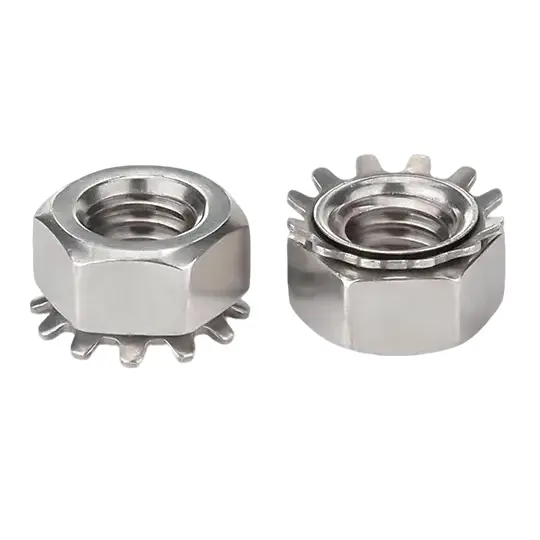
A lock nut is a specialized nut designed with features that increase friction or mechanical interference to resist loosening under stress. Unlike standard hex nuts, lock nuts incorporate structural modifications such as deformation, inserts, or thread locking mechanisms.
Common engineering objectives of lock nuts include:
-
Preventing self-loosening under vibration
-
Maintaining preload in bolted joints
-
Enhancing safety in dynamic mechanical systems
-
Reducing maintenance frequency
3. How a Lock Nut Works
The working principle of a lock nut depends on increasing resistance to rotational motion. This is achieved through different mechanical and friction-based mechanisms:
-
Elastic deformation: The nut is intentionally deformed so that it grips the bolt threads tightly.
-
Friction enhancement: Nylon inserts or prevailing torque designs increase resistance during rotation.
-
Mechanical interference: Thread distortion creates controlled resistance to movement.
When installed, a lock nut creates a preload force that counteracts external vibrations. As vibration attempts to loosen the nut, internal resistance forces maintain the clamping load, preventing rotation.
In engineering terms, the lock nut increases the coefficient of friction between mating threads and introduces prevailing torque that must be overcome for loosening to occur.
4. Types of Lock Nuts
Different applications require different locking mechanisms. Below is a structured comparison of common lock nut types:
|
Type
|
Mechanism
|
Advantages
|
Typical Use
|
|
Nylon Insert Lock Nut
|
Polymer ring increases friction
|
Reusable, vibration resistant
|
Automotive, machinery
|
|
All-Metal Lock Nut
|
Deformed threads or elliptical shape
|
High temperature resistance
|
Industrial equipment
|
|
Flange Lock Nut
|
Integrated washer base increases grip
|
Load distribution, anti-loosening
|
Structural assemblies
|
|
Stover Lock Nut
|
Distorted top threads
|
Strong vibration resistance
|
Aerospace, heavy machinery
|
5. Industrial Applications
Lock nuts are critical in systems where failure is not an option. Their usage spans multiple industries:
-
Automotive: suspension systems, engine mounts, wheel assemblies
-
Aerospace: structural frames, vibration-prone assemblies
-
Construction: steel structures, scaffolding systems
-
Electrical systems: panel mounting, grounding assemblies
-
Heavy machinery: mining equipment, hydraulic systems
In each case, the primary goal is to maintain joint integrity under continuous stress and vibration.
6. Installation Guidelines
Proper installation is critical for achieving optimal performance from a lock nut. Incorrect installation can significantly reduce its effectiveness.
Recommended steps include:
-
Ensure threads are clean and free from debris.
-
Align nut properly before applying torque.
-
Use calibrated torque tools to achieve correct preload.
-
Avoid over-tightening nylon insert types to prevent damage.
For industrial applications, torque specifications should always be followed according to engineering design requirements.
7. Common Problems and Solutions
Even high-quality lock nuts may encounter issues if misused or exposed to extreme conditions.
-
Thread wear: Caused by repeated reuse → Solution: replace after limited cycles
-
Loss of locking force: Occurs under extreme heat → Solution: use all-metal variants
-
Improper torque: Leads to insufficient preload → Solution: use torque calibration tools
8. Maintenance and Best Practices
To maximize lifespan and performance:
-
Inspect fasteners regularly in high-vibration environments
-
Replace lock nuts after disassembly in critical applications
-
Avoid mixing incompatible materials (e.g., stainless with carbon steel without coating consideration)
-
Store in dry conditions to prevent corrosion
Proper maintenance ensures long-term structural stability and reduces unexpected downtime.
9. Key Advantages
Lock nuts provide multiple engineering benefits:
-
Improved resistance to vibration-induced loosening
-
Enhanced safety in structural systems
-
Reduced maintenance requirements
-
Wide compatibility with standard bolts
-
Cost-effective long-term fastening solution
These advantages make them a preferred choice for engineers across industries.
10. Frequently Asked Questions
Q1: Can lock nuts be reused?
Some types, such as nylon insert lock nuts, have limited reuse cycles depending on application conditions.
Q2: Are lock nuts necessary in low-vibration environments?
Not always, but they are recommended for safety-critical assemblies.
Q3: What is the main failure mode of a lock nut?
Loss of locking friction due to wear, heat exposure, or improper installation.
Q4: How do I choose the right lock nut?
Selection depends on load conditions, temperature, vibration level, and material compatibility.
11. Conclusion and Contact
Lock nuts are essential components in modern mechanical and structural systems, providing reliable resistance against loosening under dynamic conditions. Understanding their working principles, types, and correct application methods ensures maximum performance and safety in engineering projects.
For high-quality fastening solutions, Jiaxing Aoke Trading Co., Ltd. offers a wide range of precision-engineered lock nuts designed for industrial reliability and long service life. Their products are manufactured to meet demanding application requirements across global markets.
Contact us today to explore customized fastening solutions and technical support tailored to your project needs. Partner with Jiaxing Aoke Trading Co., Ltd. to ensure your assemblies remain secure, stable, and efficient under all operating conditions.