How do you troubleshoot melt fracture and surface roughness in ABS profile extrusion
2026-05-07
Melt fracture and surface roughness are persistent challenges in any ABS Profile Extrusion Line, often leading to rejected batches and reduced throughput. At Yongte, we have helped dozens of processors diagnose these defects systematically.
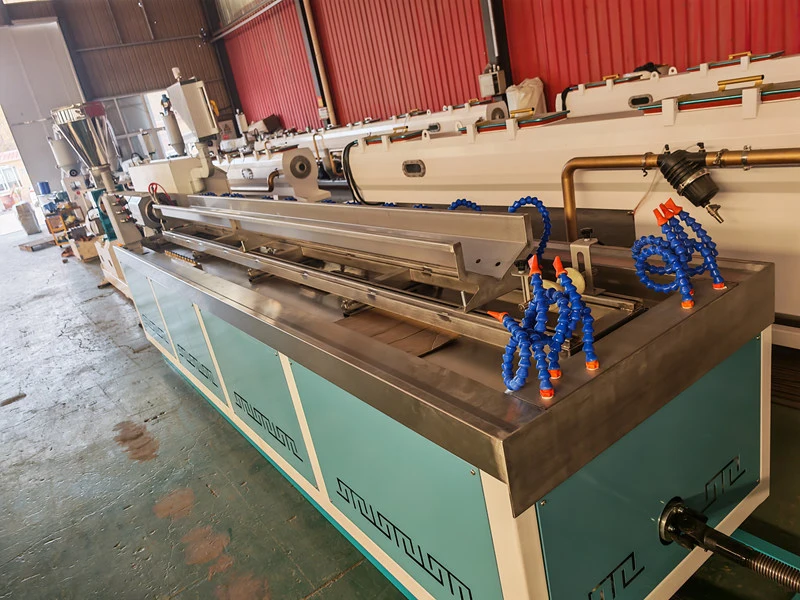
Root Causes at a Glance
| Defect | Primary Cause | Secondary Cause |
|---|---|---|
| Melt fracture (sharkskin, screw-stress pattern) | High shear rate at die exit | Incompatible die land length |
| Surface roughness (orange peel, matte finish) | Moisture content >0.1% | Inconsistent melt temperature |
| Gross melt fracture (chaotic distortion) | Die entry stress concentration | Over-pressurization |
Step-by-Step Troubleshooting Workflow
Step 1: Check Moisture and Material Conditioning
ABS is hygroscopic. Even 0.05% excess moisture vaporizes at the die lip, creating micro-explosions on the surface. Dry at 80-85°C for 2-4 hours using a dehumidifying dryer.
Step 2: Adjust Die Design Parameters
Reduce output temporarily. If melt fracture disappears, your die land length is too short relative to shear rate. Increase land length to 15-20 times the gap.
Step 3: Modify Temperature Profile
Lower the rear zone temperature by 5-10°C while increasing the adapter zone slightly. This reduces viscosity gradient across the ABS Profile Extrusion Line.
Step 4: Examine Screw Configuration
A mixing section (e.g., Maddock or pineapple mixer) can eliminate unmelted particles that scratch the surface. Yongte recommends barrier screws for ABS to improve homogenization.
ABS Profile Extrusion Line FAQ
Question 1: Why does melt fracture only appear when I increase line speed above 2 m/min?
Answer: Melt fracture is shear-rate dependent. At higher line speeds, the volumetric output forces the ABS melt through the die at a critical wall shear stress (approximately 0.2-0.3 MPa for most ABS grades). Once exceeding this value, the melt tears at the die lip. Solution: either increase die gap (reduces shear rate), switch to a lower-MFR ABS, or apply a fluoropolymer processing aid. Yongte systems include adjustable die geometries to delay the onset of melt fracture.
Question 2: How do I distinguish between moisture-induced roughness and die-line roughness?
Answer: Moisture roughness appears as random clusters of tiny craters or silvery streaks across the entire profile surface, visible within seconds of start-up. Die-line roughness shows parallel, continuous scratches or grooves aligned with the extrusion direction, often originating from a burr or carbon deposit on the die lip. To verify: rub the surface with a fingernail. Moisture defects are uniformly shallow; die-line defects are deeper and repeated at fixed intervals. A Yongte technician can perform on-site surface analysis to pinpoint the source.
Question 3: Can worn screws cause surface roughness without altering output pressure?
Answer: Yes. A screw with worn flight tips (especially in the metering section) allows solid ABS granules to slip past the flights. These unmelted particles exit the die as hard specks, creating random pitting and roughness downstream. Pressure may remain stable if the screw still develops enough head pressure. Measure screen pack pressure drop over 24 hours. If pressure drops faster than normal without visible screen pack blinding, inspect screw dimensions. Yongte offers refurbished screws with hard chrome plating specifically for abrasive ABS compounds.
Preventive Maintenance Checklist for Your ABS Profile Extrusion Line
-
Daily: Inspect die lip for carbon buildup using a brass scraper
-
Weekly: Verify thermocouple accuracy at die and adapter zones (drift >3°C causes roughness)
-
Monthly: Pull screw and measure flight clearance (replace if >0.5mm for 75mm screw)
-
Per batch: Record moisture content via loss-on-drying moisture meter
Summary Table: Quick Reference for Operators
| Symptom | Immediate Action | Long-term Fix |
|---|---|---|
| Sharkskin at high speed | Reduce line speed by 20% | Lengthen die land or add polymer processing aid |
| Orange peel texture | Check dryer dewpoint (< -40°C) | Install downstream dryer regeneration alarm |
| Periodic gouges (every 5-10m) | Inspect cooling calibration tank for debris | Add mesh filter before water spray |
Effective troubleshooting requires a systematic approach. Yongte provides complete documentation, on-site training, and retrofit components for any ABS Profile Extrusion Line, from screw redesign to die laser scanning.
Contact us today for a free surface defect audit. Our engineers will analyze your current profile samples and deliver a written improvement plan within 48 hours.