How Do You Install a DIN 7967 Self-Locking Pal Nut Correctly
2026-10-26
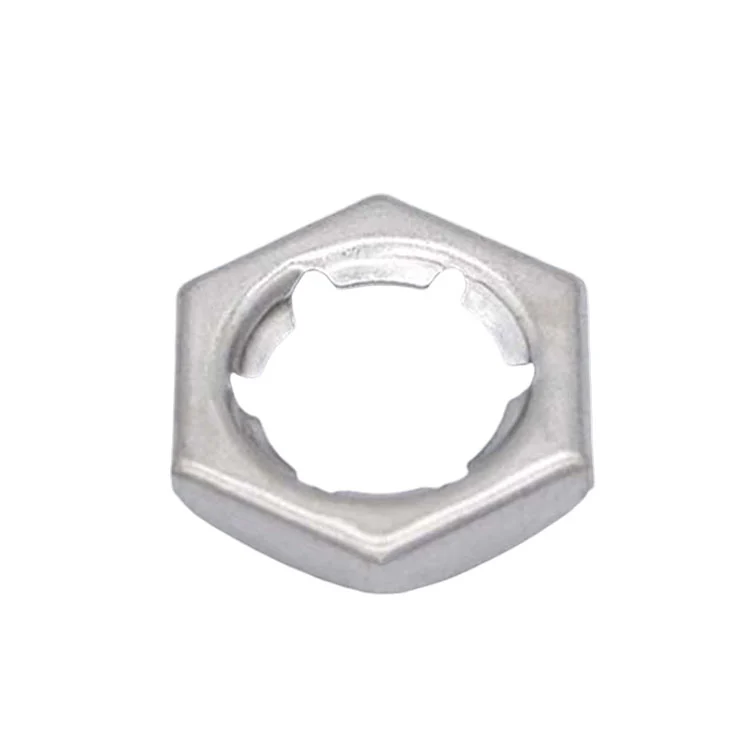
Proper installation of a DIN 7967 Self-Locking Pal Nut is essential for achieving reliable vibration resistance and long-term joint integrity. As a thin, all-metal lock nut with a distinctive multi-point crown, this fastener relies on correct seating and controlled deformation of the locking prongs rather than on a nylon insert. Zhenhua has manufactured and supplied DIN 7967 Self-Locking Pal Nut components for industrial assemblies for years, and the guidance below reflects the practices that consistently produce secure, repeatable results in production and maintenance environments.
Understanding the Fastener Before Installation
The DIN 7967 Self-Locking Pal Nut is a stamped, one-piece locking nut with raised prongs that grip the mating thread when tightened. Correct installation depends on understanding three characteristics:
-
Thread engagement: The nut must engage a sufficient number of full threads to develop locking action.
-
Seating surface: A flat, perpendicular bearing surface is required for even load distribution.
-
Prong deformation: The locking effect comes from controlled elastic deflection of the crown, not from over-tightening.
Zhenhua recommends inspecting each DIN 7967 Self-Locking Pal Nut for prong damage and thread cleanliness before assembly, since stamped nuts are sensitive to burrs and debris.
Step-by-Step Installation Procedure
| Step | Action | Key Parameter | Common Error |
|---|---|---|---|
| 1 | Verify thread match and pitch | Confirm nut and bolt share the same metric thread | Forcing a mismatched pitch |
| 2 | Clean and inspect | Free of burrs, oil film, and debris | Installing over damaged threads |
| 3 | Align on the thread by hand | Nut should spin on freely until prongs contact | Cross-threading at start |
| 4 | Seat against the bearing surface | Flat, perpendicular contact | Angled seating on chamfers |
| 5 | Tighten to specification | Use the torque value for the nut size and property class | Over-compressing the prongs |
| 6 | Verify locking action | Nut should resist back-off by hand | Accepting a loose fit |
| 7 | Final inspection | Check for prong deformation and full seating | Skipping post-install checks |
Recommended Tightening Guidance
| Nut Size | Typical Seating Torque Range | Thread Engagement |
|---|---|---|
| M5 | Low, hand-tool range | Minimum 3 full threads |
| M6 | Low, hand-tool range | Minimum 3 full threads |
| M8 | Moderate, controlled wrench | Minimum 3 full threads |
| M10 | Moderate, controlled wrench | Minimum 3 full threads |
Exact values depend on property class, coating, and mating material. Zhenhua supplies dimensional and material data with each DIN 7967 Self-Locking Pal Nut order so that engineers can set torque limits precisely.
Best Practices That Prevent Failures
-
Never reuse a deformed nut. Once the prongs have been compressed beyond their elastic range, locking performance drops sharply.
-
Avoid lubricants on the locking crown. Excess lubrication can reduce friction-dependent locking behavior.
-
Use hardened washers where the bearing surface is soft or uneven.
-
Match nut thickness to the application. Thin pal nuts suit low-profile joints; thicker variants suit higher load paths.
-
Confirm the standard. The DIN 7967 Self-Locking Pal Nut is a specific dimensional standard, and substituting a generic pal nut can change performance.
Frequently Asked Questions
Can a DIN 7967 Self-Locking Pal Nut be reused after removal?
No, a DIN 7967 Self-Locking Pal Nut should generally be replaced after removal because the locking prongs deform permanently during tightening, and reuse reduces holding torque and vibration resistance.
What thread engagement is required for reliable locking?
A minimum of three full threads of engagement is recommended for a DIN 7967 Self-Locking Pal Nut, and shorter engagement risks inadequate locking action and thread stripping under load.
Does the DIN 7967 Self-Locking Pal Nut work on both standard and fine threads?
Yes, the DIN 7967 Self-Locking Pal Nut is available in multiple metric thread pitches, but the nut must be matched precisely to the bolt pitch, since a fine-thread nut will not lock correctly on a coarse-thread fastener.
What causes a DIN 7967 Self-Locking Pal Nut to loosen after installation?
Loosening usually results from insufficient thread engagement, an uneven bearing surface, over-compression of the prongs, or reuse of a deformed nut, all of which reduce the DIN 7967 Self-Locking Pal Nut locking effect.
Which industries commonly use the DIN 7967 Self-Locking Pal Nut?
The DIN 7967 Self-Locking Pal Nut is widely used in automotive, appliance, electrical enclosure, and general machinery assemblies where a thin, low-cost, vibration-resistant lock nut is required.
Contact Us
For dimensional drawings, material certificates, torque guidance, or sample evaluation of the DIN 7967 Self-Locking Pal Nut, contact Zhenhua today and let our engineering team support your next assembly project with dependable fastening solutions.