How Do You Choose the Right Size of Single Direction Thrust Ball Bearings
2026-11-02
Selecting the correct size of Single Direction Thrust Ball Bearings is one of the most consequential decisions in axial load system design. An undersized bearing will fail early through raceway brinelling or cage damage, while an oversized unit adds unnecessary weight, cost, and housing complexity. At BMT, we have supported hundreds of OEM and MRO projects where sizing errors were the root cause of premature failure. This guide distills the practical criteria our engineers apply when matching Single Direction Thrust Ball Bearings to real operating conditions.
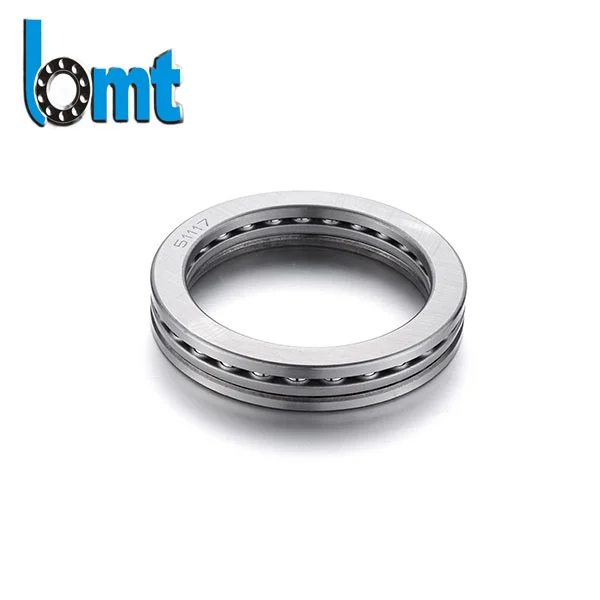
Start With the Load Case, Not the Catalog
The most common mistake is opening a catalog and picking a bore size that fits the shaft. Single Direction Thrust Ball Bearings carry axial load in one direction only, so the sizing process must begin with a clear load definition.
Key inputs to establish before sizing:
-
Pure axial load magnitude (continuous and peak)
-
Presence of radial load — these bearings are not designed for it
-
Speed range including startup and overspeed conditions
-
Operating temperature and lubrication method
-
Required life in hours or revolutions
-
Available axial space in the housing
Dynamic and Static Load Rating Checks
Every BMT Single Direction Thrust Ball Bearings datasheet lists dynamic load rating (Ca) and static load rating (C0a). Both must be verified.
| Check | Formula / Criterion | Purpose |
|---|---|---|
| Dynamic life | L10 = (Ca / P)³ × 10⁶ rev | Confirms fatigue life target |
| Static safety | s0 = C0a / P0 ≥ 2–3 | Prevents brinelling at peak load |
| Speed limit | n ≤ n_lim (oil or grease) | Avoids cage and lubrication breakdown |
| Minimum load | P ≥ 0.01 × Ca | Prevents skidding of balls |
For applications with shock loads, BMT recommends applying a service factor of 1.5 to 2.0 to the calculated axial load before entering the life equation. This single step eliminates most field failures we diagnose in thrust bearing applications.
Geometry and Envelope Constraints
Sizing is not only about load rating. The selected Single Direction Thrust Ball Bearings must fit the available axial envelope while maintaining adequate shaft and housing shoulder support.
| Parameter | Design Guidance |
|---|---|
| Shaft washer bore | Match shaft diameter with h6 or j6 fit |
| Housing washer OD | H7 or H8 housing bore for free axial float |
| Minimum shoulder height | At least 1.5 × ball diameter for uniform support |
| Axial clearance | Allow 0.2–0.5 mm for thermal growth |
| Misalignment tolerance | Keep below 0.05° — thrust ball bearings do not self-align |
Speed, Lubrication, and Thermal Verification
A bearing that passes the load check may still be wrong if the speed-lubrication combination is marginal. BMT Single Direction Thrust Ball Bearings are available in pressed steel and machined brass cage variants; the cage type directly affects the permissible speed.
-
Grease lubrication: use for lower speeds and maintenance-free designs
-
Oil lubrication: required for higher dn values and heat dissipation
-
Verify operating temperature stays below the lubricant's continuous limit
-
Confirm the housing material's thermal expansion does not consume axial clearance
FAQ: Single Direction Thrust Ball Bearings
Q: Can Single Direction Thrust Ball Bearings accommodate any radial load?
A: No. Single Direction Thrust Ball Bearings are designed exclusively for axial load in one direction. Any radial component must be carried by a separate radial bearing, such as a deep groove ball bearing or cylindrical roller bearing, arranged on the same shaft. Allowing even modest radial load to act on the thrust washers causes uneven ball loading, cage wear, and rapid raceway failure.
Q: How do I calculate the equivalent axial load for sizing?
A: For pure axial loading, the equivalent dynamic load P equals the actual axial load Fa. When shock or vibration is present, multiply Fa by a service factor of 1.5 to 2.0 before applying the L10 life formula. For static verification, compare the peak axial load against C0a with a safety factor of at least 2. BMT application engineers can review your load spectrum and confirm the appropriate factors.
Q: What happens if I select a bearing that is too large?
A: An oversized Single Direction Thrust Ball Bearings may operate below its minimum required load, causing ball skidding rather than rolling. This leads to smearing, lubricant breakdown, and noisy operation. Oversizing also increases axial space requirements, housing cost, and rotating mass. Size to the calculated load with an appropriate service factor rather than defaulting to the next larger catalog size.
Work With BMT on Your Next Bearing Selection
Correct sizing of Single Direction Thrust Ball Bearings combines load analysis, envelope verification, and lubrication review into one disciplined process. BMT supplies precision thrust ball bearings with full technical documentation, and our engineers support sizing calculations, fit recommendations, and failure analysis for OEM and aftermarket programs. Contact us today with your load, speed, and space requirements, and our team will recommend the exact Single Direction Thrust Ball Bearings configuration for your application.