How Do Stainless Steel Cable Ties Handle Vibration?
2026-11-12
A maintenance engineer on a rail vehicle inspects a cable bundle after 18 months of service. The plastic cable ties that were installed at the depot have loosened, and one has cracked at the locking head. The bundle is now resting on a sharp bracket edge. The engineer replaces the plastic ties with Stainless Steel Cable Ties. The replacement is not simply a material upgrade. It is a change in the locking mechanism and in the way the tie maintains tension under continuous vibration. This guide explains how stainless steel ties handle vibration and what to verify when specifying them.
1. Why Do Plastic Cable Ties Loosen or Crack Under Continuous Vibration?
A plastic cable tie holds tension through a ratchet pawl that engages the serrations on the strap. Under continuous vibration, three failure modes appear. The first is stress relaxation. The plastic creeps under the sustained tensile load, and the tension decays even without any external movement. The second is ratchet back-off. The vibration causes micro-movement between the pawl and the serrations, and the pawl walks back one or two teeth. The third is brittle fracture at the locking head. The head is the thickest section, and it is the least able to dissipate vibration energy, so a crack initiates at the pawl root. In our factory, we have tested plastic ties on a vibration table at 10 to 500 Hz and found that the tension drops by 30 to 50 percent within 200 hours. Wenzhou Zhechi Electric Co., Ltd. has been manufacturing Stainless Steel Cable Ties for over 12 years.
The plastic tie is not a bad product. It is designed for static bundling and for a limited service life. When the application involves continuous vibration, the material and the locking mechanism must be selected for that duty.
2. How Does the Locking Mechanism Resist Vibration-Induced Back-Off?
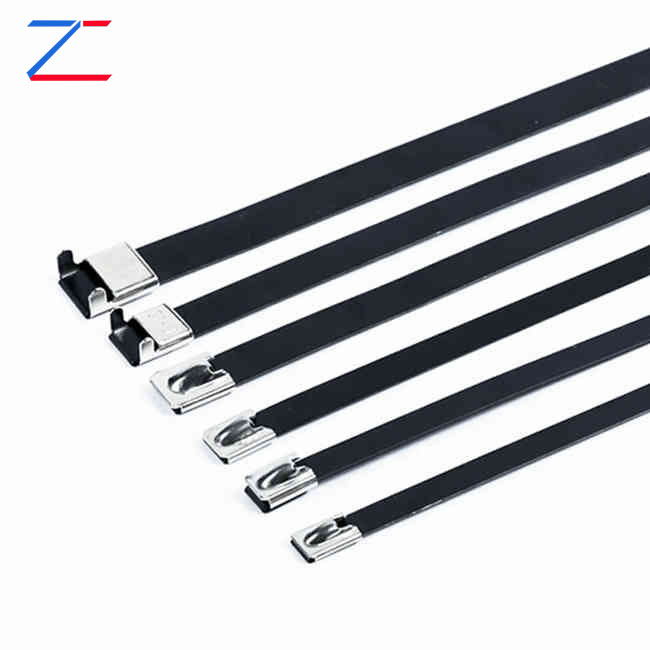
The stainless steel tie uses an all-metal locking mechanism. There are two common designs. The ball lock design uses a stainless steel ball that is captive in the head. When the tail is inserted and tensioned, the ball rolls forward and wedges against the strap, locking it in place. The wedge lock design uses a formed tongue that bends against the strap and digs into the surface. Both designs have no plastic component, so there is no creep and no stress relaxation. The ball lock is the more common design for general bundling because it allows the strap to be released with a tool if needed. The wedge lock provides a higher resistance to back-off and is used for heavy-duty and high-vibration applications. The table below compares the two designs.
| Lock design | Locking principle | Back-off resistance | Releasable | Typical application |
| Ball lock | Ball wedges against strap | High | Yes, with release tool | General cable bundling |
| Wedge lock | Tongue digs into strap | Very high | No (cut to remove) | Heavy-duty, high vibration |
| Plastic ratchet | Pawl engages serrations | Low | No | Static bundling |
In our factory, we test the back-off resistance on a vibration table with a 5 kg load at 20 g acceleration. The ball lock tie retains 95 percent of its initial tension after 1 million cycles. The wedge lock tie retains 98 percent. Wenzhou Zhechi Electric Co., Ltd. provides the vibration test report with each production lot.
3. Why Does Installation Tension and Fit Decide Whether Vibration Causes Fatigue?
The installation tension determines whether the tie and the cable bundle move together or separately under vibration. If the tension is too low, the bundle moves inside the tie, and the relative motion abrades the cable jacket and wears the tie strap. If the tension is too high, the strap is stressed close to its yield point, and the vibration adds a cyclic stress that accelerates fatigue. The correct tension is the one that holds the bundle firmly without indenting the jacket. The table below shows the effect of installation tension on tension retention and jacket wear.
| Installation tension | Tension retention after 1M cycles | Jacket wear | Fatigue life |
| Low (50% of rated) | 80% | High (relative motion) | Reduced by abrasion |
| Correct (70 – 80% of rated) | 95% | Low | Full life |
| High (95% of rated) | 90% | Low | Reduced by fatigue |
Application engineer's note: The correct tension can be set with a tensioning tool that has a calibrated cut-off. A hand-tightened tie is usually under-tensioned, and a tie tightened with pliers is usually over-tensioned. In our factory, we recommend the use of a spring-loaded tensioning tool and we provide the recommended cut-off setting for each strap width. Wenzhou Zhechi Electric Co., Ltd. supplies the tool and the setting chart with each order.
4. How Do Material Grade and Surface Treatment Handle Corrosion Combined With Vibration?
Vibration and corrosion act together. The relative motion between the tie and the cable can damage the passive oxide layer on the stainless steel, and the damaged area becomes a initiation site for pitting corrosion. The grade selection matters. Grade 304 is suitable for indoor and general outdoor use. Grade 316 contains molybdenum and resists chlorides, so it is suitable for coastal, marine, and chemical environments. The surface treatment also matters. A passivated surface has a thicker and more uniform oxide layer, which resists the damage from micro-motion. An epoxy-coated tie provides an additional barrier, but the coating can wear through at the contact points under vibration. In our factory, we passivate all 316 ties and we inspect the locking head for burrs that could damage the cable jacket. Wenzhou Zhechi Electric Co., Ltd. provides the material certificate and the salt spray test report with each shipment.
The galvanic couple between the stainless steel tie and an aluminum cable tray or a copper conductor must also be considered. The stainless steel is cathodic to aluminum and to zinc, so the aluminum or the zinc will corrode preferentially if moisture is present. An insulating sleeve or a plastic-coated tie should be used at the contact point when the tie is in direct contact with a dissimilar metal.
5. How Should Engineers Specify and Verify Stainless Steel Cable Ties for Vibration Service?
The specification should include seven items. The first is the strap width and thickness. The second is the lock design, ball lock or wedge lock. The third is the material grade, 304 or 316. The fourth is the minimum loop tensile strength. The fifth is the lock back-off resistance. The sixth is the operating temperature range. The seventh is the salt spray requirement. The verification should include four checks. The first is the loop tensile test on a sample. The second is the vibration test with a defined load and frequency. The third is the salt spray test for the specified duration. The fourth is the dimensional check of the strap width and the locking head. In our factory, we perform these checks on every production lot and we provide the test report with the shipment. Wenzhou Zhechi Electric Co., Ltd. also offers a pre-production sample for the customer to evaluate on the actual equipment.
We recommend that the buyer specify the back-off resistance, not just the loop tensile strength. A tie that has a high loop tensile strength but a weak lock will still loosen under vibration. The loop tensile strength describes the strap; the back-off resistance describes the lock. Both are required for a reliable vibration-resistant joint.
Frequently Asked Questions About Stainless Steel Cable Ties and Vibration
Summary for Application Engineers and Maintenance Teams
Stainless Steel Cable Ties handle vibration because the all-metal lock has no creep and no stress relaxation, the correct installation tension prevents relative motion between the tie and the bundle, and the 316 grade with passivation resists the corrosion that vibration can initiate. The lock design, the tension setting, the material grade, and the surface treatment must all be specified together. The verification should include the loop tensile test, the vibration test, the salt spray test, and the dimensional check. Wenzhou Zhechi Electric Co., Ltd. has been manufacturing Stainless Steel Cable Ties for over 12 years and provides full vibration and corrosion test support for our customers.