How do progressive dies improve efficiency in mass production of stamped small parts
2026-05-22
In the world of high‑volume manufacturing, Stamping Small Parts with precision and speed is a constant challenge. Nuote has refined this process using progressive dies—tools that transform metal strips into finished components through a sequence of stations. But how exactly do progressive dies boost efficiency when Stamping Small Parts? This article explores the mechanics, benefits, and practical insights behind this technology.
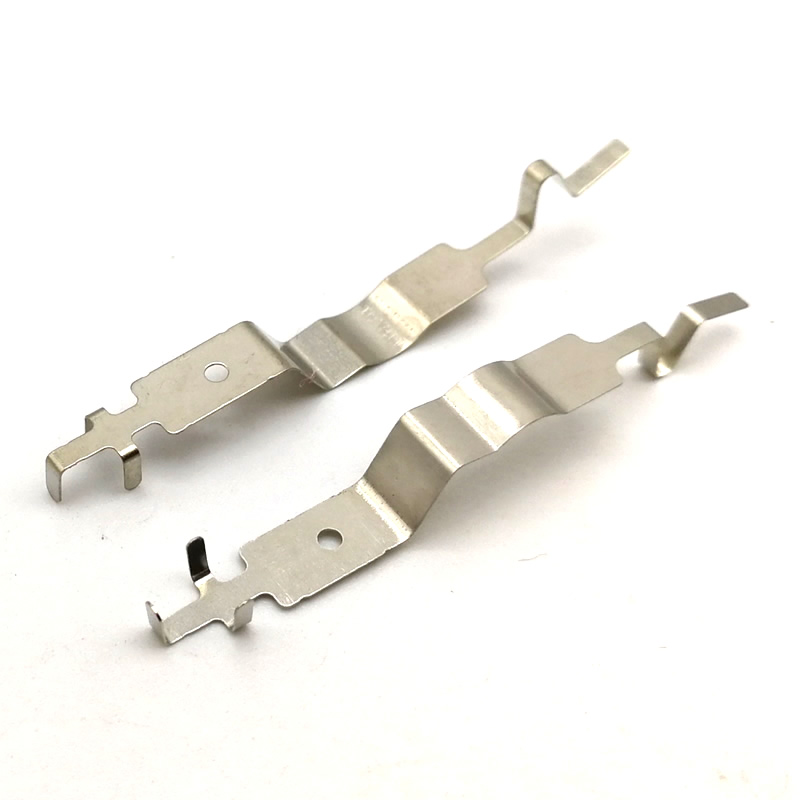
The core mechanism of a progressive die
A progressive die is a single tool set containing multiple workstations. A metal strip moves through each station as the press cycles. Different operations—piercing, forming, blanking, coining—occur at different stations simultaneously. With each stroke, the strip advances by one pitch, producing one finished part per stroke.
| Feature | Function | Efficiency Benefit |
|---|---|---|
| Multiple stations in one die | Perform sequential operations without moving the part | Eliminates part handling between steps |
| Pilot holes and strip feeding | Precisely positions the strip at each station | Reduces setup time and alignment errors |
| Scrap strip carrier | Supports small or fragile parts until final cut | Enables Stamping Small Parts with complex geometry |
| Embedded sensors | Monitors material flow and tool condition | Minimizes unplanned downtime |
Five ways progressive dies drive efficiency
-
Higher output rate – Each press stroke produces a completed part. For Stamping Small Parts, cycle rates often exceed 300–800 strokes per minute.
-
Reduced labor – One progressive die replaces multiple single‑operation tools and transfer systems. A single operator can manage several presses.
-
Lower work‑in‑progress – Parts are not stockpiled between operations. Material enters as coil and exits as finished parts.
-
Consistent quality – Because all operations share the same strip reference, dimensional variation from repositioning errors is eliminated.
-
Less scrap per part – Optimized nesting across the strip width reduces skeleton waste compared to separate die operations.
“Stamping Small Parts” FAQ common questions
Question 1: What types of small parts are best suited for progressive die stamping?
Answer: Progressive dies work best for parts with predictable strip‑feeding characteristics. Typical examples include electrical terminals, connector pins, spring clips, shield cans, and lead frames. The ideal part has a total length between 2 mm and 100 mm, a material thickness from 0.1 mm to 3 mm, and does not require deep drawn cups or highly asymmetrical side projections that would conflict with the strip carrier. Nuote recommends progressive dies when annual production volume exceeds 500,000 pieces, as tooling amortization becomes highly favorable.
Question 2: How does tool maintenance differ between progressive dies and single‑operation dies for Stamping Small Parts?
Answer: Progressive dies require scheduled preventive maintenance based on stroke count, not visible wear. A typical interval is every 500,000 to 2 million strokes. Maintenance involves cleaning each station, checking pilot pins, and regrinding cutting edges simultaneously across all stations to maintain balanced strip travel. Single‑operation dies can be maintained individually, but the total maintenance hours per million parts is often 30‑50% higher because of repeated disassembly, reassembly, and realignment of multiple die sets. Nuote provides detailed maintenance logs with every progressive tool to track station‑specific wear patterns.
Question 3: Can progressive dies handle multiple material types for Stamping Small Parts in one tool?
Answer: No. A single progressive die is designed for one specific material type, thickness, and temper condition. Changing from brass to stainless steel, even at the same thickness, alters springback behavior, required forming force, and galling tendency. However, Nuote designs modular progressive die architectures where the strip feed mechanism and pilot system remain unchanged, but individual forming stations can be swapped out for different material families. For high‑mix production, a better solution is to use dedicated progressive dies for each material family but share the same press and coil handling equipment, reducing changeover time to under 15 minutes.
Real‑world impact on cost per part
| Production volume | Single‑operation dies | Progressive dies (Nuote) |
|---|---|---|
| 50,000 parts | $0.085 per part | $0.120 per part |
| 500,000 parts | $0.047 per part | $0.029 per part |
| 2,000,000 parts | $0.041 per part | $0.018 per part |
At higher volumes, progressive dies lower the total cost of Stamping Small Parts by reducing handling, inspection, and secondary deburring operations.
Contact us
For a detailed feasibility analysis of your next Stamping Small Parts project, reach out to Nuote today. Our engineering team provides die design, material recommendations, and pilot production runs. Contact us to request a sample layout and cycle time estimate for your specific part geometry.