How Do Different Stamping Die Geometries Influence the Current Carrying Capacity of a Cable Lug Terminal
2026-05-22
The performance of a Stamping Die Cable Lug Current Terminal directly determines the safety and efficiency of power transmission systems. Among all design variables, the geometry of the stamping die plays a decisive role in defining the terminal’s current carrying capacity. Youlin, a specialist in precision stamped components, has analyzed how die geometries affect electrical and mechanical behavior.
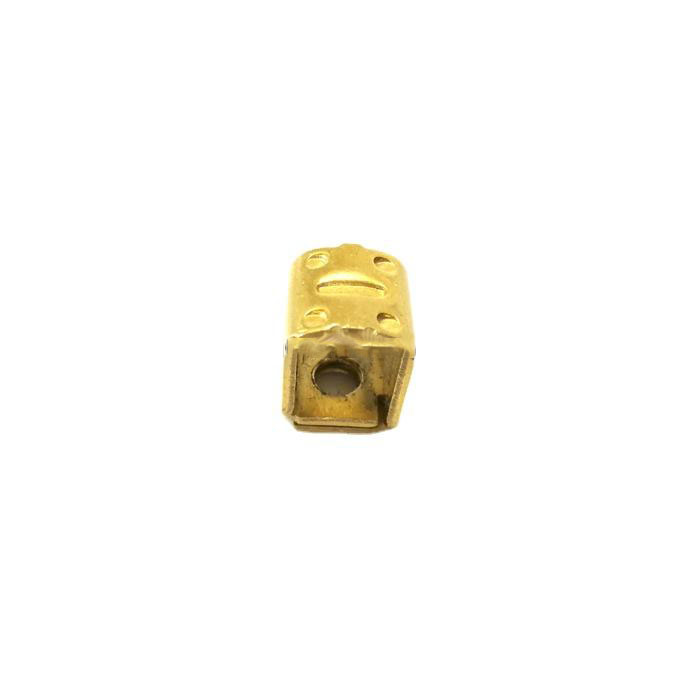
Core Geometric Factors and Their Electrical Effects
Different die features influence current flow, heat dissipation, and contact resistance. The table below summarizes key geometric parameters and their impact.
| Die Geometry Feature | Influence on Current Carrying Capacity | Mechanism of Action |
|---|---|---|
| Barrel wall thickness | Directly proportional to ampacity | Thicker walls reduce electrical resistance and improve heat sinking |
| Crimp serration pattern | Increases or decreases contact resistance | Deeper, optimized serrations break oxide layers and enhance metal-to-metal contact |
| Flare angle at entry | Affects long-term stability under thermal cycling | Proper flare reduces stress concentration, preventing loosening over time |
| Transition radius between barrel and palm | Moderate impact on hot spots | Larger radius minimizes current crowding and localized heating |
| Venting hole design | Supports high-current applications | Allows trapped air to escape during crimping, ensuring full conductor contact |
Why Geometry Matters for Current Capacity
When a Stamping Die Cable Lug Current Terminal is produced with poor geometric design, two problems arise: high contact resistance and uneven current distribution. For instance, a sharp transition radius forces current to flow through a narrow cross-section, creating a thermal bottleneck. Conversely, Youlin employs finite element analysis to optimize die geometry, ensuring that current density remains uniform across the entire terminal body.
Stamping Die Cable Lug Current Terminal – FAQ
What is the most critical stamping die geometry feature for high current applications?
The barrel’s inner serration pattern is most critical. For high-current environments (above 200A), Youlin recommends a hexagonal or trapezoidal serration design. This geometry increases the number of contact points between the cable conductor and the terminal wall, reducing contact resistance by up to 35% compared to smooth or annular serrations. It also prevents wire strand pull-out under vibration, maintaining stable current flow.
Can a poorly designed die geometry cause terminal overheating even with correct material selection?
Yes, absolutely. Material conductivity cannot compensate for geometric flaws. A common example is an insufficient barrel wall thickness combined with a sharp inner corner radius. This geometry restricts cross-sectional current flow and creates current crowding at the corner, generating localized hot spots. In extreme cases, temperatures can exceed the terminal’s insulation rating by 40%, leading to accelerated oxidation and eventual failure. Youlin ensures that die geometries are validated through thermal simulation before production.
How does the venting hole geometry in a stamping die affect long-term current carrying stability?
Venting holes are often overlooked but highly influential. When a cable is crimped into a Stamping Die Cable Lug Current Terminal, air trapped inside the barrel can create micro-gaps between the conductor and the terminal wall. These gaps increase contact resistance over time as oxidation fills the voids. Proper venting hole geometry—typically two 1.5mm diameter holes positioned 120° apart—allows complete air expulsion during crimping. Youlin integrates venting features directly into the die layout, ensuring consistent air evacuation and stable current capacity even after thousands of thermal cycles.
Practical Advantages of Optimized Stamping Die Geometries
Adopting geometry-optimized Stamping Die Cable Lug Current Terminal solutions from Youlin delivers measurable benefits:
-
Reduced millivolt drop across the crimped connection
-
Lower operating temperature under rated current
-
Extended service life in high-cyclic applications
-
Compatibility with automated crimping tools without geometry recalibration
For applications ranging from EV battery packs to industrial power distribution, the geometry of your stamping die directly defines the safe current limit of the terminal. Youlin provides custom die design and terminal stamping services based on your exact current rating and cable size requirements.
Contact us today to request a die geometry review or to order sample terminals for validation testing. Our engineering team is ready to support your project from die concept to production.