How Can Core Customization Service Solve Complex Product Development Challenges?
2026-06-26
Abstract
Core Customization Service plays a critical role in modern manufacturing by enabling highly tailored product development solutions that address unique structural, functional, and market-driven requirements. For industries such as automotive, consumer goods, medical devices, and industrial equipment, standard production methods often fail to meet evolving expectations. This article explores how Core Customization Service provided by Ningbo P&M helps businesses overcome design limitations, reduce development risks, and accelerate time-to-market while ensuring precision, scalability, and cost efficiency.
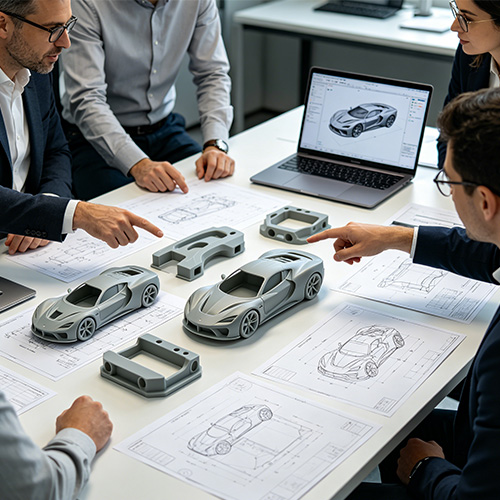
Table of Contents
- 1. Overview of Core Customization Service
- 2. Key Industry Pain Points
- 3. Core Customization Workflow
- 4. Technical Capabilities and Engineering Strength
- 5. Industry Applications
- 6. Standard Production vs Core Customization
- 7. Core Advantages for Global Buyers
- 8. Why Choose Ningbo P&M
- 9. Frequently Asked Questions
- 10. Conclusion
1. Overview of Core Customization Service
Core Customization Service refers to a specialized engineering and manufacturing approach that focuses on adapting product cores, structures, and functional components based on client-specific requirements. Instead of relying on fixed molds or standardized configurations, this service integrates flexible design engineering, precision tooling, and iterative prototyping to achieve highly optimized outcomes.
At Ningbo P&M, Core Customization Service is built around the principle of “engineering for purpose.” This means every core component is designed from scratch or re-engineered based on performance goals, environmental conditions, and end-user expectations. The result is a product that performs better in real-world conditions while maintaining manufacturability and cost control.
2. Key Industry Pain Points
Manufacturers across industries face several persistent challenges when developing new products. Core Customization Service is designed to address these issues directly:
- Design Limitations: Standard molds restrict innovation and reduce product differentiation.
- High Development Costs: Repeated tooling adjustments increase budget pressure.
- Slow Time-to-Market: Traditional workflows delay prototyping and validation cycles.
- Performance Gaps: Generic structures often fail under specialized operating conditions.
- Material Constraints: Limited material adaptability affects durability and function.
These challenges often lead to inefficiencies in product development cycles. Core Customization Service helps eliminate these bottlenecks by introducing engineering flexibility at the core stage of product design.
3. Core Customization Workflow
The customization process at Ningbo P&M follows a structured yet flexible workflow designed to ensure precision and repeatability:
- Requirement Analysis: Detailed consultation to understand technical and commercial needs.
- Concept Engineering: Initial structural modeling and feasibility evaluation.
- Material Selection: Identification of optimal polymers, alloys, or composite materials.
- Prototype Development: Rapid prototyping using advanced tooling systems.
- Testing & Validation: Performance testing under simulated conditions.
- Optimization: Iterative refinement based on test feedback.
- Mass Production Integration: Transition into scalable manufacturing systems.
This structured approach ensures that every customized core solution is both technically reliable and production-ready.
4. Technical Capabilities and Engineering Strength
Core Customization Service requires advanced engineering capabilities. Ningbo P&M integrates multiple disciplines to deliver high-performance solutions:
- High-precision CNC machining for mold accuracy
- Advanced injection molding systems for complex geometries
- Material modification and polymer optimization
- 3D modeling and simulation for structural validation
- Thermal and mechanical stress testing systems
These capabilities ensure that even highly complex core structures can be manufactured with consistent quality and dimensional stability.
5. Industry Applications
Core Customization Service is widely applicable across multiple industries. Below are some key application areas:
- Automotive Industry: Engine components, interior systems, and precision housings
- Consumer Electronics: Device enclosures and internal structural cores
- Medical Equipment: High-precision, biocompatible components
- Industrial Machinery: Load-bearing and high-durability parts
- Packaging Systems: Custom structural molds for specialized packaging
Each industry benefits from tailored engineering that enhances performance, durability, and product lifecycle efficiency.
6. Standard Production vs Core Customization
| Aspect | Standard Production | Core Customization Service |
|---|---|---|
| Design Flexibility | Limited to predefined molds | Fully adaptable structural design |
| Development Speed | Moderate to slow | Faster through iterative prototyping |
| Cost Efficiency | Low initial cost, high modification cost | Optimized lifecycle cost |
| Performance Optimization | General-purpose | Application-specific engineering |
| Scalability | Fixed production limits | Highly scalable manufacturing integration |
7. Core Advantages for Global Buyers
Businesses adopting Core Customization Service gain significant competitive advantages:
- Enhanced product differentiation in competitive markets
- Improved structural reliability and performance consistency
- Reduced risk in large-scale production deployment
- Shortened development cycles through engineering integration
- Better alignment with evolving customer demands
These benefits make customization not just an option, but a strategic necessity in modern manufacturing environments.
8. Why Choose Ningbo P&M
Ningbo P&M has established itself as a reliable partner in precision mold manufacturing and Core Customization Service. With extensive experience in engineering design and industrial production, the company focuses on delivering solutions that combine innovation, durability, and cost efficiency.
Unlike conventional suppliers, Ningbo P&M emphasizes full-cycle development support—from conceptual design to mass production optimization. This ensures that clients receive not only a product but a complete engineering solution tailored to their operational needs.
- Strong engineering and design team support
- Advanced manufacturing infrastructure
- Strict quality control systems
- Global client service capability
9. Frequently Asked Questions
Q1: What is included in Core Customization Service?
It includes design analysis, material selection, prototype development, testing, and production integration.
Q2: How long does the customization process take?
Depending on complexity, it typically ranges from a few weeks to several months.
Q3: Can small batch production be supported?
Yes, Ningbo P&M supports both small-batch and large-scale manufacturing requirements.
Q4: What industries benefit most from this service?
Automotive, electronics, medical devices, and industrial manufacturing sectors benefit significantly.
Q5: Is design confidentiality ensured?
Yes, strict confidentiality protocols are applied throughout all development stages.
10. Conclusion
Core Customization Service represents a transformative approach to modern manufacturing. By shifting from standardized production models to highly adaptive engineering systems, companies can achieve superior performance, improved efficiency, and stronger market positioning.
With its deep technical expertise and commitment to precision manufacturing, Ningbo P&M continues to support global clients in building advanced, customized solutions that meet evolving industrial demands. Whether for prototyping or full-scale production, Core Customization Service provides the foundation for long-term product success.
For more detailed collaboration opportunities and tailored engineering solutions, Ningbo P&M welcomes your inquiry—contact us today to explore how our Core Customization Service can elevate your next project.