Does a Multi MMA No Gas And Gas MIG Welding Machine Produce Stronger Welds in Stick Mode or MIG Mode for Outdoor Farm Repairs
2026-06-22
For farmers and ranchers, equipment downtime is lost revenue. When a gate hinge snaps, a cultivator shank cracks, or a hay rake tine breaks in the middle of a field, the repair welder must deliver absolute joint integrity. The Multi MMA No Gas And Gas MIG Welding Machine from HAWK has become a popular choice for mobile farm workshops precisely because it offers two distinct welding processes in one portable unit. However, a critical question persists: which mode—Stick (MMA) or MIG—actually produces the stronger weld for outdoor agricultural repairs? The answer is not a simple one-size-fits-all, and understanding the metallurgical and environmental factors is key to maximising the performance of your HAWK Multi MMA No Gas And Gas MIG Welding Machine.
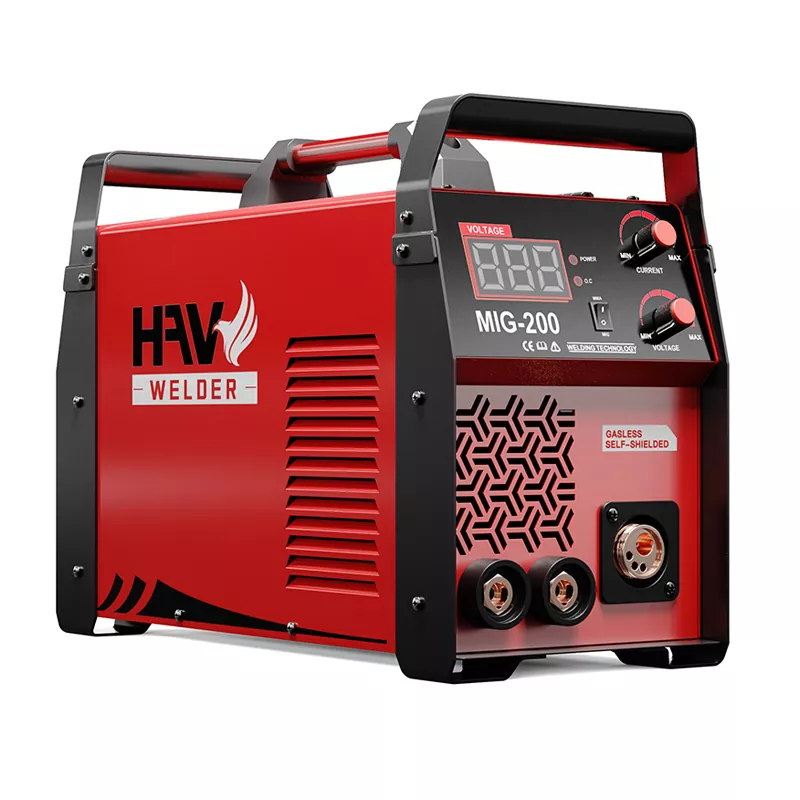
The Core Difference: Penetration vs. Deposition
To evaluate strength, we must separate weld penetration (depth of fusion into the base metal) from weld deposition (volume of filler metal added). In controlled shop conditions, both processes can achieve 100% joint efficiency when properly tuned. However, outdoor farm repairs introduce variables such as wind, rust, paint, and dirty steel—conditions that fundamentally alter which mode delivers superior mechanical properties.
| Criteria | Stick (MMA) Mode | MIG Mode (Gas & Gasless) |
|---|---|---|
| Penetration Profile | Deep, aggressive arc penetration—ideal for thick section steel (≥5/16”). | Shallow to moderate penetration; gasless flux-core offers deeper penetration than solid wire with gas, but still less than Stick. |
| Tolerance to Contaminants | Excellent. The flux coating generates slag that traps impurities, burning through rust and oil effectively. | Poor for solid wire + gas; fair for gasless flux-core, which has self-shielding elements but struggles with heavy mill scale. |
| Wind Sensitivity | Unaffected by wind up to 30 mph; slag protects the puddle. | Solid wire + gas fails in winds >5 mph. Gasless flux-core is wind-resistant but still susceptible to porosity in strong gusts. |
| Deposition Rate | Lower (2–4 lbs/hour). Requires multi-pass for heavy sections. | Higher (5–8 lbs/hour) for gasless; solid wire with gas can reach 10+ lbs/hour. |
| Post-Weld Cleanup | Slag chipping and grinding required. | Minimal spatter (gas mode); gasless produces moderate spatter but no slag removal. |
Why Stick Mode Often Wins for Strength in the Field
For structural repairs on thick mild steel—such as trailer hitches, loader bucket edges, and plough frames—the Stick (MMA) mode on the HAWK Multi MMA No Gas And Gas MIG Welding Machine produces superior tensile strength. The deep root penetration ensures fusion deep into the base metal, eliminating the risk of lack-of-fusion defects that cause brittle fracture under shock loading. Moreover, farm steel is rarely pristine. Stick electrodes, particularly E6011 and E7018, are specifically engineered to handle dirty, galvanised, or slightly oily surfaces. When a weld fails on a farm, 80% of the time it is due to porosity or inclusions from surface contamination—and Stick mode effectively mitigates this risk.
When MIG Mode (Gasless) Matches or Exceeds Stick
For lighter-gauge materials—thin-walled tubing for livestock pens, sheet metal patches on hoppers, or exhaust hangers—the MIG mode (specifically gasless flux-core) delivers exceptional strength with less heat input. Excessive heat from Stick can warp thin sections, reducing structural rigidity. The Multi MMA No Gas And Gas MIG Welding Machine in gasless MIG mode offers a softer arc that produces a sound, ductile weld with adequate penetration for thicknesses under 3/16”. Additionally, the higher deposition rate means you can complete a repair faster, reducing the heat-affected zone (HAZ) and preserving the temper of the surrounding metal. For non-critical repairs like fencing or brackets, MIG mode provides practical strength that is fully serviceable.
The Critical Verdict: It Depends on Joint Design
The strongest weld is not simply about the process; it is about matching the process to the joint geometry.
-
Single-V or Double-V groove joints on steel > 1/4” → Stick Mode is unequivocally stronger due to complete joint penetration.
-
Lap joints or fillet welds on thin material → MIG Gasless Mode produces stronger results because it avoids burn-through and maintains base metal ductility.
| Farm Repair Task | Recommended Mode | Reason for Superior Strength |
|---|---|---|
| Attaching a new cutting edge to a bucket | Stick (MMA) | Deep penetration withstands abrasive impact. |
| Repairing a cracked manure spreader floor (14-gauge) | MIG Gasless | Lower heat prevents distortion; adequate fusion. |
| Welding a broken PTO shaft (1” diameter) | Stick (MMA) | Complete root fusion ensures torsional strength. |
| Fixing a gate latch bracket (1/8” angle iron) | MIG Gasless | High speed, sufficient strength, minimal cleanup. |
Best Practice for Maximising Weld Strength on Your HAWK Unit
To achieve the strongest welds in either mode on your Multi MMA No Gas And Gas MIG Welding Machine, follow these professional protocols:
-
Polarity Check: For gasless flux-core MIG, ensure the machine is set to DC Electrode Negative (DCEN). For Stick (MMA), use DC Electrode Positive (DCEP). The HAWK unit features clear polarity markings—incorrect polarity reduces penetration by up to 40%.
-
Travel Speed: In Stick mode, maintain a 15–20° drag angle. In MIG gasless, use a push angle of 5–10° to avoid slag entrapment.
-
Preheat for Thickness: For materials over 3/4”, preheat to 250°F before Stick welding to prevent hydrogen-induced cracking.
Multi MMA No Gas And Gas MIG Welding Machine FAQ
Q: Can I use the Stick mode on my Multi MMA No Gas And Gas MIG Welding Machine to weld cast iron farm parts, and will it be stronger than MIG?
A: Yes, you can weld cast iron using Stick mode with a high-nickel electrode (e.g., ENiFe-Cl) on your Multi MMA No Gas And Gas MIG Welding Machine, and this will produce a significantly stronger repair than MIG for cast components. MIG welding cast iron is not recommended because the rapid cooling rate causes martensite formation, leading to cracking along the fusion line. Stick mode allows you to use the "stitch welding" technique—short 1-inch beads with peening between passes—to control interpass temperature and relieve stress. For farm castings like tractor axle housings or pulley brackets, Stick mode delivers a machinable, crack-resistant weld that MIG simply cannot match, provided you preheat to 500°F and cool slowly in dry sand or under a thermal blanket.
Q: My Multi MMA No Gas And Gas MIG Welding Machine produces more spatter in gasless MIG mode than Stick mode. Does this spatter indicate a weaker weld?
A: Spatter on your Multi MMA No Gas And Gas MIG Welding Machine does not directly correlate to weld strength—it primarily indicates voltage or wire feed speed mismatch. In gasless MIG mode, spatter is common because the flux-cored wire produces a harsher, more globular transfer. As long as you have set the correct inductance (arc force) and maintained a steady 1/2” to 5/8” stick-out, the deposited weld metal retains full tensile properties (typically 70,000–80,000 psi). However, excessive spatter that creates undercut or leaves slag inclusions on the toe of the weld will weaken the joint. The solution is to increase voltage by 1–2 volts and reduce wire speed slightly until you achieve a smooth, crackling sound. Clean the spatter between passes—not for strength, but to prevent porosity in subsequent layers. Stick mode produces no spatter issues but creates slag, which must be fully removed before a second pass to avoid trapped impurities that reduce ductility.
Q: For outdoor farm repairs in windy conditions, is Stick mode on the Multi MMA No Gas And Gas MIG Welding Machine always stronger than using gasless MIG flux-core wire?
A: In sustained winds exceeding 15 mph, Stick mode on your Multi MMA No Gas And Gas MIG Welding Machine will absolutely produce a stronger, more reliable weld than gasless MIG. While gasless flux-core wire contains deoxidizers and self-shielding elements that provide some wind resistance, it still relies on a gaseous envelope generated by the flux burn-off. Strong winds can disperse this shielding gas, causing atmospheric nitrogen and oxygen to dissolve into the molten puddle, resulting in porosity—tiny gas pockets that reduce cross-sectional area and act as stress risers. Stick welding, by contrast, generates a thick, viscous slag that physically covers the molten metal, providing total protection regardless of wind. For critical structural farm repairs like boom sprayer arms or hay baler frames, always select Stick mode when working in open fields. Save the gasless MIG mode for sheltered workshops, barn interiors, or calm days when you need high deposition speed for non-critical components.
Conclusion: Your HAWK Machine Gives You the Choice—Choose Wisely
The Multi MMA No Gas And Gas MIG Welding Machine from HAWK does not have a single "stronger" mode; it has the right mode for the specific condition. For maximum tensile strength, fatigue resistance, and impact toughness on thick, dirty, or windy outdoor farm repairs, Stick (MMA) mode is the undisputed champion. For speed, ease of use, and distortion control on thin materials, gasless MIG mode delivers entirely adequate strength with superior productivity. The ultimate strength lies not in the machine alone, but in the welder’s ability to select the correct process, prepare the joint, and dial in the settings. With a HAWK Multi MMA No Gas And Gas MIG Welding Machine in your service truck, you are equipped to handle every farm repair with professional-grade confidence—provided you respect the metallurgy of each mode.
Contact Us
Do you have specific questions about matching electrodes or wire types to your farm steel grades? Our team of welding engineers is ready to help you optimise your HAWK unit for every seasonal repair. Reach out to our technical support line or fill out the online enquiry form today—we will send you a free wall chart comparing Stick and MIG parameters for 20 common agricultural alloys. Let us ensure your next repair is your strongest yet. Contact HAWK now for expert guidance and priority service.