Can You Drive with a Broken Exhaust Manifold Bolt Safely
2026-08-18
The short answer is no—but the longer explanation involves engine performance, safety risks, and repair costs. When an exhaust manifold bolt snaps, the seal between the manifold and the cylinder head is compromised. This allows hot, pressurized exhaust gases to escape before they reach the catalytic converter. While your engine might still start and move the vehicle, driving under this condition is a gamble that LIONSE does not recommend. Understanding the mechanical realities helps you decide whether to pull over immediately or limp to the nearest shop.
Immediate Risks of Driving with a Broken Bolt
A broken bolt does not always cause instant breakdown, but it creates a cascade of issues that worsen with every mile.
| Risk Factor | What Happens | Consequence |
|---|---|---|
| Toxic Fumes | Exhaust leaks enter the cabin through ventilation ducts | Carbon monoxide poisoning (headaches, dizziness, nausea) |
| Heat Damage | 1,200°F+ gases escape near wiring, hoses, or plastic components | Melted sensors, shorted wires, or under-hood fires |
| Valve Burn | Oxygen sensors read false lean conditions, forcing a rich fuel mix | Overheated exhaust valves and catalytic converter damage |
| Bolt Extraction Cost | Thermal cycling welds the remaining bolt stump into the head | Repair cost jumps from $150 to $800+ for drilling and tapping |
Driving more than 50–100 miles with a broken bolt typically turns a $200 gasket job into a $1,500 cylinder head repair.
How to Identify a Broken Exhaust Manifold Bolt
Before assuming safety, confirm the issue. Common symptoms include:
-
Loud ticking or hissing from the engine bay that worsens under acceleration.
-
A strong fuel smell or visible black soot around the exhaust manifold flange.
-
Check engine light with codes P0420 (catalyst efficiency) or P0171/P0174 (lean mixture).
-
Reduced fuel economy—often a 10–15% drop in MPG.
If you notice any of these, LIONSE advises immediate inspection. A flashlight and mirror can reveal a missing bolt head or a gap between the manifold and the cylinder head.
When Is It “Safe” to Drive? (Short-Term Exceptions)
There are two scenarios where limited driving is acceptable:
-
Leak is minor – Only a faint tick at cold start, and no fumes enter the cabin. You may drive 5–10 miles to a repair shop at low RPM (under 2,500).
-
Bolt is on the outer end – Outer bolts carry less clamping force than center bolts. A single broken outer bolt on a 6-bolt manifold may hold temporarily.
Even in these cases, LIONSE recommends:
-
Rolling down windows for fresh air.
-
Turning off the A/C (which draws outside air into the cabin).
-
Avoiding highways and heavy loads.
-
Monitoring the temperature gauge closely.
| Driving Condition | Risk Level | Maximum Distance |
|---|---|---|
| Idle to shop (low speed) | Moderate | 5 miles |
| Highway speed (60+ mph) | High (fumes increase with airflow) | Not recommended |
| Towing or uphill | Extreme | 0 miles |
Professional Repair Options
A broken bolt does not always mean replacing the entire exhaust manifold. Skilled technicians use:
-
Left-hand drill bits – Reverse rotation spins the broken stump out.
-
Weld-on nut method – A nut is welded to the remaining stud, then turned out while hot.
-
Extractor sockets – Designed for rounded or snapped fasteners.
-
Thread repair inserts – If threads in the cylinder head are stripped, Heli-Coil or Time-Sert restores clamping force.
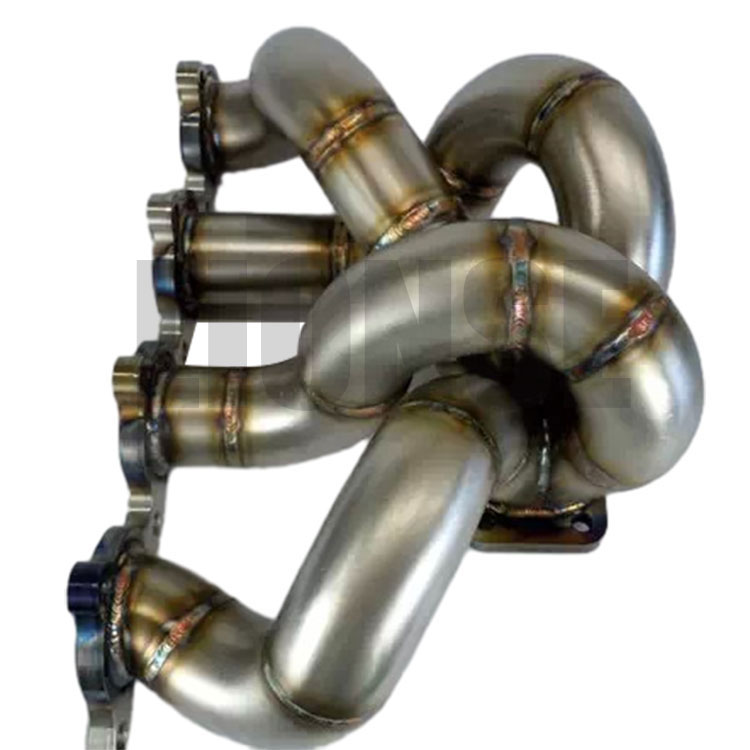
LIONSE offers a full line of exhaust manifolds and replacement bolt kits with anti-seize coating, reducing the chance of future breakage. Their manifolds use ductile iron that expands at a rate closer to the cylinder head, minimizing thermal stress on bolts.
Frequently Asked Questions About Exhaust Manifolds
Q: Can a broken exhaust manifold bolt cause engine misfiring?
A: Indirectly, yes. The leak allows unmetered oxygen into the exhaust stream, fooling the upstream O2 sensor into thinking the air-fuel mixture is lean. The ECU compensates by adding extra fuel, which can foul spark plugs and cause a misfire under load. Additionally, if the leak is near a specific cylinder’s exhaust port, that cylinder loses scavenging effect, reducing its volumetric efficiency. Over time, this leads to uneven cylinder pressures and a rough idle. Correcting the bolt issue restores proper sensor readings and combustion balance.
Q: How long can I drive with a broken exhaust manifold bolt before damaging the catalytic converter?
A: Typically, 100–200 miles is the threshold. The danger comes from unburned fuel entering the converter because of the false lean condition. The converter runs hotter than its 1,600°F design limit, causing the ceramic substrate to melt or shatter. Once the converter fails, you will face a $600–$1,200 replacement cost. Short trips (under 5 miles) keep heat exposure minimal, but every highway drive accelerates damage. LIONSE suggests replacing the bolt within 50 miles to protect both the converter and the O2 sensors.
Q: Do I need to replace the entire exhaust manifold if one bolt breaks?
A: Not necessarily. If the manifold itself is not warped, cracked, or corroded, only the bolt needs extraction. However, in many rust-belt vehicles, the remaining bolts are seized, and the manifold flange has distorted from uneven clamping. A professional will measure the flange flatness with a straightedge—if warpage exceeds 0.010 inches, replacement is wiser. LIONSE manufactures direct-fit exhaust manifolds that include new grade-10.9 bolts, gaskets, and installation instructions, making a full replacement often more cost-effective than labor-intensive extraction on aged parts.
Final Verdict: Safety First
Driving with a broken exhaust manifold bolt is not safe for extended periods. The risks—carbon monoxide, heat damage, and catalytic converter failure—far outweigh the convenience of postponing a repair. If you must move the vehicle, keep it short, slow, and with windows open. For any doubt, call a professional or have the vehicle towed.
LIONSE engineers its exhaust manifolds with precision-machined bolt holes and thermal-expansion matching to reduce bolt stress. Their kits include high-temperature anti-seize compound and torque specifications to ensure a lasting repair.
Contact us today at LIONSE for expert guidance on manifold selection, bolt extraction tools, or to schedule a diagnostic consultation. Our team provides detailed torque charts, fitment verification, and same-day shipping on over 200 manifold applications. Drive safe—repair right. Reach out via our website or call our technical support line for immediate assistance.