Can an Axial Needle Roller and Cage Assembly Replace a Conventional Thrust Washer Bearing
2026-10-26
When engineers look for ways to reduce friction and save space in axial load applications, the Axial Needle Roller and Cage Assembly often comes up as a compact alternative to traditional thrust solutions. At BMT, we regularly help design teams evaluate whether this component can substitute for a conventional thrust washer bearing — and the answer depends on load, speed, lubrication, and the surrounding housing design.
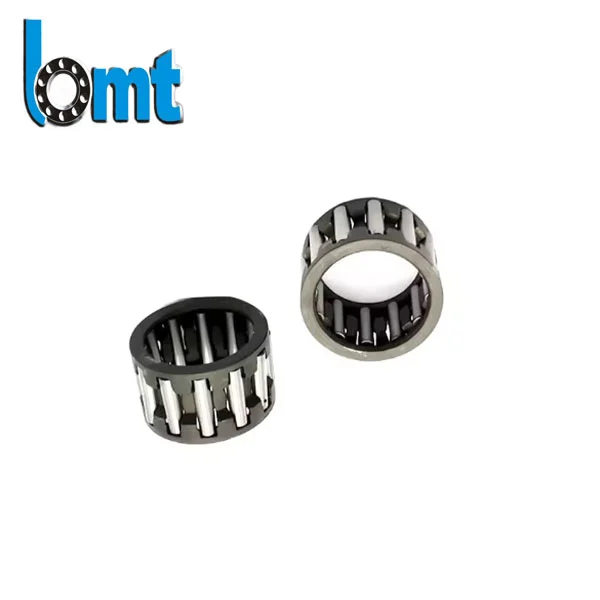
What a Thrust Washer Bearing and an Axial Needle Roller and Cage Assembly Actually Do
A conventional thrust washer bearing typically consists of two hardened washers with rolling elements between them, or a simple flat washer that runs against a mating surface. An Axial Needle Roller and Cage Assembly uses a cage to retain cylindrical rollers oriented radially, allowing them to carry axial loads with a very low section height. The cage keeps the rollers evenly spaced, which improves load distribution and reduces skew.
Key Comparison Points
| Feature | Conventional Thrust Washer Bearing | Axial Needle Roller and Cage Assembly |
|---|---|---|
| Section height | Higher, requires full washer stack | Very low, often just the cage and rollers |
| Load capacity | Moderate to high | High for its size, excellent in confined spaces |
| Speed capability | Good with proper lubrication | Good, but sensitive to misalignment |
| Required mating surfaces | Integral washers | Hardened and ground raceways required |
| Installation complexity | Simple drop-in | Needs correct raceway hardness and flatness |
| Cost | Often higher | Usually more economical |
When Replacement Works Well
An Axial Needle Roller and Cage Assembly is a strong candidate when the adjacent components can serve as raceways. If the housing and shaft faces are hardened and ground to the required hardness and flatness, the cage assembly can replace a thrust washer bearing with lower friction and a smaller footprint. BMT recommends verifying raceway hardness, surface finish, and parallelism before committing to a substitution.
When Replacement Is Not Recommended
Replacement is usually unsuitable when the existing design relies on the washer to bridge soft housing surfaces, when misalignment is significant, or when the application demands a self-contained unit that can be handled as a single part. In these cases, a conventional thrust washer bearing remains the safer choice.
Installation and Lubrication Checklist
-
Confirm raceway hardness and surface finish meet specification.
-
Check flatness and parallelism of both mating faces.
-
Select lubrication compatible with the operating temperature and speed.
-
Ensure the cage is centered and free to rotate.
-
Verify axial clearance after assembly.
Frequently Asked Questions
Q: Can an Axial Needle Roller and Cage Assembly operate without hardened raceways?
A: No. The rollers require hardened and ground mating surfaces to prevent brinelling and rapid wear; soft faces will deform under load and shorten service life dramatically.
Q: What axial load can an Axial Needle Roller and Cage Assembly carry compared with a thrust washer bearing?
A: For the same section height, the Axial Needle Roller and Cage Assembly typically carries a higher axial load because the rollers provide line contact, but the actual capacity depends on roller count, raceway hardness, and lubrication.
Q: How do I know whether replacement is suitable for my application?
A: Evaluate load, speed, misalignment tolerance, raceway condition, and available space; if the mating faces are hardened and ground and the assembly can be properly lubricated, replacement is often feasible.
Conclusion
An Axial Needle Roller and Cage Assembly can replace a conventional thrust washer bearing in many space-constrained, axially loaded applications — provided the raceways are properly prepared and lubrication is correct. BMT supplies Axial Needle Roller and Cage Assembly solutions with consistent cage geometry and roller quality for reliable performance.
Contact us today to discuss your application and request a technical recommendation or sample from BMT.