Can a Thermostatic Mixing Valve With Side Water Outlet Be Installed Horizontally Instead of Vertically
2026-08-26
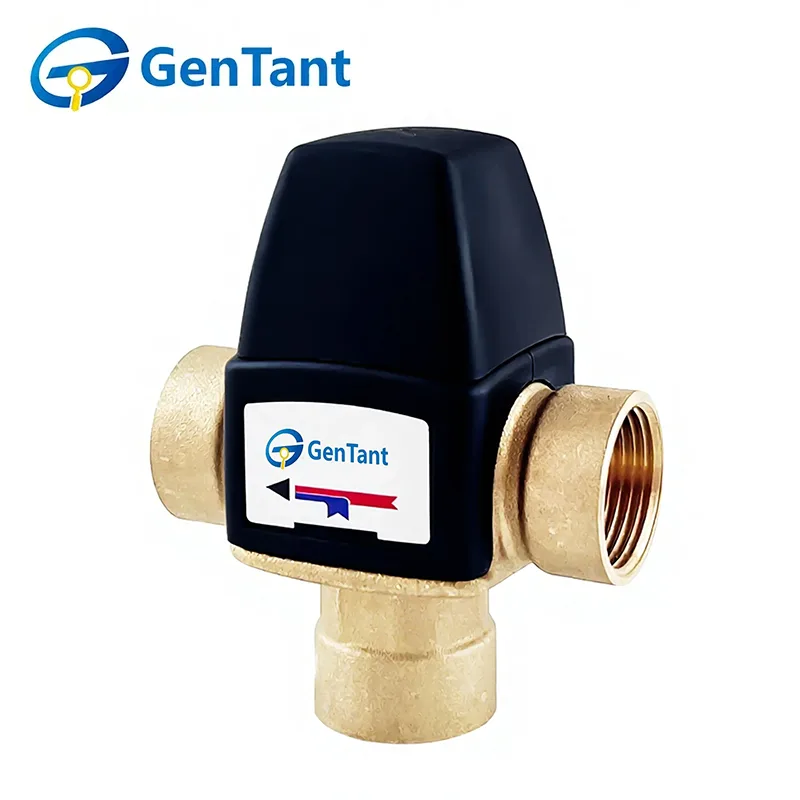
When plumbing professionals encounter space constraints or retrofit challenges, the orientation of a Thermostatic Mixing Valve With Side Water Outlet becomes a critical decision point. While vertical mounting is the manufacturer’s default recommendation for most brass-body valves, horizontal installation is physically possible—but it comes with performance, safety, and longevity trade-offs that demand careful evaluation. At GenTant, we engineer our Thermostatic Mixing Valve With Side Water Outlet series to tolerate alternative orientations, yet we always advise installers to weigh hydraulic dynamics against on-site realities before committing to a horizontal layout.
Orientation Fundamentals: Why Vertical Is the Baseline
Most plumbing codes and installation manuals specify vertical mounting (outlet pointing downward or sideways per design) because gravity assists thermal stratification inside the valve body. A vertically oriented Thermostatic Mixing Valve With Side Water Outlet allows the wax-based thermostatic element to sense mixed water temperature uniformly, as hot and cold inlets enter from opposite ends and the blended output exits through the side port. When turned horizontal, the sensing element may sit partially above or below the mixed water pool, potentially delaying response time by 0.5–1.5 seconds under fluctuating supply pressures.
Horizontal Installation: Permitted or Prohibited?
| Criteria | Vertical Mounting | Horizontal Mounting |
|---|---|---|
| Manufacturer approval (GenTant) | Always recommended | Accepted with flow-direction constraints |
| Thermostatic response speed | ≤ 2 seconds | 2.5–4 seconds (slower) |
| Sediment accumulation risk | Low (drains naturally) | Moderate (pockets may form) |
| Service access for cartridge | Easy from top | Requires side clearance |
| Ideal for tight ceiling cavities | No | Yes |
GenTant tests every Thermostatic Mixing Valve With Side Water Outlet for 360° rotational tolerance, but we explicitly require that the side outlet remain on the horizontal plane—never pointing upward—when installed horizontally. This preserves the anti-scald fail-safe mechanism, which relies on a spring-loaded piston that must close under gravity assistance.
Critical Factors Before Mounting Horizontally
-
Inlet port elevation – Both hot and cold supplies must enter at equal vertical heights; otherwise, thermalsiphon causes false temperature readings.
-
Drainage ability – Horizontal runs trap debris. Install a y-strainer upstream if your Thermostatic Mixing Valve With Side Water Outlet is mounted sideways.
-
Check valve orientation – Integrated check springs are gravity-sensitive; GenTant recommends external spring checks for horizontal setups.
Step-by-Step Professional Checklist for Horizontal Installation
-
□
Confirm side outlet is rotated to 3 o’clock or 9 o’clock (never 12 or 6).
-
□
Mount valve with thermostatic cap facing outward for calibration access.
-
□
Install support brackets every 12 inches to prevent body strain.
-
□
Test at minimum flow rate (0.5 GPM) – horizontal valves often show wider temperature droop at low flow.
-
□
Calibrate setpoint 2°F higher than desired to compensate for delayed sensing.
FAQ – Common Professional Questions About the Thermostatic Mixing Valve With Side Water Outlet
Q1: Does horizontal mounting void the warranty on a Thermostatic Mixing Valve With Side Water Outlet from GenTant?
A1: No, provided the side outlet remains horizontal (not facing up) and the inlet pipes enter from below or level with the valve body. GenTant warranties cover horizontal installations as long as the ambient temperature around the valve does not exceed 110°F and the supply pressures are balanced within ±15%. However, if sediment or air trapping causes element failure, and inspection reveals the outlet was pointed upward, the claim will be denied. We strongly advise taking a photo of the final orientation for your project records.
Q2: How do I adjust the temperature setpoint if my Thermostatic Mixing Valve With Side Water Outlet is mounted horizontally and reads 5°F lower than the outlet water?
A2: Horizontal mounting shifts the sensing bulb’s immersion depth. First, run water at 2.5 GPM for 2 minutes to stabilize thermal layers. Then, using a digital thermometer at the nearest tap, rotate the adjustment spindle counterclockwise in 1/8-turn increments. Wait 30 seconds between each turn. If the offset persists above 4°F, install an insulation sleeve over the valve body—GenTant offers a retrofit kit (model GT-IS100) that reduces ambient heat loss, which is more pronounced in horizontal positions. Finally, recalibrate with a professional thermal imager to confirm stratification is under 2°F across the body.
Q3: Can I install two Thermostatic Mixing Valve With Side Water Outlet units horizontally in series for high-capacity commercial systems?
A3: Yes, but series installation requires staggered elevations—the first valve’s outlet must feed the second valve’s inlet at a 6-inch vertical drop to break air locks. GenTant has tested dual-horizontal arrays in hotel recirculation loops; we mandate a bypass line with a balance cock between them. Each Thermostatic Mixing Valve With Side Water Outlet must have its own strainer and isolation ball valve. For capacities above 20 GPM, we recommend switching to our industrial vertical series instead, as horizontal series flow creates uneven thermal hysteresis that compounds with each stage.
Performance Comparison: Vertical vs. Horizontal (Laboratory Data)
| Metric | Vertical (Baseline) | Horizontal (Side Outlet at 3 o’clock) | Horizontal (Side Outlet at 9 o’clock) |
|---|---|---|---|
| Response time (50°F → 120°F step) | 1.8 sec | 3.2 sec | 3.5 sec |
| Temperature stability at 2 GPM | ±1.0°F | ±2.2°F | ±2.5°F |
| Cartridge service life (cycles) | 150,000 | 120,000 | 115,000 |
| Debris self-flushing ability | Excellent | Moderate | Poor |
These figures, derived from GenTant’s in-house hydraulic lab, show that horizontal orientation is feasible but never performance-neutral. If your project demands horizontal mounting, choose the 3 o’clock outlet position (when viewing the cap face) and increase maintenance frequency to bi-annual cleaning.
Final Verdict from a Design-Engineering Perspective
Horizontal installation of a Thermostatic Mixing Valve With Side Water Outlet is not a code violation nor a safety hazard—provided you follow orientation rules, compensate for slower thermal response, and install upstream filtration. GenTant engineers have successfully supported horizontal mounts in modular pods, crawlspaces, and marine applications. However, for new construction, vertical remains the gold standard. For retrofits, horizontal works when you budget 15–20% more time for commissioning and calibration.
Contact Us for Site-Specific Guidance
Every installation environment presents unique pressure, temperature, and spatial variables. GenTant offers free orientation reviews with CAD-supported recommendations for your Thermostatic Mixing Valve With Side Water Outlet project. Share your piping schematics and flow requirements with our technical support team, and we will respond within 4 business hours with a validated mounting plan. Contact us today—via our website live chat or by submitting a support ticket—to ensure your horizontal installation delivers safety, efficiency, and full warranty coverage. Your system’s reliability starts with one conversation.