Can a Planetary Joint Module Be Integrated Directly into a Robot Joint
2026-10-29
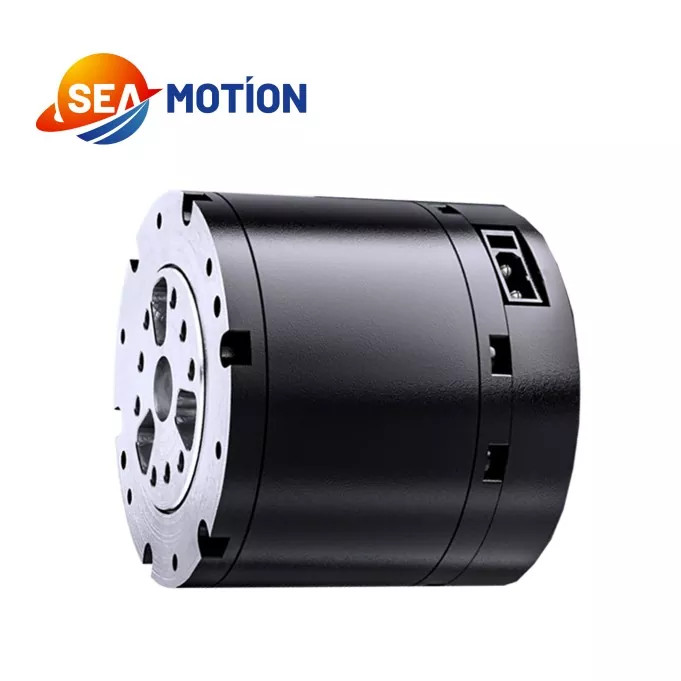
Integrating a Planetary Joint Module directly into a robot joint is not only feasible but increasingly common in modern robotic design. As a compact, high-torque solution, a Planetary Joint Module from SEA MOTION combines a planetary gearbox, bearing system, and often an integrated servo motor into a single unit, allowing engineers to embed it straight into the joint structure without an external transmission assembly. This direct integration shortens the kinematic chain, reduces weight, and improves stiffness — key advantages for collaborative robots, humanoids, and automated guided vehicles.
Why Direct Integration Works
A Planetary Joint Module is engineered as a self-contained drive unit. Its flange, hollow shaft, and mounting interface are designed to bolt directly onto a robot link. The table below summarizes the technical factors that determine whether direct integration is suitable.
| Factor | Requirement for Direct Integration | SEA MOTION Advantage |
|---|---|---|
| Torque density | High torque in a small envelope | Optimized planetary stages |
| Backlash | Low backlash for positioning accuracy | Precision-ground gears |
| Stiffness | High torsional rigidity | Integrated cross-roller bearing |
| Motor compatibility | Matched servo motor and encoder | Co-designed motor-gearbox pairing |
| Thermal management | Effective heat dissipation | Compact housing with thermal path |
Key Integration Considerations
-
Mechanical interface: Confirm shaft fit, flange pattern, and allowable radial/axial loads before mounting the Planetary Joint Module.
-
Backlash and repeatability: Select a low-backlash variant when the joint performs precise positioning tasks.
-
Lubrication and sealing: A sealed Planetary Joint Module reduces maintenance in sealed robot joints.
-
Control integration: Integrated encoders and brakes simplify wiring and enable direct fieldbus communication.
-
Service life: Calculate L10 life based on actual load spectra rather than peak torque alone.
FAQ
Q: Can a Planetary Joint Module be mounted directly without an extra bearing?
A: Yes. Many Planetary Joint Module designs, including SEA MOTION units, incorporate a cross-roller bearing that carries external loads directly, so no separate output bearing is required — provided the applied loads stay within the catalog ratings.
Q: Does direct integration reduce robot joint stiffness?
A: No — it typically increases stiffness. Mounting the Planetary Joint Module directly to the link removes adapter plates and couplings, shortening the load path and reducing compliance, which improves positioning accuracy and dynamic response.
Q: What maintenance does an integrated Planetary Joint Module require?
A: A sealed Planetary Joint Module generally needs only periodic inspection of seals, lubrication condition, and backlash. SEA MOTION recommends checking mounting bolts and monitoring temperature during the first operating cycles.
Conclusion
Direct integration of a Planetary Joint Module into a robot joint delivers compactness, stiffness, and design simplicity when mechanical, thermal, and control factors are properly matched. SEA MOTION supports this process with application engineering, load calculations, and customization.
Contact us today to discuss your robot joint requirements and request a Planetary Joint Module selection guide from SEA MOTION.