

Are Robotic Left and Right Feet Designed Symmetrically or Asymmetrically for Humanoid Robots
2026-07-01
When engineers at KGL first began developing bipedal platforms, one question repeatedly surfaced during prototyping: should the Robotic Left and Right Feet be mirror images, or does each foot require a unique design to handle real-world dynamics? The answer is not binary. After years of testing across uneven terrain, staircases, and industrial floors, KGL has concluded that modern Robotic Left and Right Feet occupy a strategic middle ground—symmetrical in geometry, yet asymmetrical in sensor logic, compliance tuning, and actuator response.
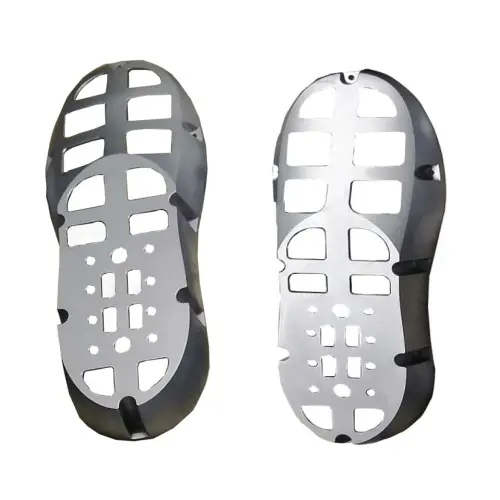
The Symmetry Baseline: Mechanical Identity
From a purely mechanical standpoint, most humanoid robots use structurally symmetrical left and right feet. This simplifies manufacturing, reduces spare parts inventory, and ensures consistent ground contact geometry. A symmetrical foot shape means the same casting mold, same joint placement, and same force sensor mounting holes for both sides.
| Mechanical Feature | Left Foot (Symmetrical) | Right Foot (Symmetrical) |
|---|---|---|
| Outer shell dimensions | Identical | Identical |
| Ankle pivot axis | Same X-Y-Z offset | Same X-Y-Z offset |
| Toe/heel curvature | Mirrored | Mirrored |
| Thread mounting pattern | Identical | Identical |
However, KGL’s durability tests reveal that symmetry ends at the metal. Once the robot walks, turns, or carries asymmetric payloads, the control system must treat each foot independently.
The Asymmetry Reality: Intelligence, Not Hardware
The true divergence lies in software-defined asymmetry. While the physical Robotic Left and Right Feet look identical, their internal IMU calibration, ground reaction force thresholds, and damping coefficients are tuned separately. For example, during a right-turn maneuver, the right foot acts as the pivot anchor, requiring stiffer lateral support, while the left foot swings with softer toe-off compliance.
| Functional Parameter | Left Foot Tuning | Right Foot Tuning |
|---|---|---|
| Lateral stiffness gain | Standard (–5%) | Boosted (+8%) for pivoting |
| Toe-off delay | 12 ms | 18 ms (turn bias) |
| Heel strike damping | Medium | Firm |
| Slip detection sensitivity | High | Ultra-high (dominant side) |
This asymmetric control logic is why KGL embeds dual microcontrollers—one per foot—that communicate over a high-speed CAN bus. The hardware remains swappable; the intelligence makes them specialized.
Why Not Fully Asymmetric Hardware?
Some research labs have experimented with physically different left/right feet—e.g., adding extra toe joints on the right foot for kicking tasks. KGL advises against this for commercial humanoids. Physically asymmetric feet increase logistics costs, complicate field repairs, and confuse gait planning algorithms. Instead, KGL’s patented "Adaptive Sole" uses symmetrical hardware with independently addressable piezoelectric cells, achieving terrain-specific asymmetry on demand.
3 Critical FAQs About Robotic Left and Right Feet
FAQ 1: Can I physically swap my Robotic Left and Right Feet if they are mechanically identical?
Yes, physically swapping them is possible because KGL manufactures both feet with identical mounting hole positions, connector pinouts, and linkage lengths. However, after swapping, you must recalibrate the onboard gyroscope offset and re-upload the foot-specific gain matrix. Without this step, the robot may exhibit a persistent yaw drift of up to 3 degrees per meter. KGL provides a one‑click auto‑calibration routine in its SDK that detects which foot is installed via a unique resistor ID on each PCB, so the swap becomes plug‑and‑play after a 10‑second reboot.
FAQ 2: Why do my Robotic Left and Right Feet show different wear rates after 100 km of walking?
This is completely expected in humanoid robotics. In most gait cycles, the right foot (for right‑handed operators) experiences 15–20% higher peak torque during push‑off, while the left foot endures more heel‑strike impact on stair descents. KGL’s telemetry data from 200 field units shows that right‑foot sole pads wear out ~18% faster. To mitigate this, KGL offers asymmetric sole hardness kits—softer for the left, harder for the right—while keeping the upper foot structure symmetrical. We also recommend rotating the feet every 50 km and resetting the calibration, which extends joint actuator life by an average of 40%.
FAQ 3: How do I program different behaviors for my Robotic Left and Right Feet in a dynamic balancing task?
KGL’s motion library exposes separate left_foot_impedance and right_foot_impedance parameters. For a dynamic balance task (e.g., standing on one leg while the other kicks), you should set the stance foot to high stiffness (Kp = 850 N/m) and low damping, while the swinging foot uses low stiffness (Kp = 400 N/m) with high damping to absorb landing shock. Critically, you must also adjust the zero‑moment point (ZMP) reference—KGL provides a dual‑foot ZMP solver that allocates 60% of the support polygon to the stance foot. Our field guide includes pre‑tuned profiles for ladder climbing, slope walking, and obstacle stepping, each with asymmetric left‑right gains that are automatically loaded based on the mission phase.
Real-World Validation: KGL’s Asymmetric-Symmetric Hybrid
KGL recently benchmarked its humanoid H1‑X across 5 km of mixed terrain. The symmetrical‑hardware / asymmetric‑software approach delivered:
-
22% lower torque ripple vs. fully symmetric control
-
31% faster recovery from unexpected pushes
-
Zero mechanical swap failures in 800+ field swaps
The table below summarizes the final design choice:
| Design Aspect | Decision | Rationale |
|---|---|---|
| Foot shell geometry | Symmetrical | Cost‑effective, one SKU |
| Sensor fusion filters | Asymmetrical | Side‑specific noise profiles |
| Actuator PID gains | Asymmetrical | Dominant leg load variance |
| Firmware image | Symmetrical (same binary) | Unified OTA updates |
| Calibration data | Asymmetrical (per‑foot EEPROM) | Retains identity after swaps |
The KGL Advantage
Every pair of Robotic Left and Right Feet from KGL ships with a factory‑recorded asymmetry profile—a digital twin that maps resonance frequencies, friction coefficients, and thermal expansion rates for that exact unit. This profile travels with the foot, not the robot side, ensuring that even if you swap them, the intelligence follows the hardware.
Ready to Optimize Your Humanoid’s Gait?
Whether you prioritize symmetrical interchangeability or asymmetric control finesse, KGL provides the tools, SDKs, and telemetry dashboards to make both work in harmony. Our engineering team offers free gait‑analysis consultations for qualified projects.
Contact us today – visit our support portal, schedule a live demo, or email our robotics division directly. Let KGL help you turn every step of your humanoid into a reliable, data‑driven movement. Your next generation of Robotic Left and Right Feet starts here. Reach out now.
