Top Air Circuit Breaker Options for Reliable Power Distribution
2026-08-27
Power distribution demands components that don't just work, but work relentlessly. Among the top air circuit breakers vying for your attention, Chang Song brings a blend of rugged durability and smart design that's hard to ignore. But what sets the best apart from the merely adequate? Let's dig into the options that keep your systems running without a hiccup.
Drawout Air Circuit Breakers That Simplify Maintenance Access
Drawout air circuit breakers are built around a simple idea: you shouldn't have to wrestle with bolted connections just to isolate a breaker for inspection. Their racking mechanism lets technicians slide the breaker from connected to test to disconnected position without touching live busbars. That quick shift cuts downtime and keeps routine checks from turning into a full shutdown.
Because the breaker carriage rolls out on rails, maintenance teams can access contacts, arc chutes, and auxiliary switches from the front of the switchgear. No need to crawl into tight cable compartments or remove adjacent panels. A visual gap appears between the breaker and the bus once it is withdrawn, giving a clear, locked-out state that meets safety protocols and speeds up lockout/tagout.
This pull-out design also simplifies testing and troubleshooting. Spare breakers can be staged and swapped in minutes, allowing testing of protection relays and trip units without interrupting the entire distribution line. Maintenance windows shrink, and the gear stays in service longer.
Fixed-Mount Units for Space-Constrained Distribution Panels
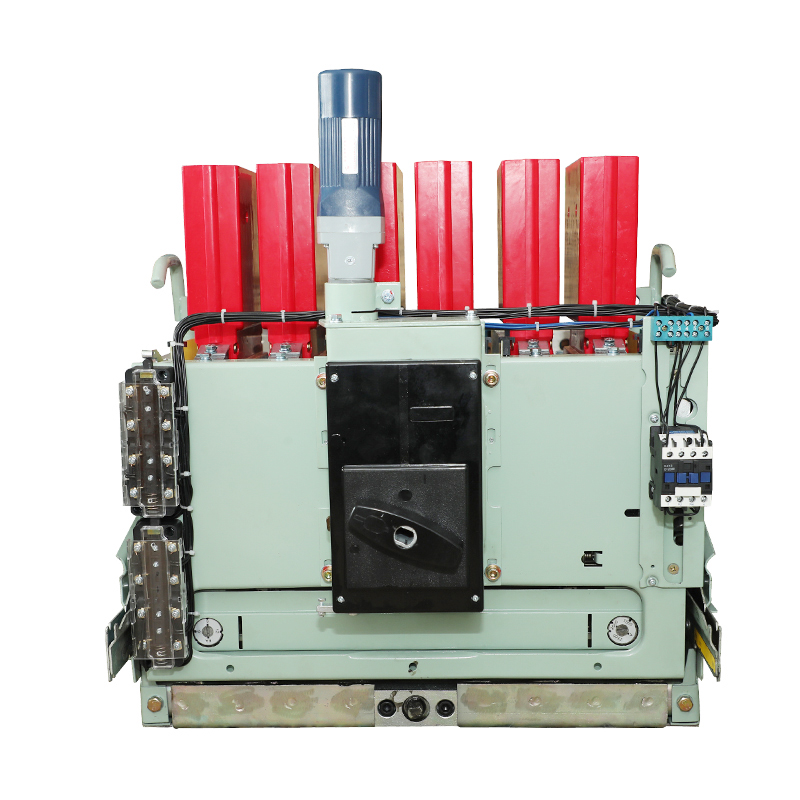
When panel depth is limited, fixed-mount units make a real difference. They do away with telescopic rails and the extra clearance needed for withdrawal, so the same enclosure can host more outgoing feeders without pushing into awkward cable-bending spaces.
Bolting the unit straight to the frame also cuts down on alignment issues during installation. There are no sliding contacts to inspect under thermography, and the busbar connections stay tight using standard torque sequences. For many maintenance teams, that means fewer moving parts and a shorter checklist during shutdowns.
Space savings don't have to come at the cost of flexibility. Fixed-mount designs accept side-mounted auxiliaries and custom terminal layouts, which helps fit protective relays or metering into corners that would otherwise stay empty. The result is a dense but serviceable panel that meets both thermal and short-circuit demands.
High-Interrupting Models Built for Heavy Industrial Loads
In plants where a sudden fault can release thousands of amps within milliseconds, standard switchgear often reaches its physical limits. High-interrupting models are built around reinforced contact assemblies, arc chutes with wider vent paths, and faster trip mechanisms that work together to clear the fault before it cascades. This focus on raw interrupting capacity makes them a practical choice for motor control centers feeding crushers, extruders, and large pump arrays, where the load profile is anything but gentle.
Selection rarely stops at the nameplate rating. Engineers tend to look closely at the available short-circuit current at the point of installation, the expected inrush from across-the-line starting, and how the device behaves after repeated operations under heavy load. Some units allow field adjustment of instantaneous and short-time pickup settings, which helps reduce nuisance tripping on loads that normally draw several times their running current for a second or two. Regular inspection then comes down to checking contact wear indicators and arc chute condition, a small trade-off for equipment that spends years absorbing the kind of punishment that would weld lesser contacts shut.
Smart Breakers With Embedded Metering and Communication
Smart breakers with embedded metering and communication go beyond simple overcurrent protection. They continuously sample voltage and current on each branch, calculating real power, reactive power, energy accumulation, and even harmonic content at the breaker itself. This granular visibility turns an ordinary panel into a distributed measurement network, so facility teams can spot unbalanced loads, drifting power factors, or persistent overloads before they become thermal failures. The metering data is stored locally and pushed over standard protocols like Modbus TCP, BACnet/IP, or MQTT to a building management system or edge gateway.
Unlike add-on current transformers and external power meters, the embedded design eliminates extra wiring and reduces points of failure. Each breaker has a dedicated communication interface, allowing individual trip thresholds, load-shedding commands, and firmware updates to be applied remotely. Because the metrology and switching functions share the same silicon, the breaker can also react to locally measured anomalies, such as opening a circuit when leakage current or arc signatures exceed preset limits. That closes the loop between monitoring and protection in a way that traditional panelboards cannot.
Compact Frames That Still Deliver Full Protection
A slim profile doesn't have to mean sacrificing your eyes. These frames use high-tensile, impact-resistant polymers and stainless steel cores that hold their shape under pressure, yet sit close enough to disappear beneath a helmet or hat. The lenses wrap subtly around the temples, blocking stray light from the sides without adding bulk.
The hinge system is engineered to flex under sudden force, preventing the frame from snapping at the bridge or temple joints. Meanwhile, a barely visible inner lip locks the lenses in place, so even a direct hit won't pop them out. You get the same ANSI-rated defense found in bulky sports goggles, but in a silhouette that won't crowd your face.
What makes this possible is a layering approach: the outer shell absorbs the initial impact, a middle dampening layer spreads the energy, and the inner frame holds everything aligned. The result is protection that feels accidental—no extra weight, no oversized edges—just a quiet confidence that your eyes are covered.
Cost-Effective Choices for Standard Commercial Buildings
Standard commercial buildings don’t have to carry custom-build price tags. A smart way to keep costs down is to stick with proven structural systems like tilt-up concrete or steel frames paired with prefabricated wall panels. These methods cut both material waste and on-site labor time, and many contractors already have crews trained for them. Choosing a simple rectangular footprint and a flat or low-slope roof also trims expenses because it reduces the amount of corner detailing, flashing, and custom engineering work.
Mechanical and electrical systems are where budgets often balloon, so prioritizing long-term efficiency pays off without inflating upfront costs. Rooftop HVAC units sized correctly for the space, LED fixtures with basic occupancy controls, and a well-insulated building envelope keep monthly utility bills predictable. Water-saving fixtures in restrooms and drought-tolerant landscaping on the perimeter are inexpensive upgrades that matter to tenants and property managers alike.
Interior choices should stay flexible. Exposed ceilings with painted ductwork, sealed concrete floors, and movable partition walls reduce finishing expenses while giving tenants room to adapt the space later. Buying materials regionally and scheduling construction to avoid peak season can also shave a meaningful percentage off the total budget without sacrificing durability or code compliance.
FAQ
An air circuit breaker is a switching device that uses air at atmospheric pressure as the arc quenching medium. It interrupts fault currents by separating contacts and cooling the arc through air chutes or arc splitters. Typically installed in low-voltage switchgear, ACBs protect main feeders and large loads from overcurrent and short circuits, handling currents from a few hundred to several thousand amps. Compared to molded case breakers, they offer adjustable trip settings and better maintenance access, making them common in industrial and commercial buildings.
When reliability matters, many engineers turn to series like Schneider Electric's Masterpact, ABB's Emax 2, Siemens' 3WL, Eaton's IZM, and Terasaki's TemPower. These breakers stand out for their robust construction, extensive testing, and long service life. The Masterpact line, for example, has a strong track record in critical facilities. Emax 2 offers advanced communication options without sacrificing mechanical durability. Choosing a well-supported brand with local service availability often matters as much as the spec sheet.
Start with the maximum continuous load current, then add margin for future growth and harmonic heating. Frame size refers to the breaker's maximum current carrying capacity, usually from 630A to 6300A. You don't want to run a breaker at 100% of its frame rating continuously. A good practice is to keep normal load around 80% or less, unless the breaker is specifically rated for 100% duty. Also check the breaking capacity against the available fault current at the point of installation. Selecting a breaker with too low a kA rating can be catastrophic, while oversizing wastes budget and space.
Most electronic trip units let you adjust long-time, short-time, instantaneous, and ground-fault settings. Long-time pickup should be set just above normal load to avoid nuisance tripping, with a time delay coordinated with downstream devices. Short-time settings handle temporary overloads or selective coordination with lower-tier breakers. Instantaneous trip should be high enough to avoid tripping on inrush currents but low enough to clear dead shorts quickly. Ground-fault protection, often set between 20% and 60% of the breaker rating with a short delay, catches arcing faults that phase protection misses. Testing the coordination with a software tool or a qualified engineer is wise.
Air circuit breakers need regular visual inspections, contact wear checks, and lubrication of moving parts. Dust and moisture are the main enemies, so keep enclosures clean and dry. Every one to three years, depending on environment and operation frequency, perform an insulation resistance test and a contact resistance test. Manually operate the breaker several times to ensure smooth charging and closing. For breakers with electronic trip units, verify settings and trip functions by injecting test currents. Logging these results helps spot trends before a failure occurs.
Yes, many current models include built-in power quality monitoring, temperature sensing, and communication protocols like Modbus or IEC 61850. These features let you see real-time current, voltage, and contact wear without opening the panel. Some breakers offer predictive maintenance alerts based on mechanical operations or thermal cycling. For example, a breaker can flag that its main contacts are nearing the end of rated endurance. This shifts maintenance from calendar-based to condition-based, reducing unexpected downtime. However, the basic requirement remains: choose a design with a solid mechanical mechanism and adequate breaking capacity, then layer smart features on top.
Conclusion
Reliable power distribution depends on choosing an air circuit breaker that matches the real demands of the installation. Drawout designs continue to gain attention because they let maintenance teams slide the breaker out of its cradle without disturbing live bus connections, cutting downtime during inspections or replacements. In tighter enclosures, fixed-mount units save valuable space while still delivering dependable interruption performance. Facilities with heavy motor loads or large transformers often turn to high-interrupting models built to handle severe fault currents without compromising safety. Even compact frames have evolved to offer full protection, proving that a smaller footprint does not mean reduced capability. These mechanical and electrical design choices shape how smoothly a distribution system operates day to day.
Beyond physical configuration, modern air circuit breakers increasingly include embedded metering and communication functions. These smart breakers track current, voltage, and energy usage in real time, allowing facility managers to spot developing problems before they cause outages. The data can be integrated into building management systems, which turns a protective device into a proactive asset. At the same time, not every project needs advanced electronics. Standard commercial buildings often benefit from cost-effective choices that meet code requirements and provide solid protection without unnecessary complexity. The key is matching the breaker's features to the electrical environment: industrial plants may prioritize high interrupting ratings and remote monitoring, while offices and retail spaces can rely on simpler, proven designs. When the right option is selected, the entire distribution network becomes more resilient and easier to maintain.
Contact Us
Contact Person: Tonglun Chen
Email: [email protected]
Tel/WhatsApp: 8618906642555
Website: https://www.cncsele.com