Smart Thermoforming Die Making Equipments Revolutionize Modern Manufacturing
2026-10-16
Every manufacturer chasing tighter tolerances and faster turnarounds has felt the drag of outdated die-making. Smart thermoforming equipment is flipping that script, and ADEWO sits at the heart of this revolution. Here's why the old ways are fading fast—and what's replacing them.
Precision Without the Guesswork: Smart Die Geometry Cuts Defects Early
Traditional die design often leans on trial-and-error, letting defects appear only after the first shots. Smart die geometry reverses that order. By shaping runner profiles, land lengths, and cooling channels around actual material behavior, designers can direct flow and solidification before tooling is ever cut.
The method pairs parametric modeling with early-stage simulation. Instead of guessing at gate size or blend radius, the geometry responds to shear rates, thermal gradients, and pressure drops. Potential tears, sink marks, and trapped air show up in the virtual model, not on the shop floor.
For teams holding tight tolerances or running hard-to-fill alloys, this early correction saves more than scrap. It shortens tryout cycles, preserves surface finish, and gives process engineers a stable starting window. The die does more of the thinking, so every shot starts closer to spec.
Modular Tooling Systems That Adapt to Short-Run Thermoforming Demands
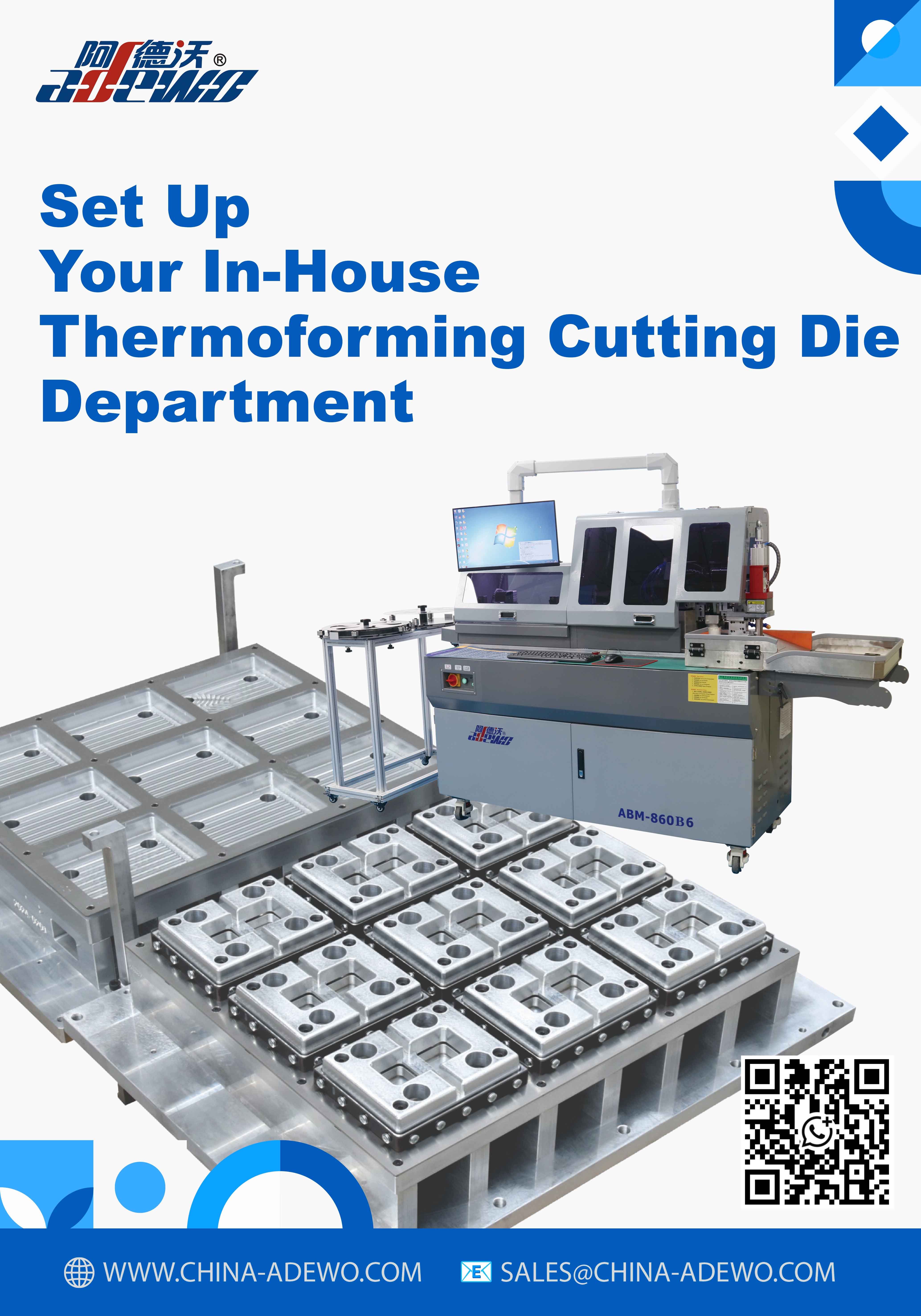
Short-run thermoforming often gets squeezed between custom tooling costs and lead times. Modular systems shift that balance by letting shops swap cavity inserts, trim fixtures, or clamp frames instead of machining an entirely new mold for each job. The result is less metal on the shelf and more flexibility when a customer wants 800 trays instead of 8,000.
One overlooked advantage is how quickly a modular setup absorbs design changes. Instead of recutting a full base, you replace one segment or adjust a rail position, then run another sample without tying up the forming station. This keeps per-part costs low on runs that don't justify dedicated hard tooling, and it makes quoting short-run work far more predictable.
Sensors Inside Dies: Turning Process Data into Immediate Adjustments
Sensors embedded directly in dies have quietly shifted the role of tooling from passive forming to active process control. Rather than waiting for a downstream inspection to reveal drift, the die itself now reads force distribution, material flow, and temperature gradients at the exact moment of contact. This immediate feedback loops into the press, allowing stroke depth, cushion pressure, or blank holder force to be nudged before a single bad part leaves the work zone.
The practical effect is a much tighter relationship between what the material does and what the machine does next. A slight thickening at the flange, for instance, can trigger a real-time adjustment in draw bead restraint. When the sensor signal shows a spike in localized friction, the system can compensate with variable punch speed or lubrication timing. These adjustments are not scheduled; they happen in the milliseconds between successive hits, often invisible to operators but clearly visible in scrap rates and die wear patterns.
Beyond immediate correction, the data stream from in-die sensing accumulates into a fingerprint for each tool and material batch. Over days and weeks, that footprint reveals how much of a process window is actually being used—and where the margin is thinner than expected. Maintenance teams start looking at sensor trends instead of fixed cycle counts, and process engineers gain a shared language for troubleshooting that doesn't rely on trial and error at the press.
Automated Die Production Bridges the Gap Between CAD and Finished Mold
For years, toolrooms have lived with a frustrating disconnect: the CAD model looks perfect on screen, but turning that geometry into a finished die or mold still depends on a chain of manual decisions. Programmers interpret surfaces, pick cutters, define roughing and finishing sequences, and often guess at how metal will move during machining. Small gaps in communication between design intent and shop-floor execution show up as reworked electrodes, unexpected bench work, or dies that need multiple tryouts before they run production parts.
Automated die production changes that equation by letting software read the CAD model the way a seasoned moldmaker would, but without the handoffs. Feature recognition identifies pockets, ribs, bosses, and shutoffs directly from the solid. Toolpath generation then follows rules tied to the shop’s own machines, materials, and cutting tools. Instead of a generic CAM file that still needs heavy editing, the system outputs a ready-to-run program with clear order of operations, realistic stepovers, and safe entry moves. Even electrode design for hard-to-reach areas can be generated automatically from the same model, so the burn sequence aligns with the milled geometry.
The practical result is that the distance from CAD release to a finished mold shrinks. Designers can make late changes without forcing the CAM team to rebuild every operation from scratch. Toolmakers spend less time fixing programs at the control and more time verifying dimensional accuracy. In shops that have adopted this approach, the mold no longer arrives at the press as a rough approximation of the model; it arrives as a direct, traceable result of the design data.
Material and Energy Savings Start with Intelligent Die Surface Engineering
Die surfaces rarely get the attention they deserve, yet they dictate how metal flows, how heat builds up, and how much force a press needs. Intelligent die surface engineering starts with measuring what actually happens at the tool-workpiece interface: contact pressure, sliding speed, temperature spikes. These data feed into surface design decisions, from micro-texturing patterns to low-friction coatings, so that forming and stamping operations run with less resistance. The immediate payoff is a drop in energy consumption per stroke, often without any change to the base tooling layout.
Material waste is even more directly tied to what happens at the die surface. Galling, pickup, and uneven wear create scratches, splits, and dimensional drift that force parts into the scrap bin. By tailoring roughness, hardness gradients, and lubricant retention to the specific alloy being formed, intelligent surface engineering prevents these defects before they start. The result is not just fewer rejected parts, but also less need for secondary grinding or rework, which means raw material goes further with the same equipment.
Another overlooked saving comes from longer, more predictable die life. When surface treatments are chosen through simulation and process data rather than habit, wear concentrates in controllable ways. This allows maintenance teams to plan regrinds and coating reapplications during scheduled downtime, avoiding the energy-intensive emergency stops and the scrapped coils that accompany unexpected tool failures. Over a full production year, the combination of lower forming energy, fewer material losses, and stable tool condition adds up to a measurable cost advantage.
Scalable Smart Dies Keep Pace with High-Mix Manufacturing Schedules
A scalable smart die architecture replaces fixed-function silicon with modular tiles and standardized die-to-die links, allowing one base design to serve several product variants. Rather than spinning a new mask set for each SKU, the same wafer start can be reconfigured through firmware or bond-out options, which keeps engineering resources focused on yield rather than redesign.
On the manufacturing floor, built-in telemetry and per-core power gating let a partially processed lot be redirected to a different variant without re-qualifying the entire flow. Operators can switch I/O widths, enable or disable compute blocks, and adjust memory stacks in software, so the line stays balanced even when a high-mix schedule shifts weekly from low-volume prototypes to volume runners.
Scalability also changes how capacity is planned. Because multiple smart dies can be interconnected in a package for higher performance or used individually for cost-sensitive parts, planners no longer need separate wafer starts for every tier. A single base die inventory can be allocated to whichever product family is currently constrained, reducing both cycle time and the risk of obsolete die banks.
FAQ
Smart systems embed sensors and adaptive controls directly into the die-making process, allowing adjustments for temperature, pressure, and material flow in real time. Traditional methods rely on fixed mechanical settings, so they can't compensate for batch variations or tool wear the way smart equipment can.
By continuously monitoring material distribution and thickness during forming, the equipment can fine-tune parameters mid-cycle. That prevents thin spots, webbing, and overstretching, which are common sources of scrap in conventional thermoforming.
Food packaging, automotive interior components, medical device trays, and consumer electronics enclosures are adopting it quickly. These sectors need tight tolerances, fast changeovers, and consistent quality across large runs, which smart die making supports well.
Even low-to-mid volume shops benefit because smart dies reduce trial-and-error during setup and allow faster switching between product designs. The initial cost is higher, but shorter lead times and lower scrap rates often recover it within one to two years.
Sensors track vibration, thermal expansion, and wear patterns continuously. Predictive algorithms flag anomalies before they cause cracks or misalignment, so maintenance can be scheduled during planned downtime instead of after an unexpected breakdown.
Thin-wall products are sensitive to small fluctuations in heating and forming pressure. Smart equipment compensates for those fluctuations automatically, holding wall thickness within a much narrower range than manual or conventional automated systems can achieve.
Many expect tighter integration with digital twin simulations, where a virtual die is tested and optimized before physical tooling is cut. Others are looking at self-learning algorithms that refine forming recipes across production shifts without operator intervention.
Conclusion
Thermoforming die production no longer hinges on trial-and-error corrections once a tool reaches the press. Modern smart die making equipment embeds geometric analysis directly into the machining phase, catching draft, corner radii, and wall thickness issues before they become scrap. Sensors integrated into die cavities go further: they track pressure, temperature, and material flow in real time, feeding adjustments back to the forming station without stopping production. This closed loop between tool design and process response replaces static molds with active components that adapt to each sheet. Automated die production chains now convert CAD models into finished molds with minimal human intervention, compressing lead times from weeks to days and eliminating the usual mismatch between digital intent and physical tooling.
The same intelligence reshapes how shops handle variety and resource use. Modular tooling systems allow quick swapping of cavity inserts, trim steels, and plug assists, so short-run thermoforming jobs no longer demand dedicated, expensive dies. Intelligent die surface engineering, including textured microstructures and low-friction coatings, reduces material sticking, improves release, and cuts energy consumption during heating and cooling cycles. Because these smart dies collect usage data, they can be scheduled, maintained, and reconfigured in line with high-mix production demands. Rather than treating a die as a fixed asset, manufacturers now view it as an updatable, sensor-rich platform that keeps pace with changing product lines while trimming scrap, energy, and downtime.
Contact Us
Contact Person: KAELYN LEE
Email: [email protected]
Tel/WhatsApp: +86 15012673758
Website: https://www.china-adewo.com