Professional Food Extruder: Key Features and Applications for Modern Kitchens
2026-08-21
Ask any chef what slows down prep, and you'll hear the same complaints: repetitive shaping, inconsistent textures, and equipment that takes up space without earning it. A professional food extruder changes that equation—but not all models are built for the demands of a modern kitchen. That's where MINGDE comes in, with features designed to streamline production and expand creative possibilities.
The Real Difference Between a Food Extruder and a Dough Sheeter
Walk into any commercial bakery and you'll hear two machines that sound nothing alike. A dough sheeter hums steadily as it passes dough back and forth between rollers, gradually reducing thickness with each pass. A food extruder, on the other hand, whines under high pressure, forcing a dense mass through a shaped die. People often lump them together because both deal with dough, but the physics couldn't be more different.
Sheeters are about control: you decide the final thickness and keep the dough's gas pockets and gluten strands intact. That's why they're non-negotiable for croissants, puff pastry, and thin pizza bases. Extruders trade that gentleness for speed and versatility. By cooking or shaping under pressure, they turn out hundreds of uniform pieces per minute — from corn puffs to dog kibble. If your product needs flaky layers, stay away from an extruder. If it needs identical, dense shapes at high volume, the sheeter will drive you crazy.
How Die Plates and Screw Geometry Control Your Final Texture
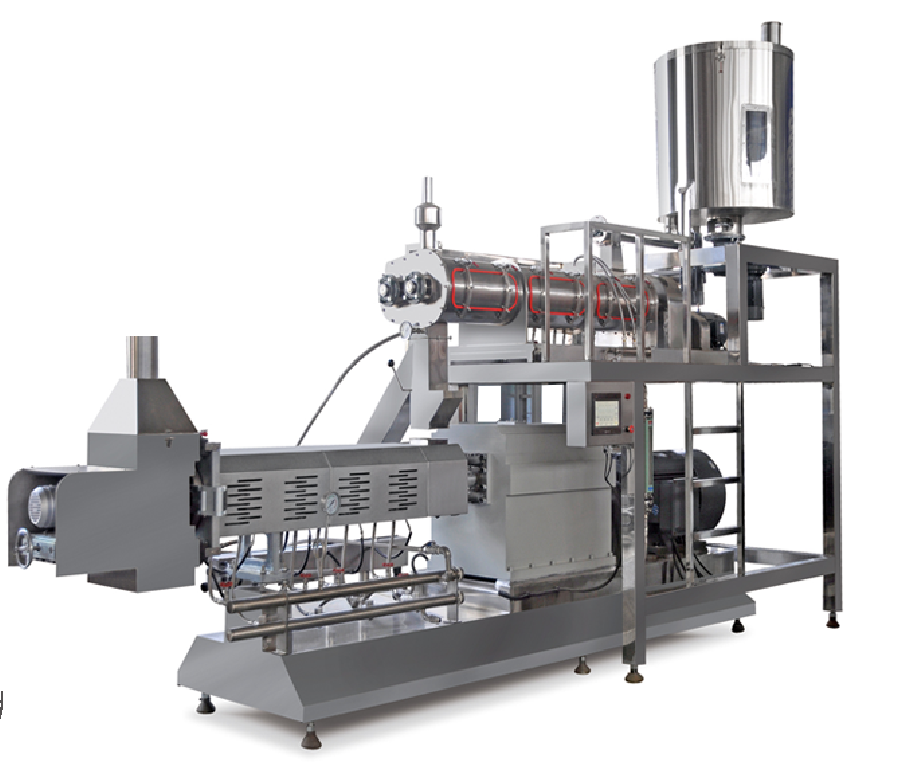
The texture you end up with is rarely just a recipe outcome. The die plate and screw inside the extruder set the physical rules for how material is pushed, sheared, and released. Small changes in either component shift the balance between dense, chewy, and airy structures without touching the ingredient list.
Die plates shape the final moment of pressure release. A longer land length keeps product under stress longer, allowing starch or protein networks to align into a smoother, firmer texture. Short lands with wider openings let moisture flash off violently, which traps bubbles and creates a rough, crisp bite. Even the number and placement of holes matter: many small openings produce fine, uniform strands, while a single large opening can create a coarser, more irregular surface.
Screw geometry controls how much mechanical energy becomes heat and shear before the die ever comes into play. Deep flights move material gently and preserve a softer, more delicate texture. Shallow flights with aggressive mixing sections raise shear and temperature, gelatinizing starch further or stretching proteins into a tougher, more elastic chew. Reverse elements and high compression ratios hold material back, increasing residence time and pressure that later shapes the final expansion or density.
Working with Heat-Sensitive Ingredients Without Losing Quality
Heat-sensitive ingredients such as certain vitamins, enzymes, live cultures, and delicate volatile aromatics demand a different approach than standard cooking or processing. The moment they encounter temperatures beyond their tolerance, you risk losing not just potency but also the subtle flavors and functional properties that make them valuable. One of the most reliable ways to protect them is to rethink thermal exposure altogether: instead of adding them early in a process, wait until the bulk of the cooking is done and the mixture has cooled below a critical threshold, typically 40–45°C for live probiotics or 60°C for many heat-labile vitamins. Even then, gentle folding or low-shear mixing can prevent localized hot spots that quietly destroy quality.
When heat cannot be avoided entirely, consider techniques that minimize contact time and intensity. A double boiler or bain-marie provides a buffered, indirect heat source that rarely exceeds 85°C, making it ideal for melting chocolate or preparing custards with egg yolks. Vacuum sealing followed by sous-vide processing at precise, lower temperatures can pasteurize without the harsh temperature spikes of open-pan methods. For powders and extracts, microencapsulation or pre-blending with a small amount of cold liquid to form a slurry allows them to disperse evenly before they meet the warmer bulk, reducing thermal shock and preserving both color and bioactivity.
Finally, build quality checks into your workflow rather than relying on guesswork. Use a probe thermometer to verify that any mixture has dropped to the safe incorporation zone before adding sensitive components. If a formula calls for acidic ingredients that can further destabilize heat-sensitive compounds, buffer the pH slightly or add protective agents like ascorbic acid or maltodextrin. Cooling rapidly in an ice bath after processing locks in the retained quality, and storing the final product away from light and oxygen prevents the slow, silent degradation that can undo even the most careful thermal handling.
Sizing the Machine to Your Kitchen’s Actual Throughput
Most equipment vendors will happily sell you the biggest, fastest model on the floor, but that rarely lines up with what your kitchen actually pushes out on a Tuesday lunch rush. The real question isn't how many plates the machine can theoretically handle per hour—it's how many covers you actually fire between 11:30 and 1:00, and what happens when two tickets hit the pass at once. If your line consistently runs six tickets at a time and each ticket has four dishes, a machine built to slam out 300 plates an hour won't save you if the bottleneck is your plating station or your expo. Match the machine's throughput to the rhythm of your busiest thirty minutes, not to a fantasy of a fully loaded dining room all day.
Undersizing hurts more than oversizing in most kitchens, but only in specific ways. A combi oven or fryer that can't keep up with your fry station during a push means tickets stack up and quality drops—fries sit under a lamp, proteins get rushed. But oversizing brings its own quiet tax: bigger footprint, longer preheat times, higher energy draw with every idle cycle, and a tendency for staff to rely on it for tasks it wasn't meant to do. The sweet spot is usually found by tracking your actual ticket times and cover counts for two weeks, not by trusting a brochure's peak output number. Look at your 90th-percentile rush, not your average, and leave a little headroom for the one night a month when everything goes sideways.
One practical way to size without overthinking it: take the number of hot dishes you fire during your highest single hour on record, multiply by 1.2 for safety, and use that as your machine's realistic hourly capacity target—not its listed maximum. A machine that hits that number comfortably at 80% duty cycle will feel effortless on a normal night and still keep up when the dining room turns twice. Anything bigger and you're paying for stainless steel you'll never truly use, plus the hidden cost of training your crew to work around a piece of equipment that doesn't fit the actual flow of your line.
A Maintenance Schedule That Prevents Downtime and Off-Flavors
A maintenance schedule that actually prevents downtime and off-flavors needs to be built around runtime hours rather than calendar dates. Equipment used seasonally or intermittently can sit idle for weeks and then run hard, so basing service intervals on operating time catches wear before it becomes a failure. For water treatment and beverage systems, that often means replacing filter cartridges at 80% of their rated capacity instead of waiting for a pressure drop, and scrubbing contact surfaces before biofilm has a chance to establish itself.
Taste and odor issues rarely appear without warning if you track the right details. Keep a simple log of flow rates, pressure readings, and any subtle changes in aroma or mouthfeel. When those numbers drift by even a few percent, schedule a descaling or component swap before the batch is ruined. This kind of condition-based upkeep costs less than emergency callouts and keeps flavors clean without relying on chemical masking agents.
New Uses for Extruded Components Beyond Pasta and Snacks
Extrusion lines originally built for durum wheat semolina are now turning out high-moisture meat analogues with fibrous, striated textures that tear like slow-cooked chicken. The shift comes down to adjustments in screw profile, cooling die length, and precise control of shear — factors that let manufacturers manipulate protein alignment in pea, fava, and mung bean blends. The result is a whole-muscle cut that holds up in stews or on a grill, not just another crumble for tacos.
The same twin-screw technology has moved into dairy alternatives and confectionery. Casein and plant protein mixes can be extruded through narrow slits to create stretchy, meltable shreds that mimic mozzarella on pizza, while sugar alcohols and polydextrose are being processed into low-calorie chewy centers for filled chocolates. These runs rely on lower barrel temperatures and rapid evaporative cooling at the die face, which prevents caramelization and keeps the mass pliable enough for downstream shaping.
Pet food and aquafeed are also pulling extrusion away from its snack-food roots. High inclusion rates of insect meal, single-cell proteins, and fishery byproducts flow through preconditioners at 30–35% moisture to form slowly sinking pellets that resist leaching in water. The real innovation is in the barrel venting system — it strips volatile amines and off-notes before the product exits, leaving a cleaner protein base that formulators can build on without masking flavors.
FAQ
A professional unit is built for continuous heavy use with a powerful motor, reinforced gears, and stainless steel or anodized aluminum parts. It also offers interchangeable dies, precise pressure control, and the ability to handle denser doughs that would stall a smaller machine.
Semolina and durum wheat pasta doughs extrude cleanly, but the same machine can handle potato-based mixes for gnocchi, shortbread-style cookie doughs, and even ground meat blends for sausages if the auger and feed tube are designed for it. The key is matching moisture content to the die size.
Die shape determines surface area and how steam escapes during cooking. Bronze dies create a rougher texture that holds sauce well, while Teflon-coated dies produce smoother strands for delicate broths. Small details like ridges or hollow centers change cooking time and mouthfeel.
Let the machine cool completely, then disassemble the auger, die, and feed tube. Soak them in warm water with a mild detergent, but avoid soaking the motor housing. Dry all parts thoroughly before reassembly to prevent rust. Run a small amount of food-grade mineral oil through the auger if it feels stiff.
Yes, but gluten-free doughs often need more binding agents like xanthan gum or eggs to hold together under pressure. Reduce the speed setting and use a die with a wider opening, since gluten-free mixtures tend to be stickier and more fragile during extrusion.
Countertop models work well for small batches up to about five kilograms per hour and fit limited prep spaces. Floor-standing machines have larger hoppers, higher torque, and can run continuously for hours without overheating, making them better for banquet prep or central kitchens.
Look for a magnetic interlock that stops the motor when the feed guard is opened, thermal overload protection to prevent burnout, and non-slip feet. A reverse function is also helpful for clearing blockages without reaching into the auger.
It gives the kitchen full control over shapes, ingredients, and batch sizes, which reduces reliance on dried commercial pasta and allows daily specials. Fresh extruded products also have a shorter cook time and better flavor, which can become a signature element on the menu.
Conclusion
A professional food extruder is not just a larger, more complicated dough sheeter. A sheeter flattens an existing mass between rollers, while an extruder forces material through a shaped die under pressure, creating continuous forms with a defined cross-section. That distinction matters because the combination of die plate openings and screw geometry—flight depth, pitch, compression ratio—directly controls shear, mixing intensity, and final texture. For example, a deeper channel with a low compression screw gives gentle mixing and a coarser bite, while a shallow, high-compression setup produces a finer, more cohesive structure. When working with heat-sensitive ingredients like fresh herbs, fruit pastes, or certain enzymes, this control is essential. Using a cooled barrel or a low-shear screw profile keeps the mass below the temperature threshold where flavor degradation or denaturation begins, so you can extrude delicate fillings and doughs without sacrificing quality.
Choosing the right size comes down to your kitchen’s actual throughput, not the machine’s maximum rating. An oversized extruder can sit idle, warm up the dough, and waste energy, while an undersized unit forces operators to run in batches and compromises consistency. A realistic estimate of kilograms per hour at peak service, plus room for a 20–30 percent surge, usually indicates the correct motor power and screw diameter. Beyond that, a maintenance schedule tied to running hours—not just calendar dates—prevents the two most common field issues: sudden downtime from worn seals and off-flavors from stale product trapped in dead zones. Wiping down screw elements, checking die plate wear, and replacing shaft seals before they leak keeps output clean and predictable. Finally, modern kitchens are pushing extruders into new roles: forming vegetable-based meat analogues, shaping coarse-textured breakfast pellets, creating decorative garnishes, and even producing laminated snack layers with multiple dies in sequence. That versatility makes the extruder a core piece of equipment rather than a single-purpose tool.
Contact Us
Contact Person: LILY SUN
Email: [email protected]
Tel/WhatsApp: 0086-13969103791
Website: https://www.snackfoodmachinery.com/